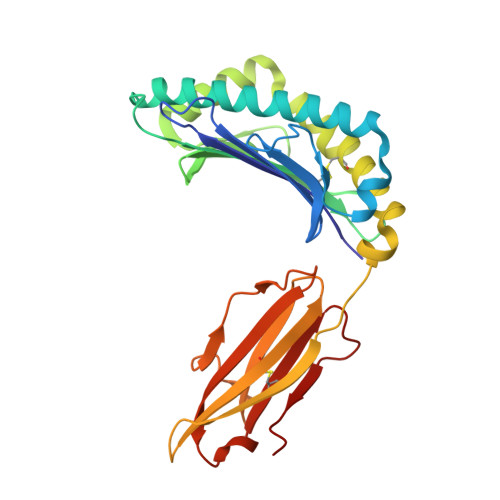
9OBF | pdb_00009obf

Crystal structure of HLA*02:01 with the 11-mer TP53 peptide GLAPPQHLIRV

  • Classification: IMMUNE SYSTEM
  • Organism(s): Homo sapiens
  • Expression System: Escherichia coli BL21(DE3)
  • Mutation(s): No 

  • Deposited: 2025-04-22 Released: 2026-06-24 
  • Deposition Author(s): Tan, K., Mallis, R.J., Reinherz, E.L.
  • Funding Organization(s): National Institutes of Health/National Cancer Institute (NIH/NCI), National Institutes of Health/National Institute Of Allergy and Infectious Diseases (NIH/NIAID), National Institutes of Health/Office of the Director

Experimental Data Snapshot

  • Method: X-RAY DIFFRACTION
  • Resolution: 3.25 Å
  • R-Value Free: 
    0.212 (Depositor), 0.211 (DCC) 
  • R-Value Work: 
    0.194 (Depositor), 0.194 (DCC) 
  • R-Value Observed: 
    0.195 (Depositor) 

Starting Model: experimental
View more details

wwPDB Validation 3D Report Full Report

Validation slider image for 9OBF

This is version 1.2 of the entry. See complete history. 

Literature

Cancers modulate processing and presentation of p53 neoantigens to evade T cell detection.

Haratani, K., Reinhold, B., Duke-Cohan, J.S., Fahey, C.G., Tan, K., Mallis, R.J., Gusev, A., Kehl, K.L., Luo, J., Karmazyn, A., Holliday, E.L., Masi, D.J., Zienkiewicz, K.J., Hennessey, C.J., Blasco, R.B., Thai, T.C., Gibbons, G.M., Kivlehan, S., Lizotte, P., Paweletz, C.P., Aguirre, A.J., Ligon, K.L., Chiarle, R., Lang, M.J., Barbie, D.A., Reinherz, E.L.

(2026) Immunity 59: 2789

  • DOI: https://doi.org/10.1016/j.immuni.2026.08.011
  • Primary Citation Related Structures: 
    9EIQ, 9EJD, 9EK4, 9OBF, 9YZH

  • PubMed Abstract: 

    TP53 mutations occur early in malignant transformation as truncal events in tumor evolution and are therefore generally present in all descendant tumor cells, creating an immunological vulnerability. Here, we examined the immunogenicity and antigenicity of p53 neoantigens emerging from these truncal mutations. Comprehensive immunopeptidomics revealed that hotspot mutations in human tumors preferentially localize to p53 regions resistant to antigen processing, thereby avoiding display altogether. Moreover, for neoantigens presentable by HLA-A ∗ 02:01 or HLA-B ∗ 07:02 and structurally divergent from corresponding wild-type p53 peptide-HLA complexes, clinical tumors commonly lacked the relevant presenting HLA allele. Tumor cells further resisted T cell killing through increased activity of the aminopeptidase ERAP1, preventing display of high-affinity HLA-A ∗ 02:01 complexes containing an immunogenic p53 I195F -derived 11-mer, or by expressing low-affinity HLA-A ∗ 02:01 complexes containing a p53 R175H -derived 9-mer with poor antigenicity despite high-quality human TCRs. These findings define mechanisms by which tumors restrict targetable truncal neoantigen display and suggest immunopeptidome shift strategies to circumvent immune escape.


  • Organizational Affiliation: 
    • Department of Medical Oncology, Dana-Farber Cancer Institute, Boston, MA, USA; Department of Medicine, Harvard Medical School, Boston, MA, USA.

Macromolecule Content 

  • Total Structure Weight: 91.26 kDa 
  • Atom Count: 6,377 
  • Modeled Residue Count: 774 
  • Deposited Residue Count: 776 
  • Unique protein chains: 3

Macromolecules

Find similar proteins by:|  3D Structure
Entity ID: 1
MoleculeChains  Sequence LengthOrganismDetailsImage
MHC class I antigen
A, D
277Homo sapiensMutation(s): 0 
Gene Names: HLA-A*02:01
UniProt
Find proteins for Q861F7 (Homo sapiens)
Explore Q861F7 
Go to UniProtKB:  Q861F7
Entity Groups
Sequence Clusters30% Identity50% Identity70% Identity90% Identity95% Identity100% Identity
UniProt GroupQ861F7
Sequence Annotations
Expand
Reference Sequence
Find similar proteins by:|  3D Structure
Entity ID: 2
MoleculeChains  Sequence LengthOrganismDetailsImage
Beta-2-microglobulin
B, E
100Homo sapiensMutation(s): 0 
Gene Names: B2M, CDABP0092, HDCMA22P
UniProt & NIH Common Fund Data Resources
Find proteins for P61769 (Homo sapiens)
Explore P61769 
Go to UniProtKB:  P61769
PHAROS:  P61769
GTEx:  ENSG00000166710 
Entity Groups
Sequence Clusters30% Identity50% Identity70% Identity90% Identity95% Identity100% Identity
UniProt GroupP61769
Sequence Annotations
Expand
Reference Sequence
Find similar proteins by:  Sequence   |   3D Structure  
Entity ID: 3
MoleculeChains  Sequence LengthOrganismDetailsImage
Peptide from Cellular tumor antigen p53
C, F
11Homo sapiensMutation(s): 0 
UniProt & NIH Common Fund Data Resources
Find proteins for P04637 (Homo sapiens)
Explore P04637 
Go to UniProtKB:  P04637
PHAROS:  P04637
GTEx:  ENSG00000141510 
Entity Groups
Sequence Clusters30% Identity50% Identity70% Identity90% Identity95% Identity100% Identity
UniProt GroupP04637
Sequence Annotations
Expand
Reference Sequence

Small Molecules

Ligands 1 Unique
IDChains Name / Formula / InChI Key2D Diagram3D Interactions
EDO

Query on EDO


Download:Ideal Coordinates CCD File
G [auth A]
H [auth A]
I [auth A]
J [auth A]
K [auth A]
G [auth A],
H [auth A],
I [auth A],
J [auth A],
K [auth A],
L [auth A],
M [auth A],
N [auth A],
O [auth B],
P [auth D],
Q [auth D],
R [auth D],
S [auth D],
T [auth D],
U [auth D]
1,2-ETHANEDIOL
C2 H6 O2
LYCAIKOWRPUZTN-UHFFFAOYSA-N

Experimental Data & Validation

Experimental Data

  • Method: X-RAY DIFFRACTION
  • Resolution: 3.25 Å
  • R-Value Free:  0.212 (Depositor), 0.211 (DCC) 
  • R-Value Work:  0.194 (Depositor), 0.194 (DCC) 
  • R-Value Observed: 0.195 (Depositor) 
Space Group: P 63 2 2
Unit Cell:
Length ( Å )Angle ( ˚ )
a = 161.13α = 90
b = 161.13β = 90
c = 330.28γ = 120
Software Package:
Software NamePurpose
HKL-3000data scaling
PHENIXrefinement
HKL-3000data reduction
HKL-3000phasing

Structure Validation

View Full Validation Report


Entry History 

& Funding Information

Deposition Data


Funding OrganizationLocationGrant Number
National Institutes of Health/National Cancer Institute (NIH/NCI)United StatesR01CA265928
National Institutes of Health/National Institute Of Allergy and Infectious Diseases (NIH/NIAID)United StatesP01AI143565
National Institutes of Health/Office of the DirectorUnited StatesS10OD030394

Revision History  (Full details and data files)

  • Version 1.0: 2026-06-24
    Type: Initial release
  • Version 1.1: 2026-09-30
    Changes: Database references
  • Version 1.2: 2026-10-28
    Changes: Database references