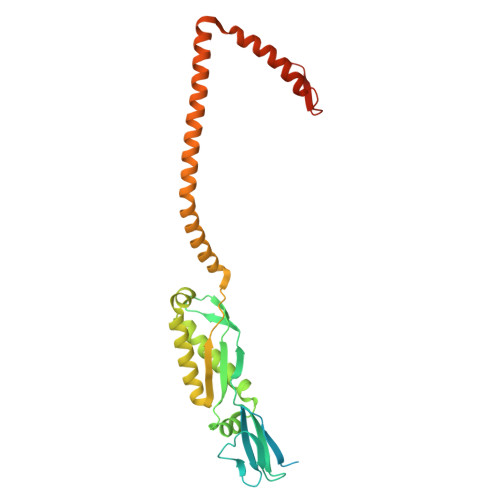
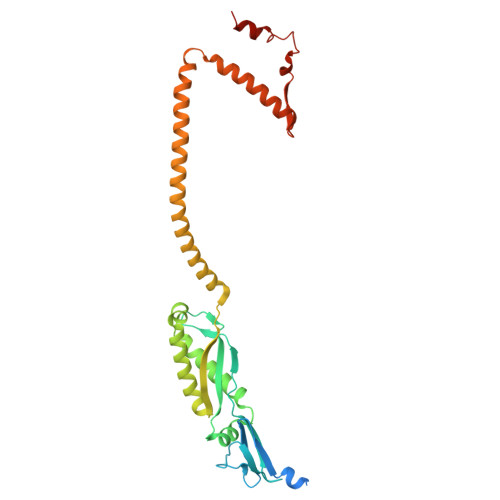
9OA0 | pdb_00009oa0

The human PHB1/2 complex (open)

  • Classification: MEMBRANE PROTEIN
  • Organism(s): Homo sapiens
  • Expression System: Homo sapiens
  • Mutation(s): No 

  • Deposited: 2025-04-18 Released: 2025-10-22 
  • Deposition Author(s): Gao, J., Shao, S., Sherpa, D., Kupko, N.
  • Funding Organization(s): National Institutes of Health/National Institute on Aging (NIH/NIA), David and Lucile Packard Foundation, Richard and Susan Smith Family Foundation

Experimental Data Snapshot

  • Method: ELECTRON MICROSCOPY
  • Resolution: 3.10 Å
  • Aggregation State: PARTICLE 
  • Reconstruction Method: SINGLE PARTICLE 

wwPDB Validation   3D Report Full Report


This is version 1.1 of the entry. See complete history


Literature

Structures of human organellar SPFH protein complexes.

Gao, J.Sherpa, D.Kupko, N.Chino, H.Zeng, J.Shao, S.

(2025) Nat Commun 16: 10064-10064

  • DOI: https://doi.org/10.1038/s41467-025-65078-3
  • Primary Citation of Related Structures:  
    9O9U, 9O9Z, 9OA0

  • PubMed Abstract: 

    Stomatin, Prohibitin, Flotillin, and HflK/C (SPFH) family proteins are found in all kingdoms of life and in multiple eukaryotic organelles. SPFH proteins assemble into homo- or hetero-oligomeric rings that form domed structures. Most SPFH assemblies also abut a cellular membrane, where they are implicated in diverse functions ranging from membrane organization to protein quality control. However, the precise architectures of different SPFH complexes remain unclear. Here, we report single-particle cryo-EM structures of the endoplasmic reticulum (ER)-resident Erlin1/2 complex and the mitochondrial prohibitin (PHB1/2) complex, revealing assemblies of 13 heterodimers of Erlin1 and Erlin2 and 11 heterodimers of PHB1 and PHB2, respectively. We also describe key interactions underlying the architecture of each complex and conformational heterogeneity of the PHB1/2 complex. Our findings elucidate the distinct stoichiometries and properties of human organellar SPFH complexes and highlight common principles of SPFH complex organization.


  • Organizational Affiliation
    • Department of Cell Biology, Harvard Medical School, Boston, MA, US.

Macromolecules
Find similar proteins by:  (by identity cutoff)  |  3D Structure
Entity ID: 1
MoleculeChains Sequence LengthOrganismDetailsImage
Prohibitin 1
A, B, C, D, E
A, B, C, D, E, F, G, H, I, J, K
307Homo sapiensMutation(s): 0 
Gene Names: PHB1PHB
UniProt & NIH Common Fund Data Resources
Find proteins for P35232 (Homo sapiens)
Explore P35232 
Go to UniProtKB:  P35232
PHAROS:  P35232
GTEx:  ENSG00000167085 
Entity Groups  
Sequence Clusters30% Identity50% Identity70% Identity90% Identity95% Identity100% Identity
UniProt GroupP35232
Sequence Annotations
Expand
  • Reference Sequence
Find similar proteins by:  (by identity cutoff)  |  3D Structure
Entity ID: 2
MoleculeChains Sequence LengthOrganismDetailsImage
Prohibitin-2299Homo sapiensMutation(s): 0 
Gene Names: PHB2BAPREA
UniProt & NIH Common Fund Data Resources
Find proteins for Q99623 (Homo sapiens)
Explore Q99623 
Go to UniProtKB:  Q99623
PHAROS:  Q99623
GTEx:  ENSG00000215021 
Entity Groups  
Sequence Clusters30% Identity50% Identity70% Identity90% Identity95% Identity100% Identity
UniProt GroupQ99623
Sequence Annotations
Expand
  • Reference Sequence
Experimental Data & Validation

Experimental Data

  • Method: ELECTRON MICROSCOPY
  • Resolution: 3.10 Å
  • Aggregation State: PARTICLE 
  • Reconstruction Method: SINGLE PARTICLE 

Structure Validation

View Full Validation Report


Entry History & Funding Information

Deposition Data


Funding OrganizationLocationGrant Number
National Institutes of Health/National Institute on Aging (NIH/NIA)United StatesAG073277
David and Lucile Packard FoundationUnited States--
Richard and Susan Smith Family FoundationUnited States--

Revision History  (Full details and data files)

  • Version 1.0: 2025-10-22
    Type: Initial release
  • Version 1.1: 2025-12-24
    Changes: Data collection, Database references