Download Mendeley
Structure-activity Relationship for Diarylpyrazoles as Inhibitors of the Fungal Kinase Yck2.
Shirley, D.J., Yiu, B., Mancera-Ortiz, I., Stogios, P.J., Liu, Z., Robbins, N., Whitesell, L., Cowen, L.E., Drewry, D.H., Willson, T.M.(2025) bioRxiv
- PubMed: 40672256 Search on PubMedSearch on PubMed Central
- DOI: https://doi.org/10.1101/2025.07.12.664496
- Primary Citation Related Structures:
9NZK - PubMed Abstract:
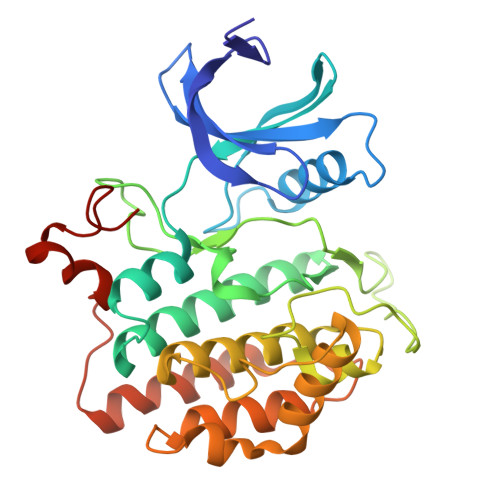
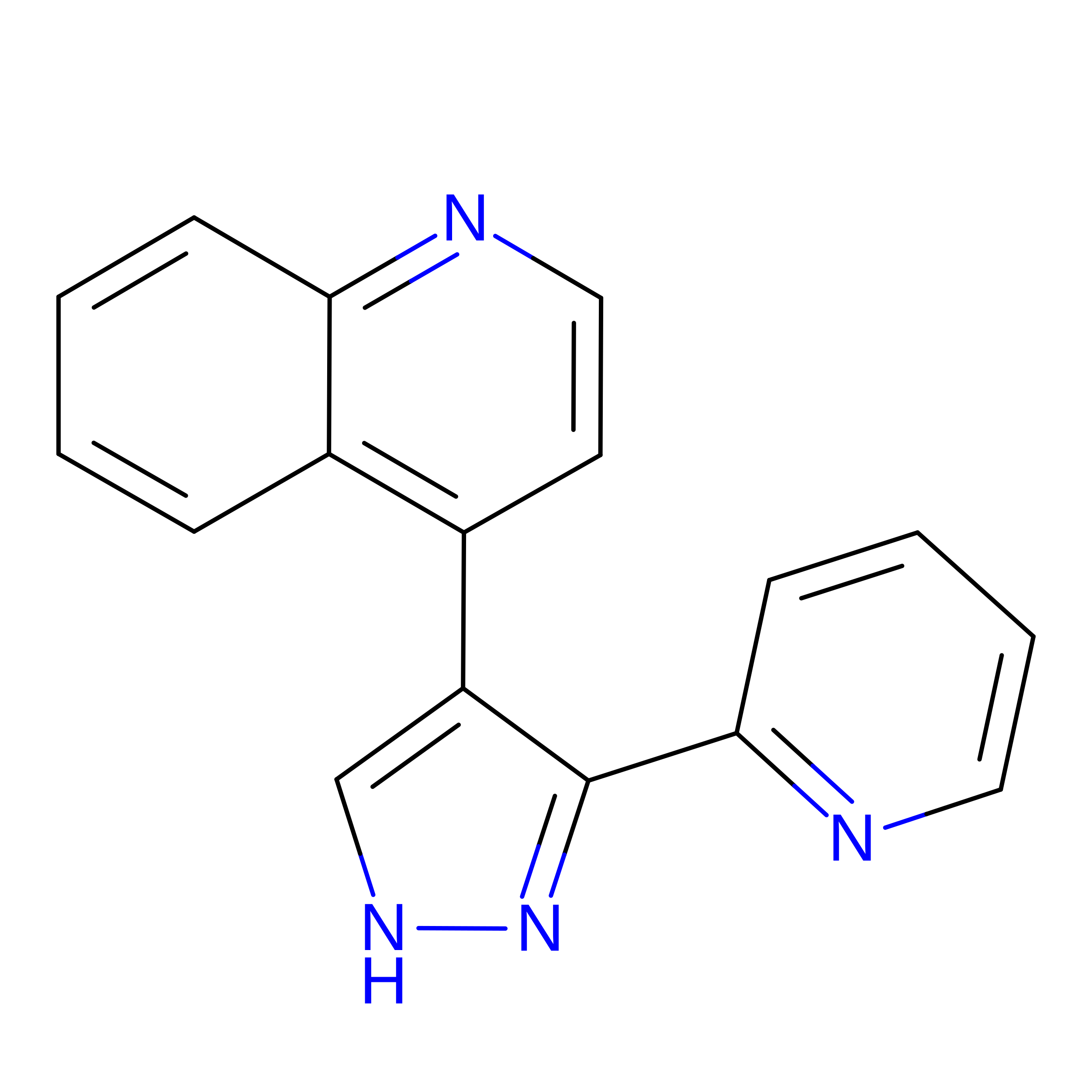
Candida albicans is a growing global health threat, causing 1.5 million invasive infections and 1 million deaths annually. Yeast casein kinase 2 (Yck2) in C. albicans has emerged as an antifungal target of the kinase inhibitor LY364947 ( LY ). Herein, we report Yck2 structure-activity relationships for 3,4- and 3,4,5-substituted pyrazole analogs of LY . X-ray crystallography and in vitro profiling revealed the importance of the hinge-binding heterocycle for Yck2 inhibition and fungal kinome selectivity. A hydrogen-bond network between the inhibitor, a bound water molecule, and catalytic residues within the ATP pocket was identified as a key determinant of selectivity over other fungal and human kinases. Phenol analog 11 showed remarkable selectivity for Yck2 and Yck22 over all other C. albicans protein kinases. Several of the LY analogs, including 11 , demonstrated improved antifungal activity. These findings provide a framework for translating human kinase inhibitors into highly selective antifungal Yck2 inhibitors.
- Structural Genomics Consortium and Division of Chemical Biology and Medicinal Chemistry, UNC Eshelman School of Pharmacy, University of North Carolina at Chapel Hill, Chapel Hill, NC 27599, USA.
Organizational Affiliation: