Download Mendeley
Mechanistic snapshots of lipid-linked sugar transfer.
Morgan, R.T., Motta, S., Gil-Iturbe, E., Bhattacharjee, B., Anwar, M.T., Di Muccio, G., Romagnoli, A., Mishra, B., Ashraf, K.U., Bang, I., Di Marino, D., Lowary, T.L., Quick, M., Petrou, V.I., Stowell, M.H.B., Nygaard, R., Mancia, F.(2025) Nat Commun 16: 11044-11044
- PubMed: 41353435 Search on PubMedSearch on PubMed Central
- DOI: https://doi.org/10.1038/s41467-025-66769-7
- Primary Citation Related Structures:
9NYC, 9NYD, 9NYE, 9NYF, 9NYK - PubMed Abstract:
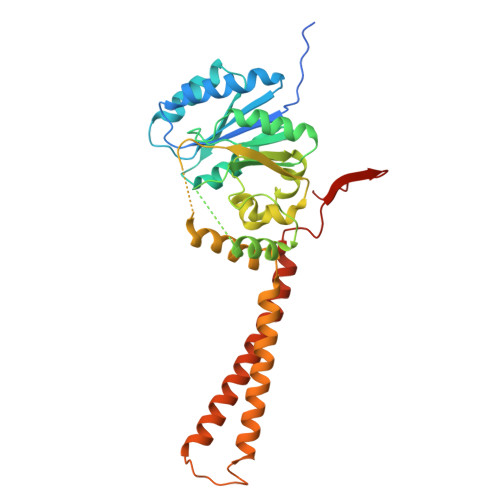
Enzymes undergo dynamic conformational changes during catalysis, yet conventional high-resolution structural methods typically capture only the most stable states. Here, we address this gap using rapid UV photolysis of a chemically caged substrate with cryogenic time-resolved electron microscopy (cryo-TREM). We elucidate the catalytic mechanism of GtrB, a membrane-bound glycosyltransferase that transfers glucose from UDP-glucose to the lipid carrier undecaprenyl phosphate. We visualized how GtrB, which has an active site ~15 Å from the membrane, transitions during the catalytic cycle to move each substrate in proximity for catalysis. From a single dataset, we resolved distinct conformational states: the initial substrate-bound state, a catalytically poised intermediate, and the product-bound state. Through molecular dynamics simulations and biochemical analyses, we identify coordinated movements within the active site that drive catalysis. These findings provide a molecular framework for understanding how glycosyltransferases function and highlight a broadly applicable strategy for capturing dynamic enzymatic states in native-like environments.
- Department of Physiology and Cellular Biophysics, Columbia University Irving Medical Center, New York, NY, USA.
Organizational Affiliation: