Download Mendeley
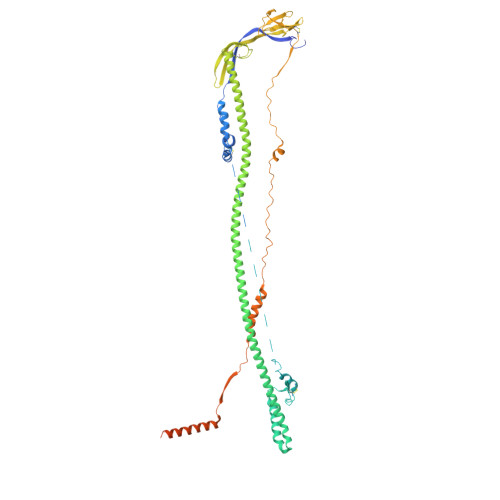
Effect of the S2' site cleavage on SARS-CoV-2 spike.
Shi, W., Jonaid, G.M., Kibria, M.G., Allen, J., Peng, H., Rits-Volloch, S., Zhu, H., Wang, S., Walsh, R.M., Lu, J., Chen, B.(2025) Nat Commun 16: 11675-11675
- PubMed: 41309650 Search on PubMedSearch on PubMed Central
- DOI: https://doi.org/10.1038/s41467-025-66693-w
- Primary Citation Related Structures:
9NXY - PubMed Abstract:
SARS-CoV-2 initiates infection of host cells by fusing its envelope lipid bilayer with the cell membrane. To overcome kinetic barriers for membrane fusion, the virus-encoded spike (S) protein refolds from a metastable prefusion state to a lower energy, stable postfusion conformation. The protein is first split into S1 and S2 fragments at a proteolytic site after synthesis, and presumably further cleaved at a second site, known as the S2' site, before membrane fusion can occur. Here, we report a cryo-EM structure of S2 fragment after the S2' cleavage, possibly representing a late fusion intermediate conformation, in which the fusion peptide and transmembrane segment have yet to pack together, distinct from the final, postfusion state. Functional assays demonstrate that the S2' cleavage accelerates membrane fusion, probably by stabilizing membrane fusion intermediates. These results advance our understanding of SARS-CoV-2 entry and may guide intervention strategies against pathogenetic coronaviruses.
- Division of Molecular Medicine, Boston Children's Hospital, Boston, MA, USA. wshi@crystal.harvard.edu.
Organizational Affiliation: