9NVG | pdb_00009nvg

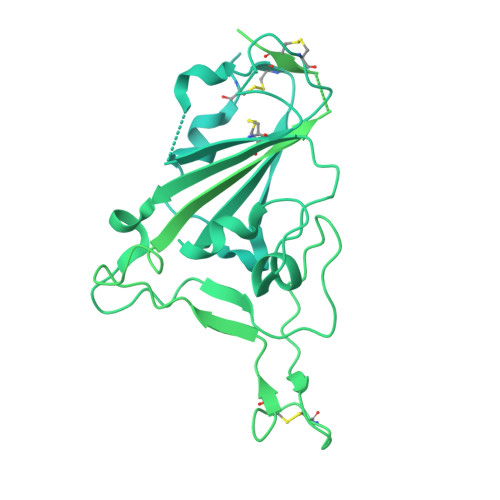
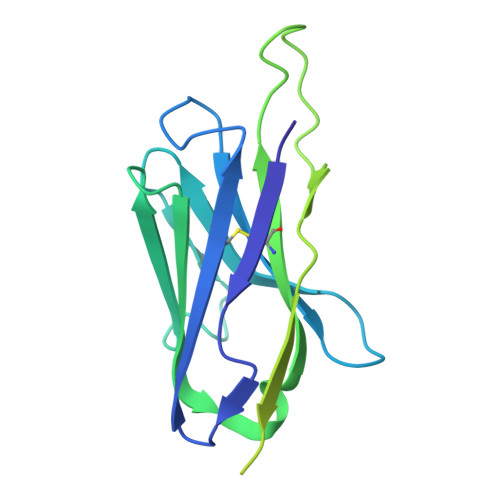
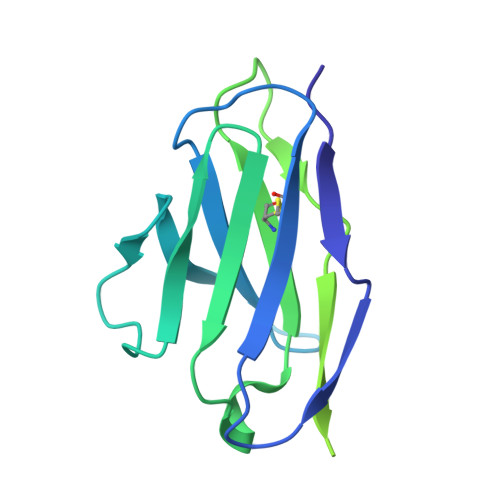
Structure of SARS-CoV-2 BA.1 spike RBD bound to COV2-3835 Fab


Experimental Data Snapshot

  • Method: ELECTRON MICROSCOPY
  • Resolution: 3.00 Å
  • Aggregation State: PARTICLE 
  • Reconstruction Method: SINGLE PARTICLE 

wwPDB Validation 3D Report Full Report

Validation slider image for 9NVG

This is version 1.1 of the entry. See complete history

Literature

Epitope-focused discovery of SARS-CoV-2 antibodies that potently neutralize Omicron variants.

Zost, S.J.Suryadevara, N.Williamson, L.E.Scheaffer, S.M.Binshtein, E.Buchman, C.D.Johnson, N.V.Catanzaro, N.J.Ravera, S.Chapman, N.S.Myers, L.Ramamohan, A.R.Handal, L.S.Nguyen, D.C.Trivette, A.Martinez, J.R.Villalobos, E.Rutherford, S.A.Eun-Hyung Lee, F.Schafer, A.Baric, R.S.McLellan, J.S.Diamond, M.S.Carnahan, R.H.Crowe Jr., J.E.

(2026) Nat Microbiol 11: 1113-1132

  • DOI: https://doi.org/10.1038/s41564-026-02282-x
  • Primary Citation Related Structures: 
    9C6Y, 9C7S, 9NVG

  • PubMed Abstract: 

    The emergence of SARS-CoV-2 Omicron variants has led to viral escape from many clinically approved monoclonal antibodies (mAbs) due to rapid evolution of the receptor-binding domain (RBD). Co-circulation of SARS-CoV-2 variants with unique sets of antigenic substitutions has further complicated therapeutic mAb discovery. New approaches are needed to rapidly discover and characterize mAbs with preferred specificity and functional characteristics. Here we describe and perform epitope-focused mAb discovery using glycan-masked antigens. We isolated and expressed a panel of 303 mAbs, some of which potently neutralize divergent Omicron subvariants by targeting the class 3 antigenic site on SARS-CoV-2 RBD. Epitope mapping of these antibodies revealed a spectrum of cross-reactivity and differential recognition of the class 3 site, validating the utility of this enrichment approach for targeted mAb discovery. Together, this work rationally designs glycan-masked engineered RBDs and uses them to isolate mAbs that potently neutralize antigenically divergent SARS-CoV-2 variants.


  • Organizational Affiliation
    • The Vanderbilt Center for Antibody Therapeutics, Vanderbilt University Medical Center, Nashville, TN, USA.

Macromolecule Content 

  • Total Structure Weight: 191 kDa 
  • Atom Count: 3,271 
  • Modeled Residue Count: 413 
  • Deposited Residue Count: 1,728 
  • Unique protein chains: 3

Macromolecules

Find similar proteins by:|  3D Structure
Entity ID: 1
MoleculeChains  Sequence LengthOrganismDetailsImage
Spike glycoprotein1,285Severe acute respiratory syndrome coronavirus 2Mutation(s): 10 
Gene Names: S2
UniProt
Find proteins for P0DTC2 (Severe acute respiratory syndrome coronavirus 2)
Explore P0DTC2 
Go to UniProtKB:  P0DTC2
Entity Groups
Sequence Clusters30% Identity50% Identity70% Identity90% Identity95% Identity100% Identity
UniProt GroupP0DTC2
Glycosylation
Glycosylation Sites: 1Go to GlyGen: P0DTC2-1
Sequence Annotations
Expand
Reference Sequence
Find similar proteins by:|  3D Structure
Entity ID: 2
MoleculeChains  Sequence LengthOrganismDetailsImage
COV2-3835 Fab Heavy ChainB [auth H]229Homo sapiensMutation(s): 0 
Find similar proteins by:|  3D Structure
Entity ID: 3
MoleculeChains  Sequence LengthOrganismDetailsImage
COV2-3835 Fab Light ChainC [auth L]214Homo sapiensMutation(s): 0 

Oligosaccharides

Help  
Entity ID: 4
MoleculeChains Length2D Diagram GlycosylationD Interactions
2-acetamido-2-deoxy-beta-D-glucopyranose-(1-4)-2-acetamido-2-deoxy-beta-D-glucopyranoseD [auth B]2N-Glycosylation
Glycosylation Resources
GlyTouCan: G42666HT
GlyCosmos: G42666HT
GlyGen: G42666HT

Experimental Data & Validation

Experimental Data

  • Method: ELECTRON MICROSCOPY
  • Resolution: 3.00 Å
  • Aggregation State: PARTICLE 
  • Reconstruction Method: SINGLE PARTICLE 
EM Software:
TaskSoftware PackageVersion
MODEL REFINEMENTPHENIX1.21rc1_5127

Structure Validation

View Full Validation Report


Entry History 

& Funding Information

Deposition Data


Funding OrganizationLocationGrant Number
Not funded--

Revision History  (Full details and data files)

  • Version 1.0: 2026-02-25
    Type: Initial release
  • Version 1.1: 2026-04-29
    Changes: Data collection, Database references