Download Mendeley
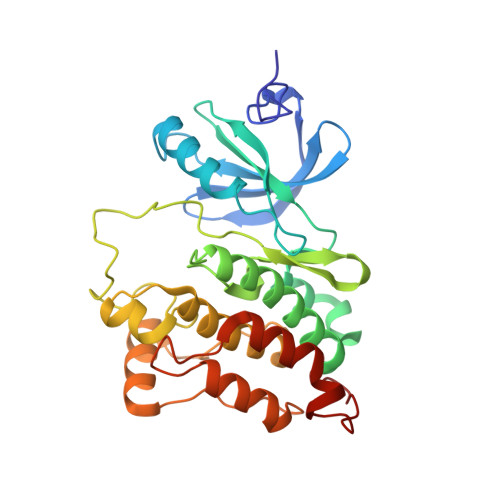
Conformational landscape adaptations enable processive phosphorylation by Src family kinases.
Cui, Y., Ali, R., Clay, M., Rossi, P., Liu, A., Yang, D., Gough, N.R., Geiger, T., Kalodimos, C.G.(2025) Science 390: eadw8310-eadw8310
- PubMed: 41411430 Search on PubMed
- DOI: https://doi.org/10.1126/science.adw8310
- Primary Citation Related Structures:
9NS0, 9NS1 - PubMed Abstract:
Processive phosphorylation by kinases enables the rapid multisite modification of signaling hubs, serving to integrate signals during time-sensitive cellular events. To achieve processivity, multiple catalytic cycles must occur before substrate dissociation, making rapid turnover rates essential. Src family kinases processively phosphorylate multisite substrates. Using nuclear magnetic resonance spectroscopy, we identified a transient intermediate state within the Src conformational ensemble, positioned between its active and inactive states. This intermediate state facilitates the rapid release of adenosine diphosphate following adenosine triphosphate hydrolysis, ensuring efficient catalytic turnover. Depletion of the intermediate state abrogated processive phosphorylation by Src, Lck, and Hck, impairing function. These findings reveal that the conformational ensemble of Src family kinases has evolved to incorporate a transient state that underpins their capacity for processive substrate phosphorylation.
- Department of Structural Biology, St. Jude Children's Research Hospital, Memphis, TN, USA.
Organizational Affiliation: