9NO1 | pdb_00009no1

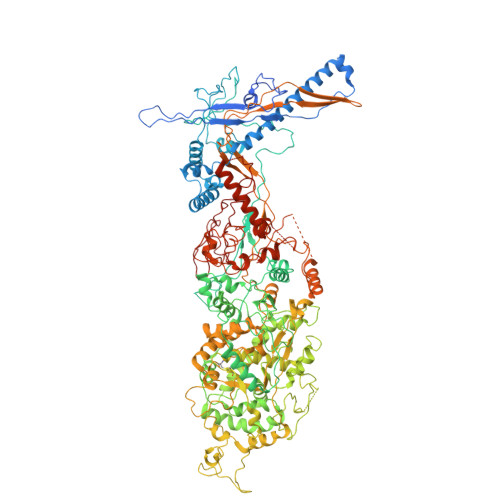
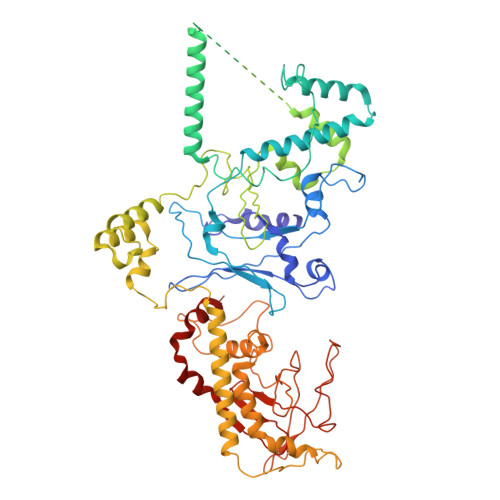
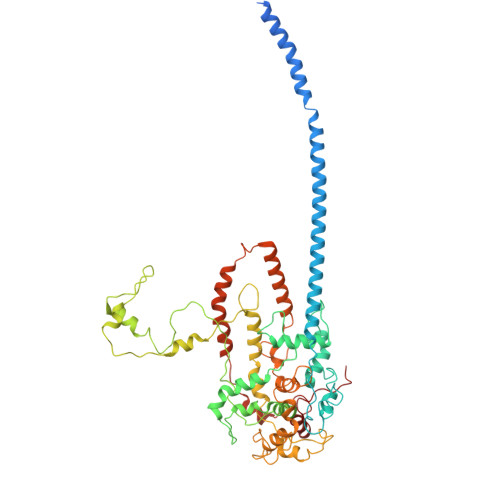
Cryo-ET map of the VZV capsid vertex (5-fold axis).

  • Classification: VIRUS
  • Organism(s): Human alphaherpesvirus 3
  • Mutation(s): No 

  • Deposited: 2025-03-07 Released: 2025-07-30 
  • Deposition Author(s): Oliver, S.L., Chen, M.
  • Funding Organization(s): National Institutes of Health/National Institute Of Allergy and Infectious Diseases (NIH/NIAID)

Experimental Data Snapshot

  • Method: ELECTRON MICROSCOPY
  • Resolution: 8.30 Å
  • Aggregation State: CELL 
  • Reconstruction Method: SUBTOMOGRAM AVERAGING 

wwPDB Validation   3D Report Full Report


This is version 1.0 of the entry. See complete history


Literature

Cryogenic Electron Tomography Redefines Herpesvirus Capsid Assembly Intermediates Inside the Cell Nucleus.

Oliver, S.L.Chen, M.Engel, L.Hecksel, C.W.Zhou, X.Schmid, M.F.Arvin, A.M.Chiu, W.

(2025) bioRxiv 

  • DOI: https://doi.org/10.1101/2025.06.27.661840
  • Primary Citation of Related Structures:  
    9NO1

  • PubMed Abstract: 

    Herpesviruses encapsulate their double-stranded DNA (dsDNA) genomes within an icosahedral nucleocapsid formed in the infected cell nucleus. Four biochemically purified nucleocapsids have been characterized, but their roles in herpesvirus replication remain controversial. The status of the capsid vertex-specific component (CVSC), essential for capsid stability and dsDNA packaging and retention, is also unclear. By integrating cryogenic focused ion beam milling with electron tomography and subtomogram averaging, we derived atomic models for all protein components, including the CVSC, across different herpesvirus capsid types within infected cell nuclei. Focused classification of pentonal vertex densities revealed differences in CVSC occupancy between genome-filled capsids and capsids lacking dsDNA, highlighting structural heterogeneity and providing insight into distinct capsid assembly stages in situ . These intra-nuclear findings redefine the maturation model of herpesvirus capsid assembly, advancing the understanding of herpesvirus replication, and demonstrate the effectiveness of in situ electron imaging by studying virus assembly within host cells.


Macromolecules
Find similar proteins by:  (by identity cutoff)  |  3D Structure
Entity ID: 1
MoleculeChains Sequence LengthOrganismDetailsImage
ORF40
A, B, D, F, H
A, B, D, F, H, J, L
1,396Human alphaherpesvirus 3Mutation(s): 0 
UniProt
Find proteins for Q4JQT5 (Varicella-zoster virus (strain Oka vaccine))
Explore Q4JQT5 
Go to UniProtKB:  Q4JQT5
Entity Groups  
Sequence Clusters30% Identity50% Identity70% Identity90% Identity95% Identity100% Identity
UniProt GroupQ4JQT5
Sequence Annotations
Expand
  • Reference Sequence
Find similar proteins by:  (by identity cutoff)  |  3D Structure
Entity ID: 2
MoleculeChains Sequence LengthOrganismDetailsImage
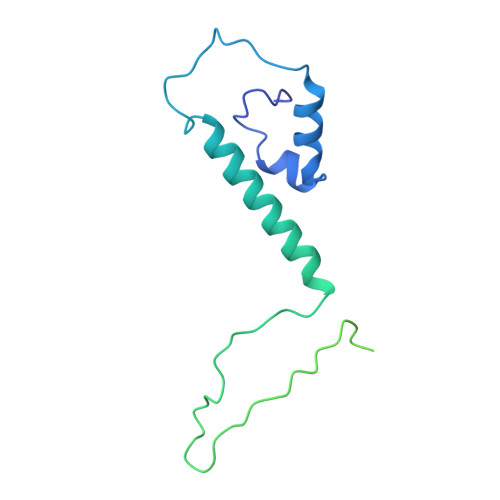
Small capsomere-interacting protein
C, E, G, I, K
C, E, G, I, K, M
235Human alphaherpesvirus 3Mutation(s): 0 
UniProt
Find proteins for Q4JQV2 (Varicella-zoster virus (strain Oka vaccine))
Explore Q4JQV2 
Go to UniProtKB:  Q4JQV2
Entity Groups  
Sequence Clusters30% Identity50% Identity70% Identity90% Identity95% Identity100% Identity
UniProt GroupQ4JQV2
Sequence Annotations
Expand
  • Reference Sequence
Find similar proteins by:  (by identity cutoff)  |  3D Structure
Entity ID: 3
MoleculeChains Sequence LengthOrganismDetailsImage
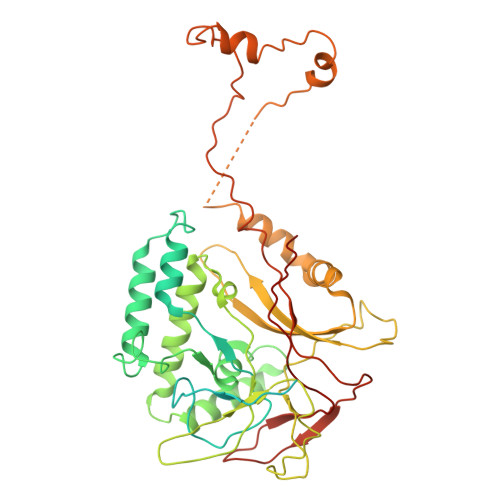
ORF20
N, Q
483Human alphaherpesvirus 3Mutation(s): 0 
UniProt
Find proteins for Q4JQV5 (Varicella-zoster virus (strain Oka vaccine))
Explore Q4JQV5 
Go to UniProtKB:  Q4JQV5
Entity Groups  
Sequence Clusters30% Identity50% Identity70% Identity90% Identity95% Identity100% Identity
UniProt GroupQ4JQV5
Sequence Annotations
Expand
  • Reference Sequence
Find similar proteins by:  (by identity cutoff)  |  3D Structure
Entity ID: 4
MoleculeChains Sequence LengthOrganismDetailsImage
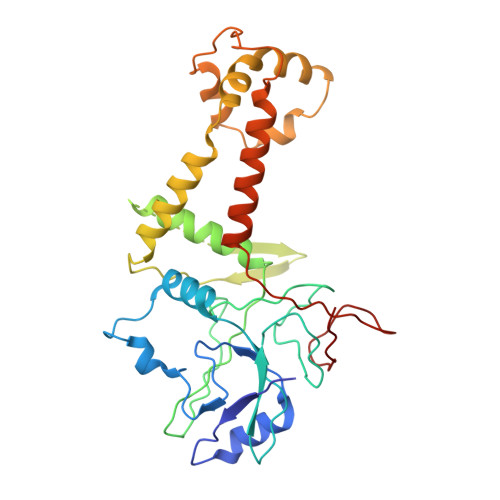
ORF41
O, P, R, S
316Human alphaherpesvirus 3Mutation(s): 0 
UniProt
Find proteins for Q4JQT4 (Varicella-zoster virus (strain Oka vaccine))
Explore Q4JQT4 
Go to UniProtKB:  Q4JQT4
Entity Groups  
Sequence Clusters30% Identity50% Identity70% Identity90% Identity95% Identity100% Identity
UniProt GroupQ4JQT4
Sequence Annotations
Expand
  • Reference Sequence
Find similar proteins by:  (by identity cutoff)  |  3D Structure
Entity ID: 5
MoleculeChains Sequence LengthOrganismDetailsImage
ORF43676Human alphaherpesvirus 3Mutation(s): 0 
UniProt
Find proteins for Q4JQT2 (Varicella-zoster virus (strain Oka vaccine))
Explore Q4JQT2 
Go to UniProtKB:  Q4JQT2
Entity Groups  
Sequence Clusters30% Identity50% Identity70% Identity90% Identity95% Identity100% Identity
UniProt GroupQ4JQT2
Sequence Annotations
Expand
  • Reference Sequence
Find similar proteins by:  (by identity cutoff)  |  3D Structure
Entity ID: 6
MoleculeChains Sequence LengthOrganismDetailsImage
ORF34
U, V
579Human alphaherpesvirus 3Mutation(s): 0 
UniProt
Find proteins for Q4JQU1 (Varicella-zoster virus (strain Oka vaccine))
Explore Q4JQU1 
Go to UniProtKB:  Q4JQU1
Entity Groups  
Sequence Clusters30% Identity50% Identity70% Identity90% Identity95% Identity100% Identity
UniProt GroupQ4JQU1
Sequence Annotations
Expand
  • Reference Sequence
Find similar proteins by:  (by identity cutoff)  |  3D Structure
Entity ID: 7
MoleculeChains Sequence LengthOrganismDetailsImage
Large tegument protein deneddylase
W, X
2,763Human alphaherpesvirus 3Mutation(s): 0 
EC: 3.4.19.12 (PDB Primary Data), 3.4.22 (PDB Primary Data)
UniProt
Find proteins for Q4JQX9 (Varicella-zoster virus (strain Oka vaccine))
Explore Q4JQX9 
Go to UniProtKB:  Q4JQX9
Entity Groups  
Sequence Clusters30% Identity50% Identity70% Identity90% Identity95% Identity100% Identity
UniProt GroupQ4JQX9
Sequence Annotations
Expand
  • Reference Sequence
Experimental Data & Validation

Experimental Data

  • Method: ELECTRON MICROSCOPY
  • Resolution: 8.30 Å
  • Aggregation State: CELL 
  • Reconstruction Method: SUBTOMOGRAM AVERAGING 

Structure Validation

View Full Validation Report


Entry History & Funding Information

Deposition Data


Funding OrganizationLocationGrant Number
National Institutes of Health/National Institute Of Allergy and Infectious Diseases (NIH/NIAID)United States--

Revision History  (Full details and data files)

  • Version 1.0: 2025-07-30
    Type: Initial release