Download Mendeley
Carbamoyl fluorides as serine hydrolase inhibitors: a case study on FphI from Staphylococcus aureus.
Randall, G., Meden, A., Rutledge, M.T., Prestresi, L., Rambaher, M.H., Chen, S., Zdovc, I., Gobec, S., Knez, D., Fellner, M.(2026) Bioorg Chem 176: 109834-109834
- PubMed: 41965188 Search on PubMed
- DOI: https://doi.org/10.1016/j.bioorg.2026.109834
- Primary Citation Related Structures:
9NIX, 9NIZ - PubMed Abstract:
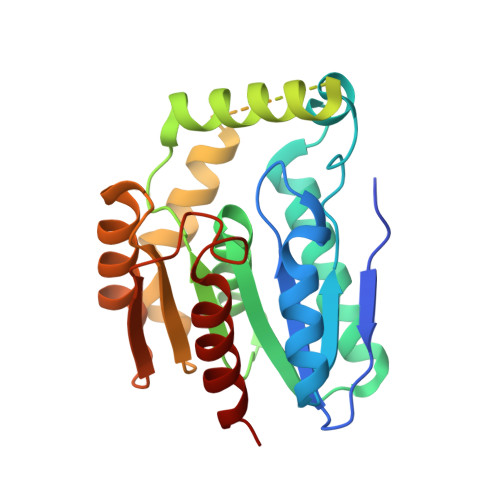
Selective covalent inhibitors have recently gained popularity as potent therapeutic drugs or molecular tools to investigate protein function. Serine hydrolases are a particular class of enzymes involved in diverse diseases. They possess a nucleophilic catalytic serine residue which can be targeted by covalent warheads. Carbamoyl fluoride is a relatively underexplored and underutilized organofluorine warhead. Here, we have designed and screened a focused library of carbamoyl fluoride fragments that successfully inhibited a recently discovered biofilm-associated serine hydrolase, FphI, from the pathogen Staphylococcus aureus. Enzyme kinetics and LC-MS experiments demonstrated that these compounds are potent covalent inhibitors of FphI. Furthermore, two resolved ligand-bound crystal structures further confirm covalent binding to the catalytic serine 94 of FphI, with the warhead carbonyl forming a key interaction at the oxyanion hole and carbamate N-substituents occupying a hydrophobic substrate binding site. These findings expand the medicinal chemist's covalent toolbox to include the carbamoyl fluoride warhead for its further development into chemical probes or covalent inhibitors of clinically relevant serine hydrolases.
- Biochemistry Department, University of Otago, Dunedin 9054, New Zealand.
Organizational Affiliation: