Download Mendeley
A disulfide redox switch mechanism regulates glycoside hydrolase function.
Martins, M.P., Martins, G.H., Fuzita, F.J., Spadeto, J.P.M., Miyamoto, R.Y., Colombari, F.M., Stoffel, F., Dolce, L.G., Santos, C.R.D., Streit, R.S.A., Borges, A.C., Galinari, R.H., Yoshimi, Y., Dupree, P., Persinoti, G.F., Morais, M.A.B., Murakami, M.T.(2026) Nat Commun 17: 45-45
- PubMed: 41491304 Search on PubMedSearch on PubMed Central
- DOI: https://doi.org/10.1038/s41467-025-67225-2
- Primary Citation Related Structures:
9NFE, 9NP8, 9NP9, 9NPA, 9NPB, 9NPC, 9NPD, 9NPE, 9NPF, 9NPL, 9NPN - PubMed Abstract:
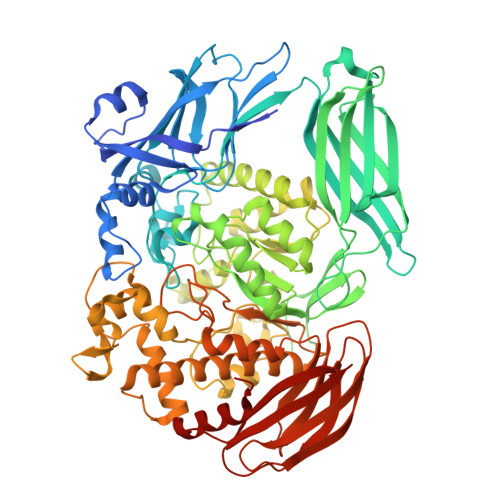
Disulfide bonds are a key post-translational modification involved in protein folding, structural stability, and functional regulation. Here, we demonstrate that a glycoside hydrolase from the GH2 family undergoes reversible redox regulation through an intramolecular disulfide bond. The enzyme is inactive in its oxidized state and becomes active when reduced through a fully reversible process. Under oxidative conditions, multiple crystallographic and cryo-EM structures revealed a pronounced structural disorder in the active site, most prominent in the regulatory and catalytic loops, which disrupts the substrate binding site and, remarkably, the configuration of the acidic catalytic residues. Conversely, a high-resolution cryo-EM structure of the active (reduced) state unveiled a well-ordered active site with catalytic residues properly positioned for a classical Koshland retaining mechanism. This reversible order-disorder process based on a disulfide switch provides a mechanism for redox-dependent control of glycoside hydrolase activity, with potential implications for carbohydrate metabolism, microbial adaptation and biotechnological applications.
- Brazilian Biorenewables National Laboratory (LNBR), Brazilian Center for Research in Energy and Materials (CNPEM), Campinas, São Paulo, Brazil.
Organizational Affiliation: