9NAB | pdb_00009nab

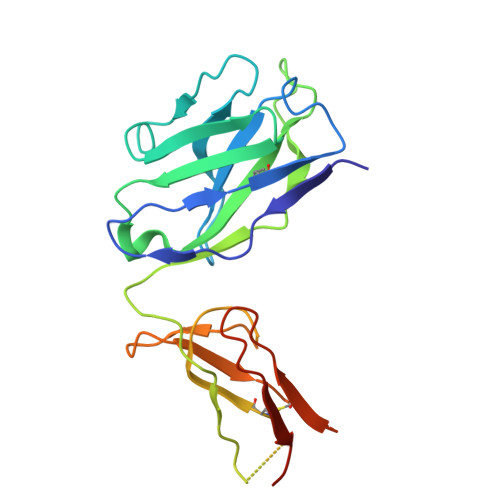
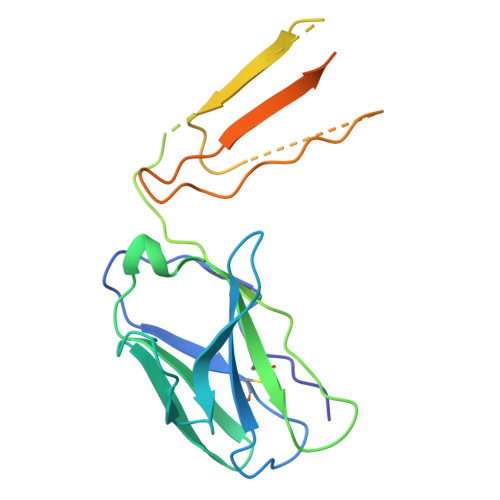
Cryo-EM structure of the alpha5beta1 integrin headpiece with OS2966 Fab


Experimental Data Snapshot

  • Method: ELECTRON MICROSCOPY
  • Resolution: 2.54 Å
  • Aggregation State: PARTICLE 
  • Reconstruction Method: SINGLE PARTICLE 

wwPDB Validation 3D Report Full Report

Validation slider image for 9NAB

This is version 1.2 of the entry. See complete history

Literature

ITGB1 Regulates Triple-Negative Breast Cancer Development by Modulating the Tumor Microenvironment.

Song, N.Chen, S.Wang, L.Dang, J.Cao, X.Singh, S.Yang, L.Wang, J.Rosen, S.T.Wang, Y.Chen, C.D.Zhang, C.Feng, M.

(2026) Adv Sci (Weinh) 13: e13672-e13672

  • DOI: https://doi.org/10.1002/advs.202513672
  • Primary Citation Related Structures: 
    9NAB

  • PubMed Abstract: 

    Tumorigenesis and metastasis are frequently attributed to the intricate interplay between cancer cells and the tumor microenvironment (TME). Comprehending the mechanisms and key regulators of cancer-immune crosstalk in the TME is imperative for developing efficacious immunotherapy. Through a series of in vivo CRISPR screens, we identified tumor-intrinsic ITGB1 as a critical regulator of triple-negative breast cancer (TNBC) development and deciphered its underlying mechanisms. Tumoral ITGB1 facilitated the establishment of pro-tumorigenic TME by orchestrating tumor-associated myeloid populations. Suppressing ITGB1 favored the enrichment of anti-tumorigenic myeloid cells and enhanced infiltration of CD4 and CD8 T cells, culminating in superior antitumor effects. CRISPR scanning pinpointed a previously unrecognized functional domain essential for ITGB1's pro-tumorigenic activity. This domain is distinct from all known ligand-binding sites in ITGB1. An antibody capable of sterically blocking this domain significantly impaired TNBC progression. These findings position tumoral ITGB1 as a promising therapeutic target for reprogramming the TME from a pro- to an anti-tumorigenic state, thereby effectively inhibiting TNBC development. Our study uncovers a novel mechanism of TNBC development and provides a unique therapeutic strategy for targeting ITGB1 in TNBC treatment.


  • Organizational Affiliation
    • Department of Immuno-Oncology, Beckman Research Institute, City of Hope, Duarte, California, USA.

Macromolecule Content 

  • Total Structure Weight: 178.58 kDa 
  • Atom Count: 8,498 
  • Modeled Residue Count: 1,106 
  • Deposited Residue Count: 1,636 
  • Unique protein chains: 4

Macromolecules

Find similar proteins by:|  3D Structure
Entity ID: 1
MoleculeChains  Sequence LengthOrganismDetailsImage
Integrin beta-1498Homo sapiensMutation(s): 0 
Gene Names: ITGB1FNRBMDF2MSK12
UniProt & NIH Common Fund Data Resources
Find proteins for P05556 (Homo sapiens)
Explore P05556 
Go to UniProtKB:  P05556
PHAROS:  P05556
GTEx:  ENSG00000150093 
Entity Groups
Sequence Clusters30% Identity50% Identity70% Identity90% Identity95% Identity100% Identity
UniProt GroupP05556
Sequence Annotations
Expand
Reference Sequence
Find similar proteins by:|  3D Structure
Entity ID: 2
MoleculeChains  Sequence LengthOrganismDetailsImage
Human Integrin alpha 5694Homo sapiensMutation(s): 0 
Find similar proteins by:|  3D Structure
Entity ID: 3
MoleculeChains  Sequence LengthOrganismDetailsImage
IgG heavy chainC [auth D]230Mus musculusMutation(s): 0 
Find similar proteins by:|  3D Structure
Entity ID: 4
MoleculeChains  Sequence LengthOrganismDetailsImage
IgG light chainD [auth C]214Mus musculusMutation(s): 0 

Experimental Data & Validation

Experimental Data

  • Method: ELECTRON MICROSCOPY
  • Resolution: 2.54 Å
  • Aggregation State: PARTICLE 
  • Reconstruction Method: SINGLE PARTICLE 
EM Software:
TaskSoftware PackageVersion
MODEL REFINEMENTPHENIX1.21.2_5419:

Structure Validation

View Full Validation Report


Entry History 

& Funding Information

Deposition Data


Funding OrganizationLocationGrant Number
National Institutes of Health/National Institute of General Medical Sciences (NIH/NIGMS)United States5R35GM128641

Revision History  (Full details and data files)

  • Version 1.0: 2025-07-23
    Type: Initial release
  • Version 1.1: 2026-02-18
    Changes: Data collection, Database references
  • Version 1.2: 2026-04-22
    Changes: Data collection, Database references