Download Mendeley
Identification of a Potent Pan-Coronaviral Main Protease Inhibitor.
Chen, P., Strunk, U., Arutyunova, E., Lu, J., Chen, S.A., Demmon, S., Maplethorpe, C., Kandadai, A.S., Shields, J., Saffran, H.A., Lamer, T., Fischer, C., Van Oers, T.J., Turner, Z., Leong, P., Iyyathurai, J., Young, H.S., Bai, B., Vederas, J.C., Nieman, J.A., Joyce, M.A., Tyrrell, D.L., Lemieux, M.J.(2026) J Med Chem
- PubMed: 42461134 Search on PubMed
- DOI: https://doi.org/10.1021/acs.jmedchem.6c00645
- Primary Citation Related Structures:
9N98, 9N99, 9N9T, 9N9U, 9N9V, 9NA0 - PubMed Abstract:
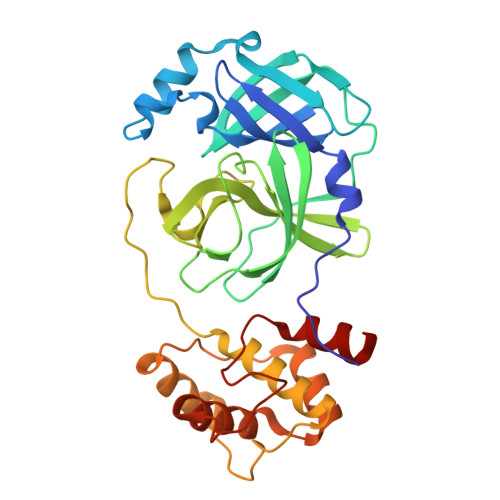
The global impact of SARS-CoV-2 and the continued emergence of zoonotic coronaviruses underscore the urgent need for broad-spectrum antivirals for pandemic preparedness. Herein, we report AVI8122 , a covalent pan-coronaviral inhibitor that targets 19 M pro s across the α, β, γ, and δ genera, encompassing bat, human, and other animal coronaviruses. AVI8122 exhibits low nanomolar potency and favorable pharmacokinetics in mice. Structural studies reveal that AVI8122 forms a covalent bond with the catalytic cysteine and maintains conserved interactions within the active sites of these M pro s. In cellulo , AVI8122 efficiently inhibited the replication of SARS-CoV-2 and its variants of concern as well as the activity of M pro s from all four genera. Furthermore, in mouse models, AVI8122 conferred dose-dependent protection against a lethal SARS-CoV-2 infection. Our findings position AVI8122 as an early lead compound and a tractable structural starting point for the development of broad-spectrum antivirals against future coronavirus spillover threats.
- Department of Biochemistry, University of Alberta, Edmonton, T6G 2H7 AB, Canada.
Organizational Affiliation: