9N4J | pdb_00009n4j

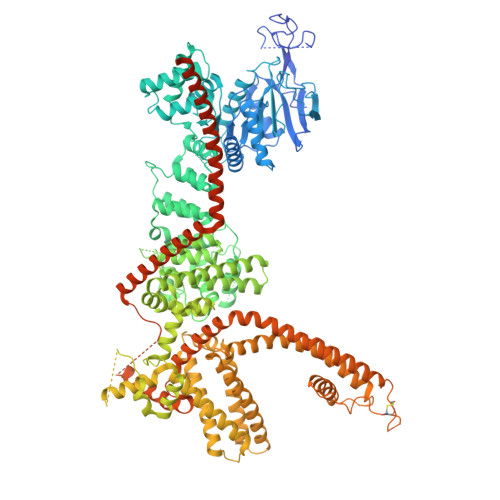
Cryo-EM structure of rabbit TRPM3 in complex with CIM0216 at 18 degrees Celsius

  • Classification: MEMBRANE PROTEIN
  • Organism(s): Oryctolagus cuniculus
  • Expression System: Homo sapiens
  • Mutation(s): No 

  • Deposited: 2025-02-03 Released: 2025-12-17 
  • Deposition Author(s): Kumar, S., Lu, W., Du, J.
  • Funding Organization(s): National Institutes of Health/National Heart, Lung, and Blood Institute (NIH/NHLBI), National Institutes of Health/National Institute of Neurological Disorders and Stroke (NIH/NINDS)

Experimental Data Snapshot

  • Method: ELECTRON MICROSCOPY
  • Resolution: 3.27 Å
  • Aggregation State: PARTICLE 
  • Reconstruction Method: SINGLE PARTICLE 

wwPDB Validation   3D Report Full Report


This is version 1.0 of the entry. See complete history


Literature

Structural basis for agonist and heat activation of nociceptor TRPM3.

Kumar, S.Jin, F.Park, S.J.Choi, W.Keuning, S.I.Massimino, R.P.Vu, S.Lu, W.Du, J.

(2025) Nat Struct Mol Biol 

  • DOI: https://doi.org/10.1038/s41594-025-01692-5
  • Primary Citation of Related Structures:  
    9N1G, 9N1H, 9N1I, 9N1J, 9N1K, 9N1L, 9N1M, 9N1N, 9N4J, 9O7W, 9O7X, 9O7Y, 9O7Z, 9O80, 9O81, 9O82, 9O83, 9O86, 9O87, 9O88, 9O89, 9O8C, 9O8F, 9O8G

  • PubMed Abstract: 

    Detecting noxious heat is vital for survival, triggering protective pain responses. The TRPM3 channel is a key nociceptor and a promising therapeutic target for pain and neurological disorders. Here we show that the rabbit TRPM3 is intrinsically dynamic, with its intracellular domain (ICD) sampling both resting and activated states, but favoring the resting state in the absence of stimulation. We reveal that heat and the synthetic agonist CIM0216 shift the equilibrium toward activation by inducing a similar ICD rearrangement. Mutations that facilitate ICD movement enhance sensitivity to both thermal and chemical stimuli, underscoring the central role of the ICD in channel gating. We also show that the antagonist primidone binds the same site as CIM0216 in the S1-S4 domain but inhibits channel activation. This study provides a structural framework for a mechanistic understanding of thermal and chemical gating of TRPM3 and for guiding the rational design of TRPM3-targeted analgesics and neurotherapeutics.


  • Organizational Affiliation
    • Department of Structural Biology, Van Andel Institute, Grand Rapids, MI, USA.

Macromolecules
Find similar proteins by:  (by identity cutoff)  |  3D Structure
Entity ID: 1
MoleculeChains Sequence LengthOrganismDetailsImage
TRPM3
A, B, C, D
1,306Oryctolagus cuniculusMutation(s): 0 
Entity Groups  
Sequence Clusters30% Identity50% Identity70% Identity90% Identity95% Identity100% Identity
Sequence Annotations
Expand
  • Reference Sequence
Small Molecules
Ligands 2 Unique
IDChains Name / Formula / InChI Key2D Diagram3D Interactions
Y01
Query on Y01

Download Ideal Coordinates CCD File 
E [auth A]
F [auth A]
H [auth A]
I [auth B]
J [auth B]
E [auth A],
F [auth A],
H [auth A],
I [auth B],
J [auth B],
L [auth B],
M [auth C],
N [auth C],
P [auth C],
Q [auth D],
R [auth D],
S [auth D]
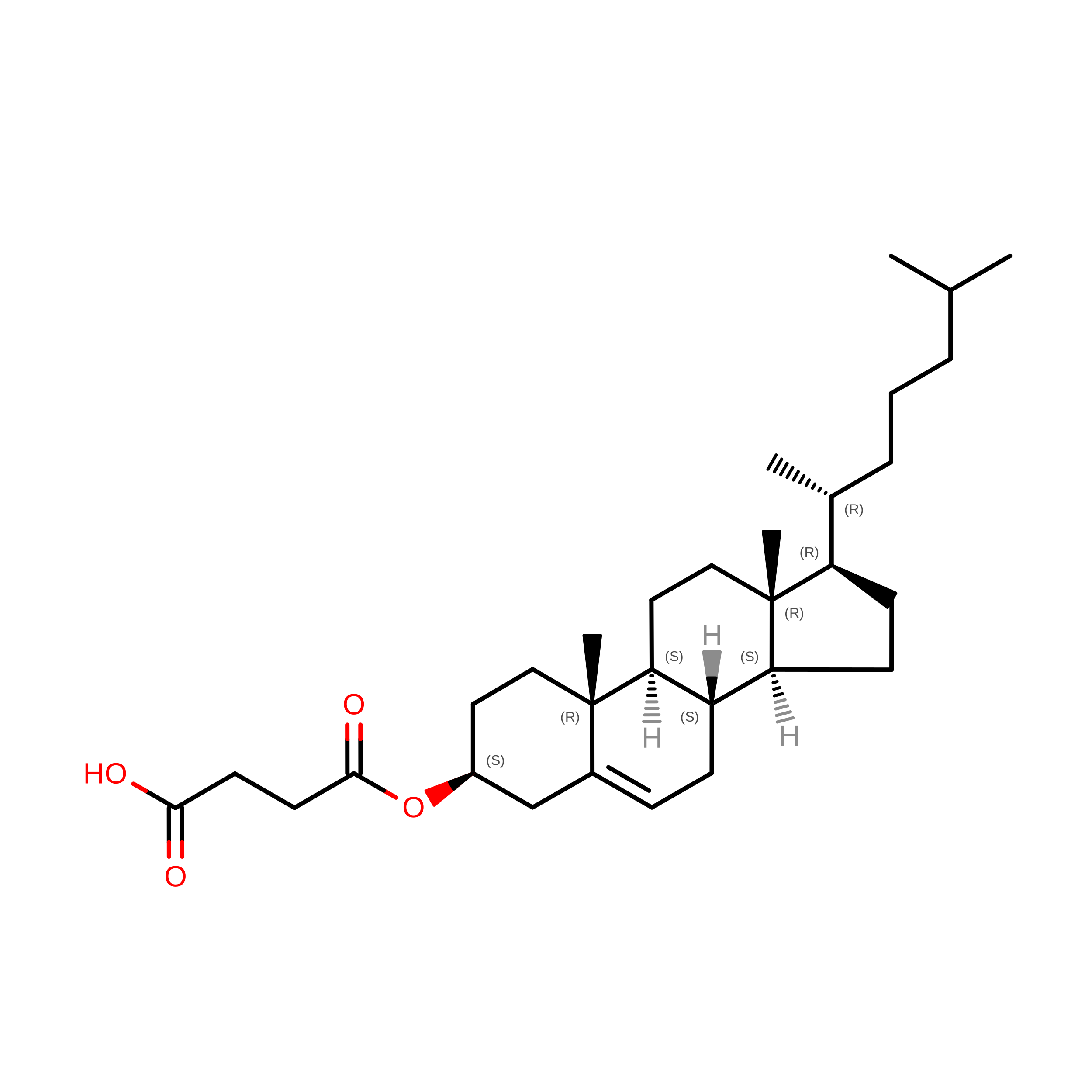
CHOLESTEROL HEMISUCCINATE
C31 H50 O4
WLNARFZDISHUGS-MIXBDBMTSA-N
A1AIB (Subject of Investigation/LOI)
Query on A1AIB

Download Ideal Coordinates CCD File 
G [auth A],
K [auth B],
O [auth C],
T [auth D]
(2S)-2-(3,4-dihydroquinolin-1(2H)-yl)-N-(5-methyl-1,2-oxazol-3-yl)-2-phenylacetamide
C21 H21 N3 O2
KSEXDSJYVSEVGF-FQEVSTJZSA-N
Experimental Data & Validation

Experimental Data

  • Method: ELECTRON MICROSCOPY
  • Resolution: 3.27 Å
  • Aggregation State: PARTICLE 
  • Reconstruction Method: SINGLE PARTICLE 
EM Software:
TaskSoftware PackageVersion
MODEL REFINEMENTPHENIX1.21.2_5419

Structure Validation

View Full Validation Report


Entry History & Funding Information

Deposition Data


Funding OrganizationLocationGrant Number
National Institutes of Health/National Heart, Lung, and Blood Institute (NIH/NHLBI)United StatesR01HL153219
National Institutes of Health/National Institute of Neurological Disorders and Stroke (NIH/NINDS)United StatesR01NS112363

Revision History  (Full details and data files)

  • Version 1.0: 2025-12-17
    Type: Initial release