9N23 | pdb_00009n23

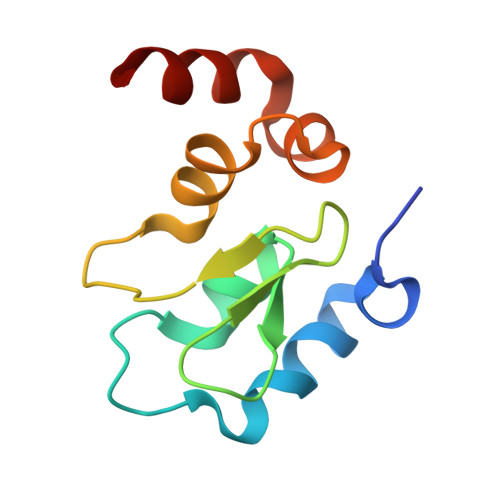
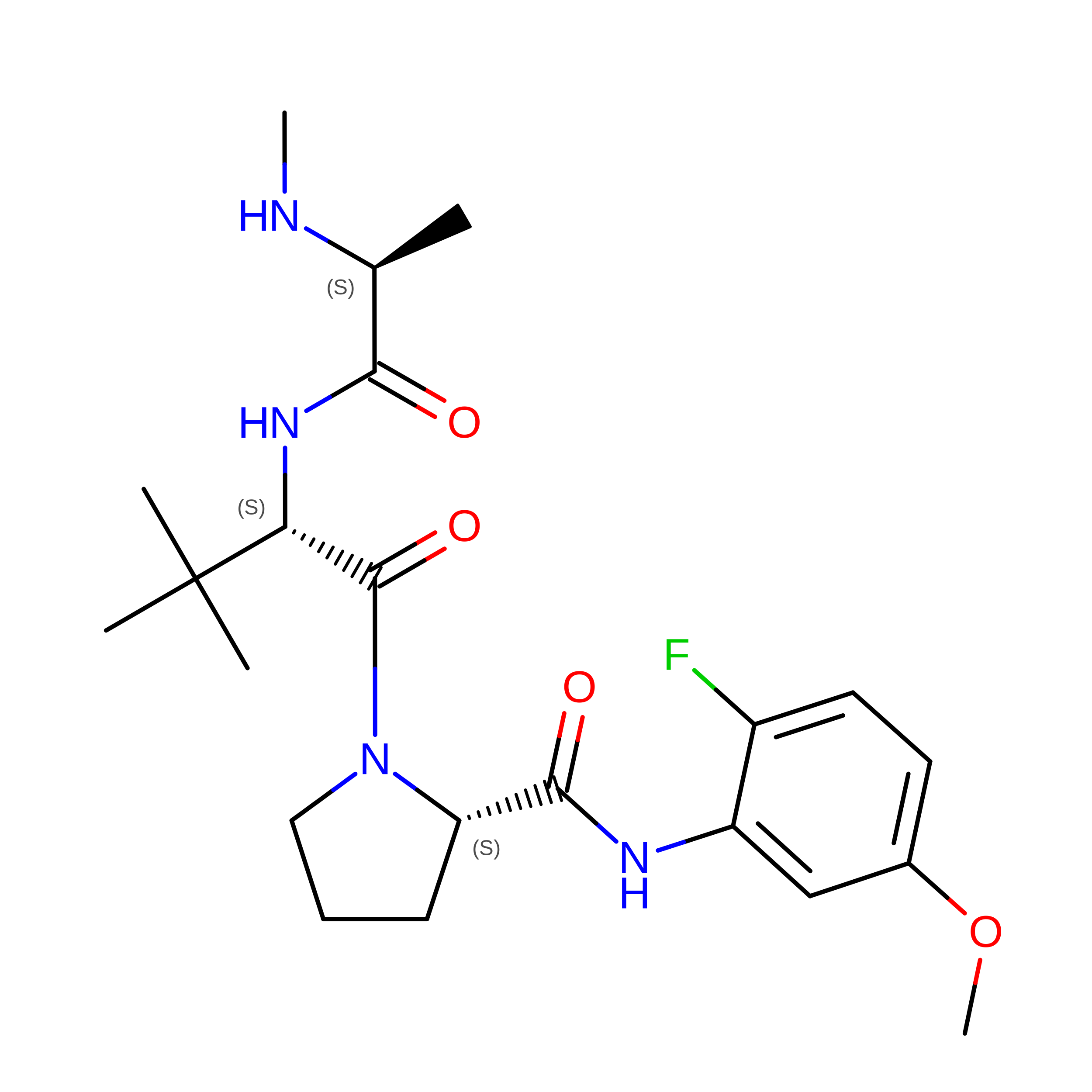
Crystal structure of cIAP1-BIR3 with XB2 series SMAC mimetic ligand


Experimental Data Snapshot

  • Method: X-RAY DIFFRACTION
  • Resolution: 1.80 Å
  • R-Value Free: 
    0.222 (Depositor), 0.222 (DCC) 
  • R-Value Work: 
    0.193 (Depositor), 0.194 (DCC) 
  • R-Value Observed: 
    0.195 (Depositor) 

Starting Model: experimental
View more details

wwPDB Validation   3D Report Full Report


Ligand Structure Quality Assessment 


This is version 1.1 of the entry. See complete history


Literature

Expanding the toolbox to develop IAP-based degraders of TEAD transcription factors.

Gupta, N.Trainor, N.Radwan, M.Nguyen, S.Duncan, L.Tang, A.X.Beveridge, J.Silke, N.Yousef, J.Bilgilier, C.Wachter, J.Greb, P.Jandova, Z.Elias, J.Kopf, S.Gerstberger, T.Stolt-Bergner, P.Braun, N.Weinstabl, H.McConnell, D.B.Mauri, F.Lucet, I.S.Silke, J.Chessum, N.E.A.Roy, M.J.

(2026) Commun Chem 

  • DOI: https://doi.org/10.1038/s42004-025-01871-x
  • Primary Citation of Related Structures:  
    9N1R, 9N21, 9N23

  • PubMed Abstract: 

    The TEAD transcription factors (TEAD1-4) are critical effectors of the Hippo pathway, forming active nuclear complexes with transcriptional co-activators YAP/TAZ to regulate cell growth/apoptosis pathways and control fundamental processes such as organ size. Frequent dysregulation of the Hippo pathway in cancer and the presence of druggable binding sites on TEADs make them attractive targets for development of small molecule inhibitors and degraders. Here, we identify and mechanistically characterize three unique series of bifunctional degraders that target TEAD1 via a lipid pocket and recruit different members of the Inhibitor of Apoptosis proteins (IAPs) family to effect degradation of TEAD1. We provide a detailed toolkit for structural, biophysical and cellular profiling, including the development of a cellular target engagement assay for the lipid pocket of TEAD1 and an IAP/TEAD1 ternary complex formation assay. Our study therefore provides essential resources for detailed characterization of IAP-recruiting degraders and important tools and learnings for bifunctional degraders targeted to the lipid pocket of TEADs.


  • Organizational Affiliation
    • Inflammation Division, Walter and Eliza Hall Institute, Parkville, VIC, Australia.

Macromolecules
Find similar proteins by:  (by identity cutoff)  |  3D Structure
Entity ID: 1
MoleculeChains Sequence LengthOrganismDetailsImage
Baculoviral IAP repeat-containing protein 2
A, B
95Homo sapiensMutation(s): 0 
Gene Names: BIRC2API1MIHBRNF48
EC: 2.3.2.27
UniProt & NIH Common Fund Data Resources
Find proteins for Q13490 (Homo sapiens)
Explore Q13490 
Go to UniProtKB:  Q13490
PHAROS:  Q13490
GTEx:  ENSG00000110330 
Entity Groups  
Sequence Clusters30% Identity50% Identity70% Identity90% Identity95% Identity100% Identity
UniProt GroupQ13490
Sequence Annotations
Expand
  • Reference Sequence
Experimental Data & Validation

Experimental Data

  • Method: X-RAY DIFFRACTION
  • Resolution: 1.80 Å
  • R-Value Free:  0.222 (Depositor), 0.222 (DCC) 
  • R-Value Work:  0.193 (Depositor), 0.194 (DCC) 
  • R-Value Observed: 0.195 (Depositor) 
Space Group: P 21 21 21
Unit Cell:
Length ( Å )Angle ( ˚ )
a = 30.252α = 90
b = 68.386β = 90
c = 124.224γ = 90
Software Package:
Software NamePurpose
PHENIXrefinement
Aimlessdata scaling
XDSdata reduction
PHASERphasing

Structure Validation

View Full Validation Report


Ligand Structure Quality Assessment 


Entry History & Funding Information

Deposition Data


Funding OrganizationLocationGrant Number
National Health and Medical Research Council (NHMRC, Australia)AustraliaGNT9000719
National Health and Medical Research Council (NHMRC, Australia)AustraliaGNT1107149
National Health and Medical Research Council (NHMRC, Australia)AustraliaGNT1195038

Revision History  (Full details and data files)

  • Version 1.0: 2026-01-21
    Type: Initial release
  • Version 1.1: 2026-02-04
    Changes: Database references