9N0Q | pdb_00009n0q

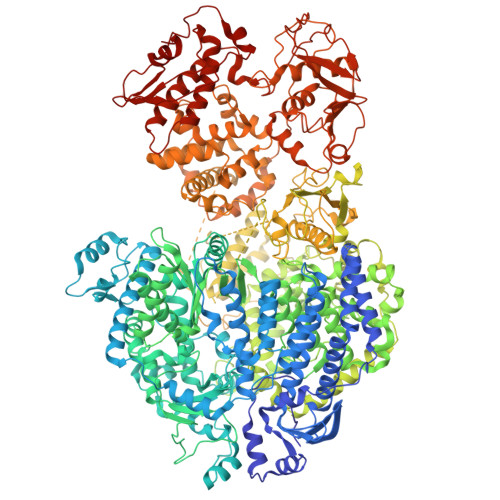
3.09A Bornavirus L-P complex (without incubation with RNA/NTP) (state 1)


Experimental Data Snapshot

  • Method: ELECTRON MICROSCOPY
  • Resolution: 3.09 Å
  • Aggregation State: PARTICLE 
  • Reconstruction Method: SINGLE PARTICLE 

wwPDB Validation 3D Report Full Report

Validation slider image for 9N0Q

This is version 1.2 of the entry. See complete history

Literature

Structural insights into the dynamic mechanism of bornavirus polymerase.

Yang, G.Wang, D.Liu, B.

(2025) Proc Natl Acad Sci U S A 122: e2504779122-e2504779122

  • DOI: https://doi.org/10.1073/pnas.2504779122
  • Primary Citation Related Structures: 
    9N0Q, 9N0R, 9N0S, 9N0T, 9N0U

  • PubMed Abstract: 

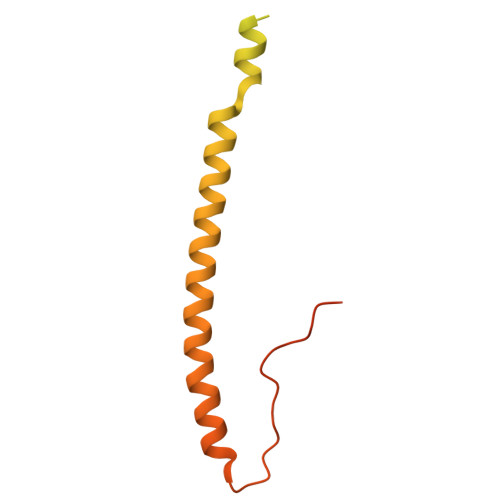
    Borna disease virus 1 (BoDV-1), an emerging zoonotic pathogen from the Bornaviridae family, is neurotropic and can infect a variety of mammalian hosts, including humans. Linked to severe encephalitis and high mortality, BoDV-1 currently lacks licensed treatments or vaccines. The BoDV-1 polymerase complex, comprising the large (L) and phosphoprotein (P) subunits, is crucial for viral replication and transcription, making it a promising target for antiviral intervention. Here, we present the cryoelectron microscopy structure of the apo BoDV-1 L-P complex, revealing a unique "mitten-shaped" architecture. The structure characterizes key domains involved in RNA synthesis, including RNA-dependent RNA polymerase, polyribonucleotidyltransferase, and an inactive methyltransferase domain. While no RNA or NTPs were visible, we observed distinct conformational states, showing large-scale rearrangements of the P tetramer and L domains, as well as remodeling of the RNA template, nucleoside triphosphates, and nascent RNA entrances and/or exits, upon introducing RNA and NTPs. These findings highlight the dynamic structural changes probably associated with polymerase activity and advance the understanding of the BoDV-1 polymerase mechanisms, offering a basis for developing targeted antiviral strategies against this deadly pathogen.


  • Organizational Affiliation
    • Section of Transcription & Gene Regulation, The Hormel Institute, University of Minnesota, Austin, MN 55912.

Macromolecule Content 

  • Total Structure Weight: 281.86 kDa 
  • Atom Count: 14,668 
  • Modeled Residue Count: 1,861 
  • Deposited Residue Count: 2,515 
  • Unique protein chains: 2

Macromolecules

Find similar proteins by:|  3D Structure
Entity ID: 1
MoleculeChains  Sequence LengthOrganismDetailsImage
RNA-directed RNA polymerase1,711OrthobornavirusMutation(s): 0 
EC: 2.7.7.48
UniProt
Find proteins for P52639 (Borna disease virus (strain V))
Explore P52639 
Go to UniProtKB:  P52639
Entity Groups
Sequence Clusters30% Identity50% Identity70% Identity90% Identity95% Identity100% Identity
UniProt GroupP52639
Sequence Annotations
Expand
Reference Sequence
Find similar proteins by:|  3D Structure
Entity ID: 2
MoleculeChains  Sequence LengthOrganismDetailsImage
P protein
B, C, D, E
201OrthobornavirusMutation(s): 0 
UniProt
Find proteins for P0C799 (Borna disease virus (strain V))
Explore P0C799 
Go to UniProtKB:  P0C799
Entity Groups
Sequence Clusters30% Identity50% Identity70% Identity90% Identity95% Identity100% Identity
UniProt GroupP0C799
Sequence Annotations
Expand
Reference Sequence

Experimental Data & Validation

Experimental Data

  • Method: ELECTRON MICROSCOPY
  • Resolution: 3.09 Å
  • Aggregation State: PARTICLE 
  • Reconstruction Method: SINGLE PARTICLE 
EM Software:
TaskSoftware PackageVersion
MODEL REFINEMENTPHENIX1.21_5207:
RECONSTRUCTIONcryoSPARC

Structure Validation

View Full Validation Report


Entry History 

& Funding Information

Deposition Data


Funding OrganizationLocationGrant Number
Not funded--

Revision History  (Full details and data files)

  • Version 1.0: 2025-09-10
    Type: Initial release
  • Version 1.1: 2025-10-08
    Changes: Data collection, Database references
  • Version 1.2: 2025-10-15
    Changes: Data collection, Database references