9MUE | pdb_00009mue

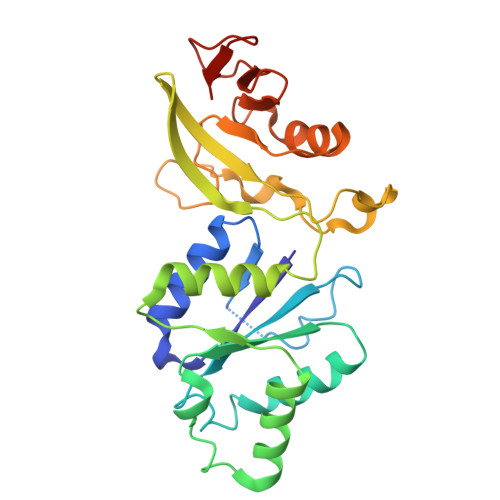
Cryo-EM structure of CRISPR-associated cA4 bound Cat1 Pentagonal filament assembly in the presence of NAD (ADPR modelled)


Experimental Data Snapshot

  • Method: ELECTRON MICROSCOPY
  • Resolution: 4.00 Å
  • Aggregation State: FILAMENT 
  • Reconstruction Method: SINGLE PARTICLE 

wwPDB Validation 3D Report Full Report

Validation slider image for 9MUE

This is version 1.2 of the entry. See complete history

Literature

Cat1 forms filament networks to degrade NAD + during the type III CRISPR-Cas antiviral response.

Baca, C.F.Majumder, P.Hickling, J.H.Patel, D.J.Marraffini, L.A.

(2025) Science 388: eadv9045-eadv9045

  • DOI: https://doi.org/10.1126/science.adv9045
  • Primary Citation Related Structures: 
    9MUD, 9MUE, 9MUO, 9MW9

  • PubMed Abstract: 

    Type III CRISPR-Cas systems defend against viral infection in prokaryotes using an RNA-guided complex that recognizes foreign transcripts and synthesizes cyclic oligo-adenylate (cOA) messengers to activate CARF immune effectors. Here we investigated a protein containing a CARF domain fused Toll/interleukin-1 receptor (TIR) domain, Cat1. We found that Cat1 provides immunity by cleaving and depleting NAD + molecules from the infected host, inducing a growth arrest that prevents viral propagation. Cat1 forms dimers that stack upon each other to generate long filaments that are maintained by bound cOA ligands, with stacked TIR domains forming the NAD + cleavage catalytic sites. Further, Cat1 filaments assemble into unique trigonal and pentagonal networks that enhance NAD + degradation. Cat1 presents an unprecedented chemistry and higher-order protein assembly for the CRISPR-Cas response.


  • Organizational Affiliation
    • Laboratory of Bacteriology, The Rockefeller University, New York, NY, USA.

Macromolecule Content 

  • Total Structure Weight: 124.26 kDa 
  • Atom Count: 8,438 
  • Modeled Residue Count: 1,020 
  • Deposited Residue Count: 1,060 
  • Unique protein chains: 1
  • Unique nucleic acid chains: 1

Macromolecules


Find similar proteins by:|  3D Structure
Entity ID: 1
MoleculeChains  Sequence LengthOrganismDetailsImage
Cat1 (CRISPR associated TIR 1) pentagonal filament assemblyA,
D [auth B],
E [auth C],
F [auth D]
263bacteriumMutation(s): 0 
Find similar nucleic acids by:  Sequence
Entity ID: 2
MoleculeChains LengthOrganismImage
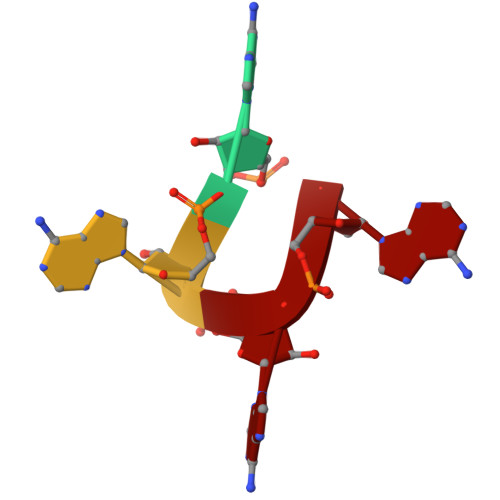
RNA (5'-R(P*AP*AP*AP*A)-3')B [auth a],
C [auth b]
4bacterium
Sequence Annotations
Expand
Reference Sequence

Small Molecules

Ligands 1 Unique
IDChains Name / Formula / InChI Key2D Diagram3D Interactions
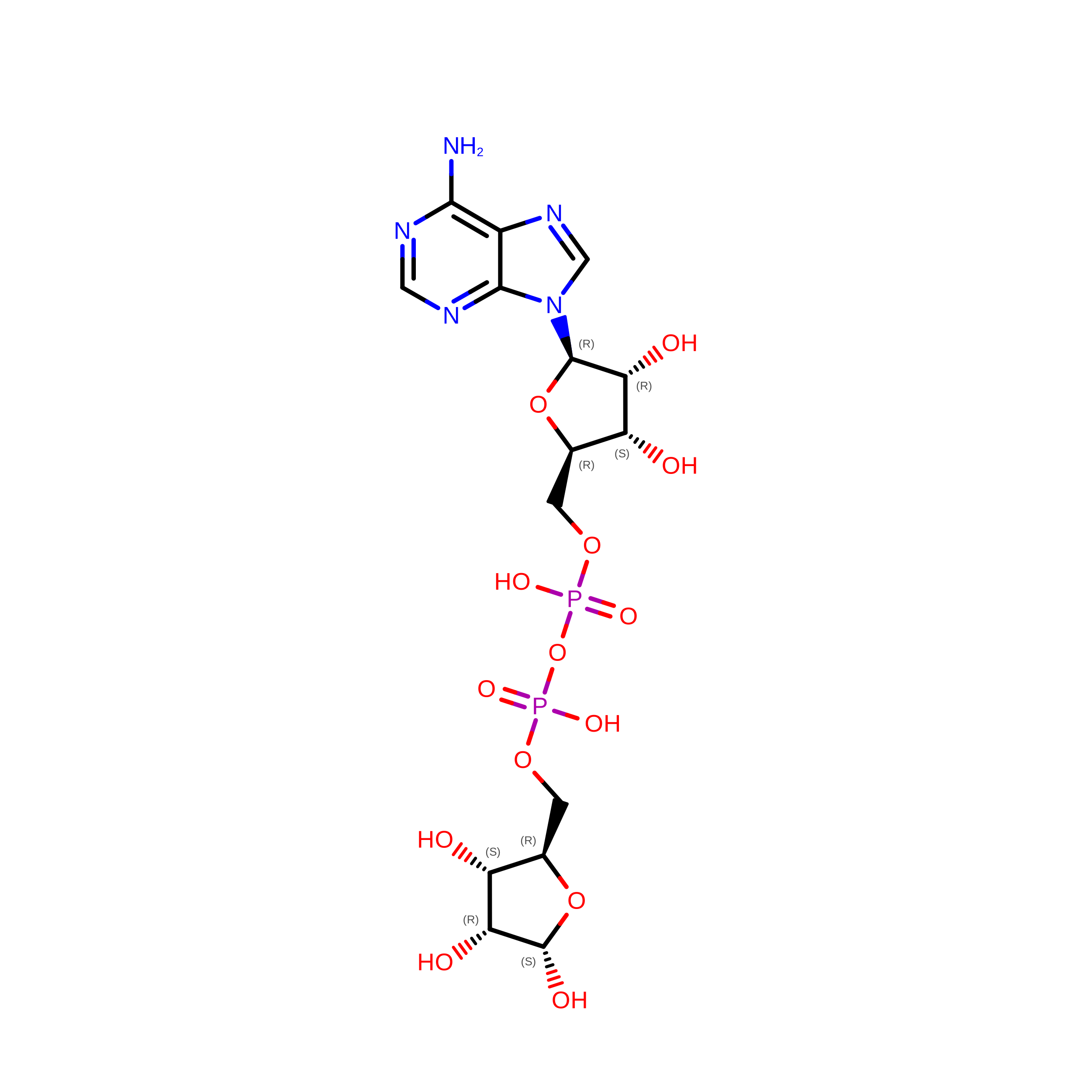
AR6
(Subject of Investigation/LOI)

Query on AR6


Download:Ideal Coordinates CCD File
G [auth B],
H [auth D]
[(2R,3S,4R,5R)-5-(6-AMINOPURIN-9-YL)-3,4-DIHYDROXY-OXOLAN-2-YL]METHYL[HYDROXY-[[(2R,3S,4R,5S)-3,4,5-TRIHYDROXYOXOLAN-2-YL]METHOXY]PHOSPHORYL] HYDROGEN PHOSPHATE
C15 H23 N5 O14 P2
SRNWOUGRCWSEMX-ZQSHOCFMSA-N

Experimental Data & Validation

Experimental Data

  • Method: ELECTRON MICROSCOPY
  • Resolution: 4.00 Å
  • Aggregation State: FILAMENT 
  • Reconstruction Method: SINGLE PARTICLE 
EM Software:
TaskSoftware PackageVersion
MODEL REFINEMENTPHENIX1.20.1_4487:

Structure Validation

View Full Validation Report


Entry History 

& Funding Information

Deposition Data


Funding OrganizationLocationGrant Number
National Institutes of Health/National Cancer Institute (NIH/NCI)United StatesGM129430
National Institutes of Health/National Cancer Institute (NIH/NCI)United StatesGM145888

Revision History  (Full details and data files)

  • Version 1.0: 2025-04-16
    Type: Initial release
  • Version 1.1: 2025-04-23
    Changes: Data collection, Database references
  • Version 1.2: 2025-06-25
    Changes: Data collection, Database references