Download Mendeley
Cryo-EM structure of the conjugation H-pilus reveals the cyclic nature of the TrhA pilin.
Ishimoto, N., Wong, J.L.C., He, S., Shirran, S., Wright-Paramio, O., Seddon, C., Singh, N., Balsalobre, C., Sonani, R.R., Clements, A., Egelman, E.H., Frankel, G., Beis, K.(2025) Proc Natl Acad Sci U S A 122: e2427228122-e2427228122
- PubMed: 40244678 Search on PubMedSearch on PubMed Central
- DOI: https://doi.org/10.1073/pnas.2427228122
- Primary Citation Related Structures:
9HVC, 9MOQ - PubMed Abstract:
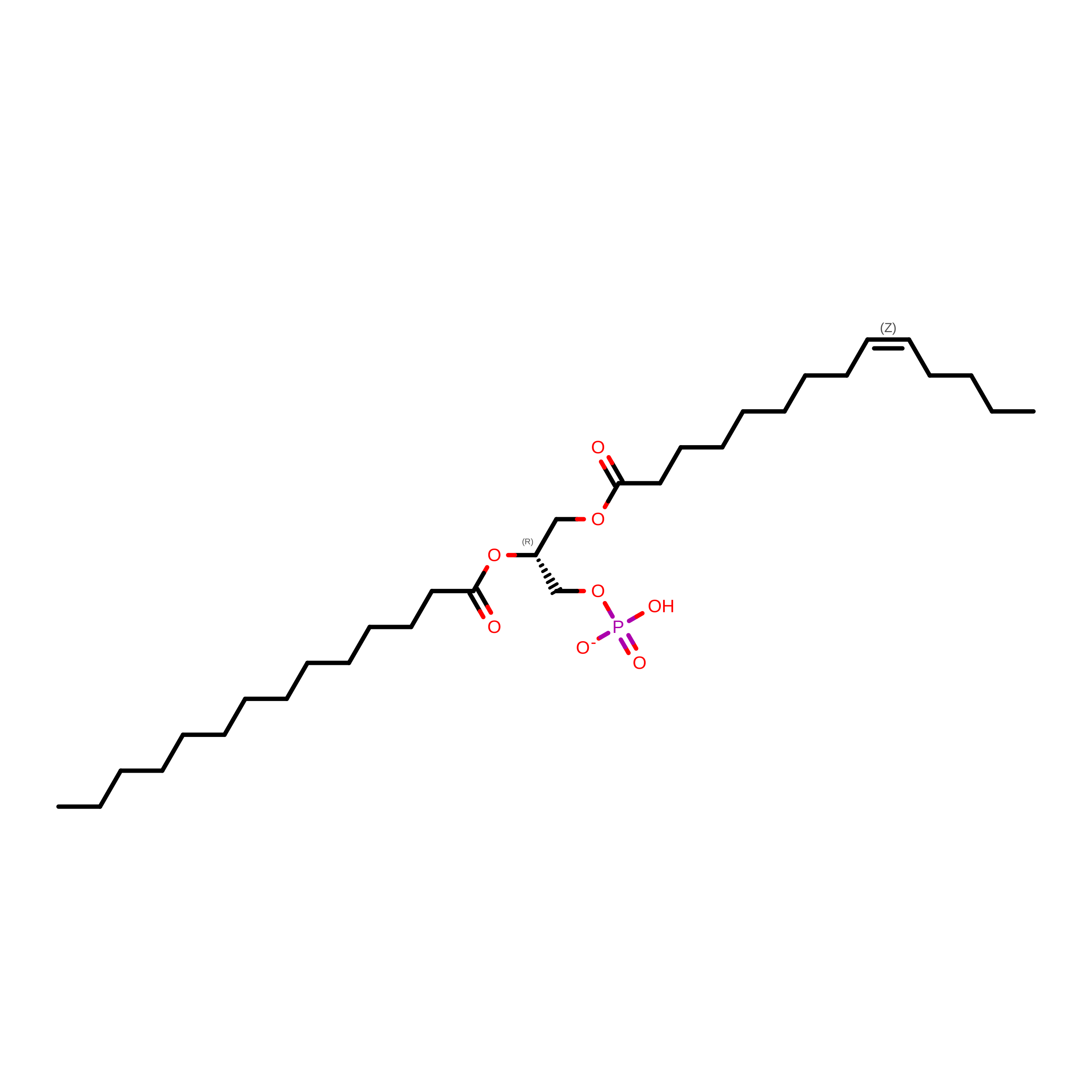
Conjugation, the major driver of the spread of antimicrobial resistance genes, relies on a conjugation pilus for DNA transfer. Conjugative pili, such as the F-pilus, are dynamic tubular structures, composed of a polymerized pilin, that mediate the initial donor-recipient interactions, a process known as mating pair formation (MPF). IncH are low-copy-number plasmids, traditionally considered broad host range, which are found in bacteria infecting both humans and animals. The reference IncHI1 plasmid R27, isolated from Salmonella enterica serovar Typhi, encodes the conjugative H-pilus subunit TrhA containing 74 residues after cleavage of the signal sequence. Here, we show that the H-pilus forms long filamentous structures that mediate MPF and describe its cryoelectron-microscopic (cryo-EM) structure at 2.2 Å resolution. Like the F pilus, the H-pilin subunits form helical assemblies with phospholipid molecules at a stoichiometric ratio of 1:1. While there were previous reports that the T-pilus from Agrobacterium tumefaciens was composed of cyclic subunits, three recent cryo-EM structures of the T-pilus found no such cyclization. Here, we report that the H-pilin is cyclic, with a covalent bond connecting the peptide backbone between the N and C termini. Both the cryo-EM map and mass spectrometry revealed cleavage of the last five residues of the pilin, followed by cyclization via condensation of the amine and carboxyl residues. Mutagenesis experiments revealed that loss of cyclization abolished pilus biogenesis and efficient plasmid transfer. The cyclic nature of the pilin could stabilize the pilus and may explain the high incidence of IncH plasmid dissemination.
- Rutherford Appleton Laboratory, Research Complex at Harwell, Didcot Oxfordshire OX11 0FA, United Kingdom.
Organizational Affiliation: