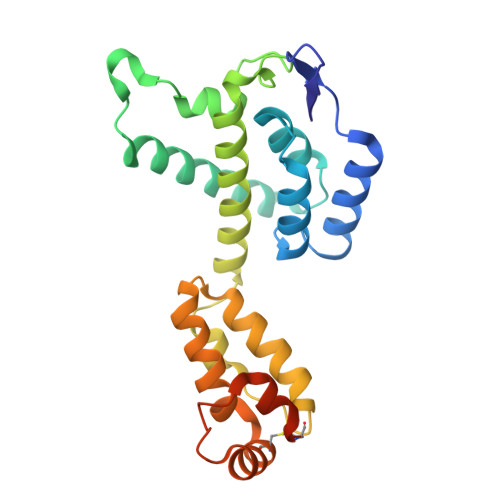
9MKR | pdb_00009mkr

CAEV CA Hexamer Assembled via Liposome Templating


Experimental Data Snapshot

  • Method: ELECTRON MICROSCOPY
  • Resolution: 3.00 Å
  • Aggregation State: PARTICLE 
  • Reconstruction Method: SINGLE PARTICLE 

Starting Model: in silico
View more details

wwPDB Validation 3D Report Full Report

Validation slider image for 9MKR

This is version 1.0 of the entry. See complete history

Literature

Exploring the Structural Divergence of HIV and SRLV Lentiviral Capsids.

Arizaga Jr., F.Freniere, C.Rey, J.S.Cook, M.Wu, C.Perilla, J.R.Xiong, Y.

(2025) J Am Chem Soc 147: 32883-32895

  • DOI: https://doi.org/10.1021/jacs.5c09436
  • Primary Citation Related Structures: 
    9MKP, 9MKQ, 9MKR, 9MKS

  • PubMed Abstract: 

    Lentiviruses require a mature capsid to package and traffic their viral genome for successful infection and propagation. Although the HIV-1 capsid structure has been extensively studied, structural information is lacking for other lentiviral capsids, limiting our understanding. Using cryo-electron microscopy (cryo-EM) and a liposome-templating system, we assembled capsid-like particles (CLPs) and resolved capsid protein (CA) pentamer and hexamer lattice structures from the two major phylogenetic groups of small ruminant lentiviruses (SRLVs). These structures exhibit an overall lattice organization like HIV-1 but differ in key characteristics, notably the absence of inositol hexakisphosphate (IP6) in the SRLV CA lattice─a critical factor for HIV-1 capsid assembly and function. Additionally, SRLV CA pentamers show a unique N-terminal domain orientation, providing insights into SRLV capsid assembly mechanisms. These observations, together with our molecular dynamics (MD) simulation, results suggest a possible mechanism for importing deoxynucleotide triphosphate (dNTP) molecules into SRLV capsids. Furthermore, key regions of host factor interaction, such as the CypA binding motifs, have diverged in the SRLV CA assemblies. Our results contribute to understanding the SRLV lentiviral capsids which may facilitate structure-based inhibitor design strategies.


  • Organizational Affiliation
    • Department of Molecular Biophysics and Biochemistry, Yale University, New Haven, Connecticut 06511, United States.

Macromolecule Content 

  • Total Structure Weight: 25.63 kDa 
  • Atom Count: 1,673 
  • Modeled Residue Count: 214 
  • Deposited Residue Count: 228 
  • Unique protein chains: 1

Macromolecules

Find similar proteins by:|  3D Structure
Entity ID: 1
MoleculeChains  Sequence LengthOrganismDetailsImage
Capsid protein p25228Caprine arthritis encephalitis virus strain CorkMutation(s): 0 
Gene Names: gag
UniProt
Find proteins for P33458 (Caprine arthritis encephalitis virus (strain Cork))
Explore P33458 
Go to UniProtKB:  P33458
Entity Groups
Sequence Clusters30% Identity50% Identity70% Identity90% Identity95% Identity100% Identity
UniProt GroupP33458
Sequence Annotations
Expand
Reference Sequence

Experimental Data & Validation

Experimental Data

  • Method: ELECTRON MICROSCOPY
  • Resolution: 3.00 Å
  • Aggregation State: PARTICLE 
  • Reconstruction Method: SINGLE PARTICLE 
EM Software:
TaskSoftware PackageVersion
MODEL REFINEMENTCoot
RECONSTRUCTIONcryoSPARCv4

Structure Validation

View Full Validation Report


Entry History 

& Funding Information

Deposition Data


Funding OrganizationLocationGrant Number
National Institutes of Health/National Institute Of Allergy and Infectious Diseases (NIH/NIAID)United StatesU54AI170791
National Institutes of Health/National Institute Of Allergy and Infectious Diseases (NIH/NIAID)United StatesR37AI116313
National Institutes of Health/National Institute Of Allergy and Infectious Diseases (NIH/NIAID)United StatesT32GM008283

Revision History  (Full details and data files)

  • Version 1.0: 2025-10-08
    Type: Initial release