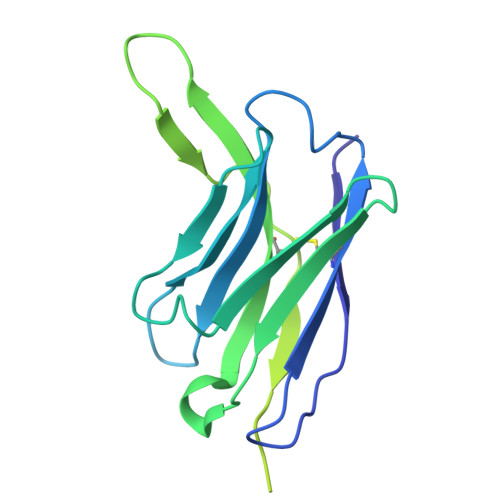
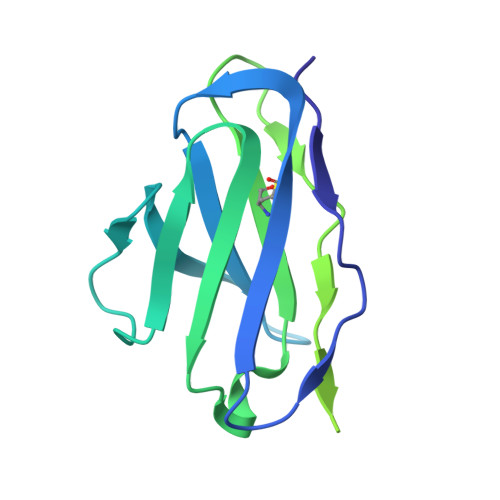
Download Mendeley
Generation of antigen-specific paired-chain antibodies using large language models.
Wasdin, P.T., Johnson, N.V., Janke, A.K., Held, S., Marinov, T.M., Jordaan, G., Gillespie, R.A., Vandenabeele, L., Pantouli, F., Powers, O.C., Vukovich, M.J., Holt, C.M., Kim, J., Hansman, G., Logue, J., Chu, H.Y., Andrews, S.F., Kanekiyo, M., Sautto, G.A., Ross, T.M., Sheward, D.J., McLellan, J.S., Abu-Shmais, A.A., Georgiev, I.S.(2025) Cell 188: 7206
- PubMed: 41192421 Search on PubMedSearch on PubMed Central
- DOI: https://doi.org/10.1016/j.cell.2025.10.006
- Primary Citation Related Structures:
9MKN - PubMed Abstract:
The traditional process of antibody discovery is limited by inefficiency, high costs, and low success rates. Recent approaches employing artificial intelligence (AI) have been developed to optimize existing antibodies and generate antibody sequences in a target-agnostic manner. In this work, we present MAGE (monoclonal antibody generator), a sequence-based protein language model (PLM) fine-tuned for the task of generating paired human variable heavy- and light-chain antibody sequences against targets of interest. We show that MAGE can generate novel and diverse antibody sequences with experimentally validated binding specificity against SARS-CoV-2, an emerging avian influenza H5N1, and respiratory syncytial virus A (RSV-A). MAGE represents a first-in-class model capable of designing human antibodies against multiple targets with no starting template.
- Program in Chemical and Physical Biology, Vanderbilt University Medical Center, Nashville, TN 37232, USA; Center for Computational Microbiology and Immunology, Vanderbilt University Medical Center, Nashville, TN 37232, USA; Vanderbilt Center for Antibody Therapeutics, Vanderbilt University Medical Center, Nashville, TN 37232, USA.
Organizational Affiliation: