9MFY | pdb_00009mfy

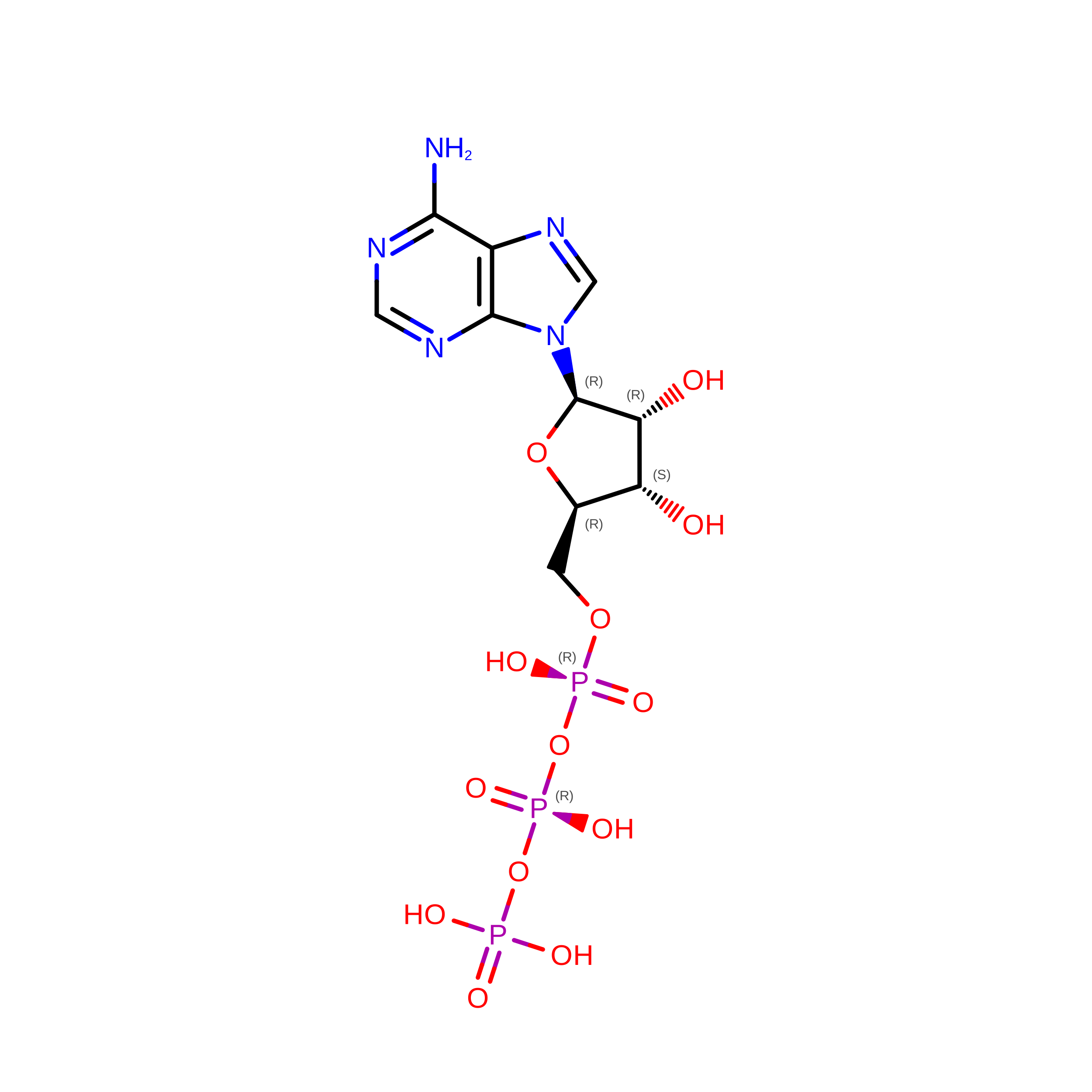
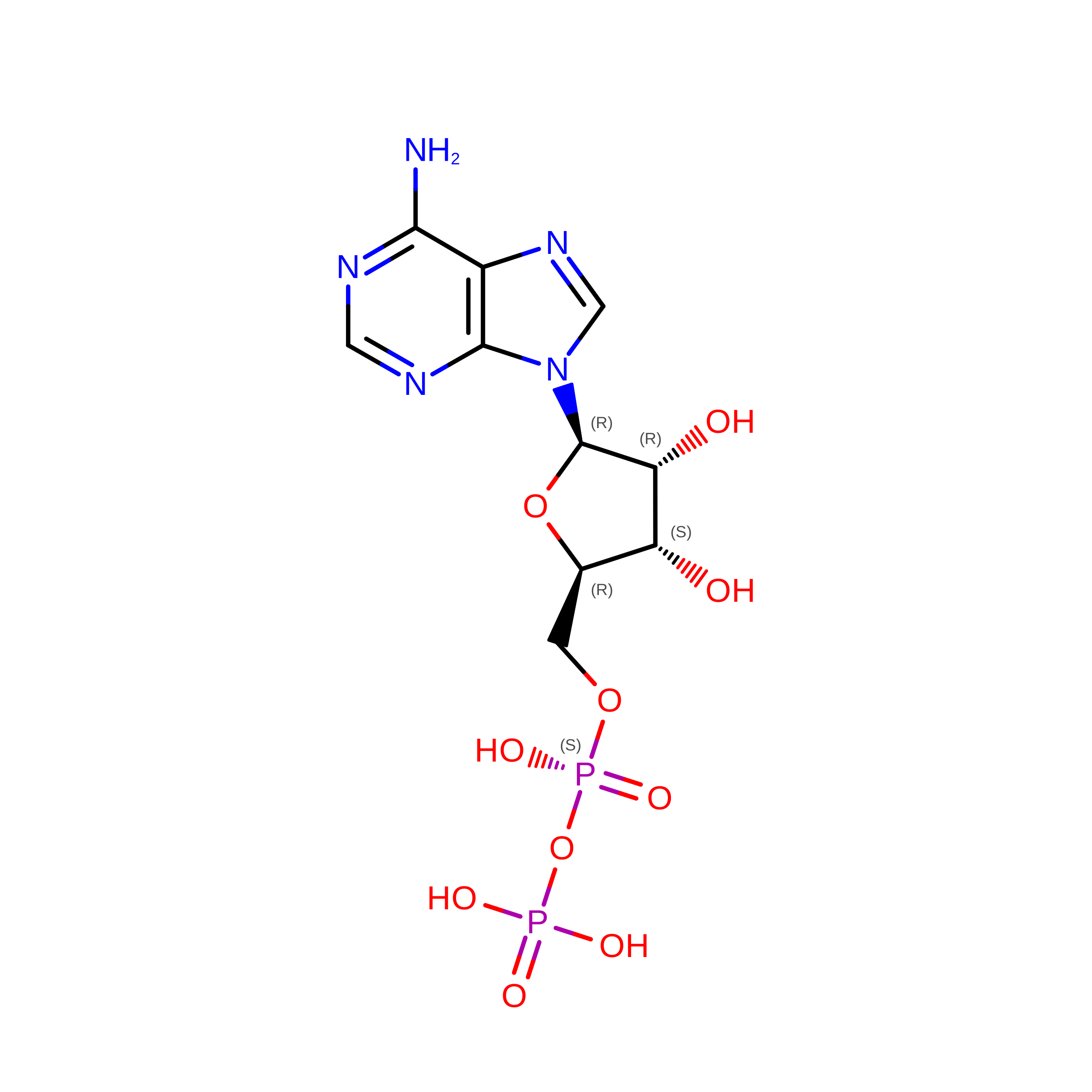
Motor domain-Pac1 complex with ADP AAA1 and Apo AAA3 from yeast full-length dynein-1 and Pac1 in 0.1 mM ATP condition


Experimental Data Snapshot

  • Method: ELECTRON MICROSCOPY
  • Resolution: 3.30 Å
  • Aggregation State: PARTICLE 
  • Reconstruction Method: SINGLE PARTICLE 

wwPDB Validation 3D Report Full Report

Validation slider image for 9MFY

This is version 1.3 of the entry. See complete history

Literature

A nucleotide code governs Lis1's ability to relieve dynein autoinhibition.

Geohring, I.C.Chai, P.Iyer, B.R.Ton, W.D.Yang, J.Ide, A.H.George, S.C.Bagri, J.S.Baird, S.V.Zhang, K.Markus, S.M.

(2026) Nat Chem Biol 22: 649-662

  • DOI: https://doi.org/10.1038/s41589-025-02096-8
  • Primary Citation Related Structures: 
    9MFV, 9MFW, 9MFX, 9MFY

  • PubMed Abstract: 

    Dynein-1 is a microtubule motor that transports numerous cytoplasmic cargoes. Activation of motility requires it first overcome an autoinhibited state before its assembly with dynactin and a cargo adaptor. Studies suggest that Lis1 may relieve dynein's autoinhibited state, although evidence for this is lacking. We first determined the rules governing dynein-Lis1 binding, revealing that their binding affinity is regulated by the nucleotide-bound states of each of three nucleotide-binding pockets within dynein. We also found that distinct nucleotide 'codes' coordinate their binding stoichiometry by impacting binding affinity at two different sites within the dynein motor domain. Electron microscopy revealed that a 1 dynein:1 Lis1 complex directly promotes an uninhibited conformational state of dynein, whereas a 1:2 complex resembles the autoinhibited state. Cryo-electron microscopy revealed that the structural basis for Lis1 opening dynein relies on interactions with the linker domain. Our work reveals the biochemical basis by which Lis1 relieves dynein autoinhibition.


  • Organizational Affiliation
    • Department of Biochemistry and Molecular Biology, Colorado State University, Fort Collins, CO, USA.

Macromolecule Content 

  • Total Structure Weight: 530.3 kDa 
  • Atom Count: 23,892 
  • Modeled Residue Count: 2,939 
  • Deposited Residue Count: 4,586 
  • Unique protein chains: 2

Macromolecules

Find similar proteins by:|  3D Structure
Entity ID: 1
MoleculeChains  Sequence LengthOrganismDetailsImage
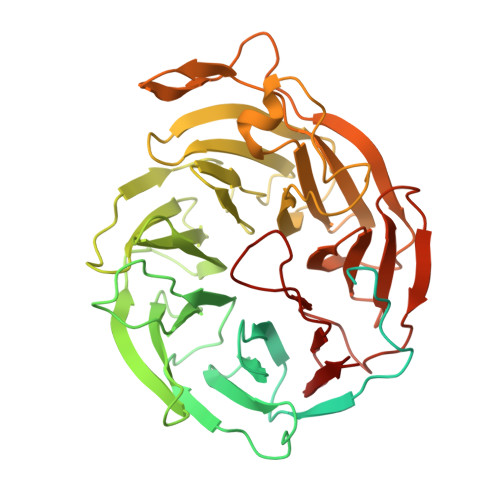
Nuclear distribution protein PAC1A [auth B]494Saccharomyces cerevisiaeMutation(s): 0 
Gene Names: PAC1LIS1YOR269W
UniProt
Find proteins for P39946 (Saccharomyces cerevisiae (strain ATCC 204508 / S288c))
Explore P39946 
Go to UniProtKB:  P39946
Entity Groups
Sequence Clusters30% Identity50% Identity70% Identity90% Identity95% Identity100% Identity
UniProt GroupP39946
Sequence Annotations
Expand
Reference Sequence
Find similar proteins by:|  3D Structure
Entity ID: 2
MoleculeChains  Sequence LengthOrganismDetailsImage
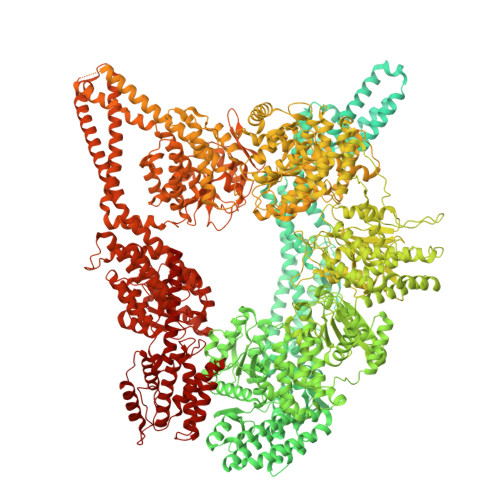
Dynein heavy chain, cytoplasmicB [auth A]4,092Saccharomyces cerevisiaeMutation(s): 0 
Gene Names: DYN1DHC1YKR054C
UniProt
Find proteins for P36022 (Saccharomyces cerevisiae (strain ATCC 204508 / S288c))
Explore P36022 
Go to UniProtKB:  P36022
Entity Groups
Sequence Clusters30% Identity50% Identity70% Identity90% Identity95% Identity100% Identity
UniProt GroupP36022
Sequence Annotations
Expand
Reference Sequence

Experimental Data & Validation

Experimental Data

  • Method: ELECTRON MICROSCOPY
  • Resolution: 3.30 Å
  • Aggregation State: PARTICLE 
  • Reconstruction Method: SINGLE PARTICLE 
EM Software:
TaskSoftware PackageVersion
MODEL REFINEMENTPHENIX
RECONSTRUCTIONcryoSPARC4

Structure Validation

View Full Validation Report


Entry History 

& Funding Information

Deposition Data


Funding OrganizationLocationGrant Number
National Institutes of Health/National Institute of General Medical Sciences (NIH/NIGMS)United StatesR35 GM139483
National Institutes of Health/National Institute of General Medical Sciences (NIH/NIGMS)United StatesR35 GM142959

Revision History  (Full details and data files)

  • Version 1.0: 2025-12-17
    Type: Initial release
  • Version 1.1: 2026-01-28
    Changes: Data collection, Database references
  • Version 1.2: 2026-02-04
    Changes: Data collection, Database references
  • Version 1.3: 2026-04-08
    Changes: Data collection, Database references