9MEU | pdb_00009meu

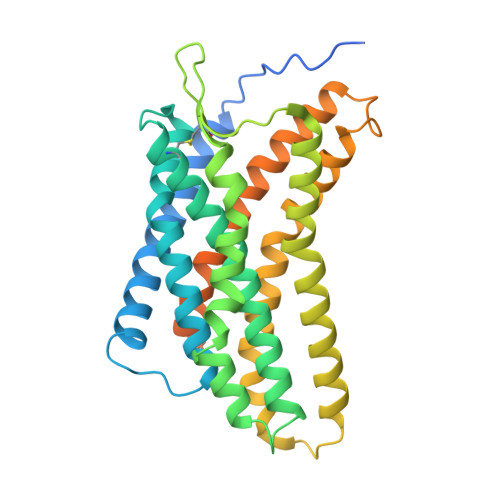
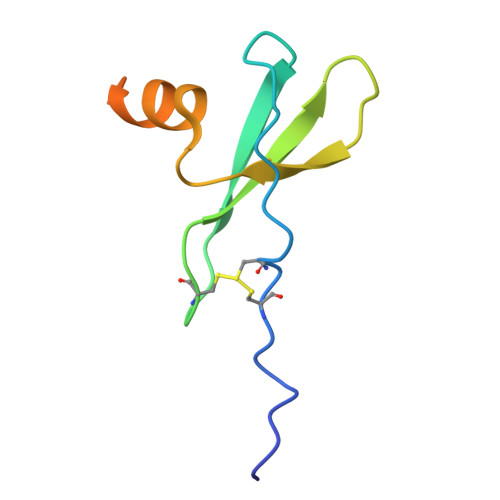
CXCR4 tetramer bound to 4 CXCL12 dimers


Experimental Data Snapshot

  • Method: ELECTRON MICROSCOPY
  • Resolution: 3.46 Å
  • Aggregation State: PARTICLE 
  • Reconstruction Method: SINGLE PARTICLE 

wwPDB Validation   3D Report Full Report


This is version 1.1 of the entry. See complete history


Literature

CXCR4 mediated recognition of HIV envelope spike and inhibition by CXCL12.

Zhang, Z.Zhang, H.Zheng, L.Chen, S.Du, S.Xiao, J.Patel, D.J.

(2025) Nat Commun 16: 8653-8653

  • DOI: https://doi.org/10.1038/s41467-025-63815-2
  • Primary Citation of Related Structures:  
    9ME1, 9MEJ, 9MEN, 9MET, 9MEU

  • PubMed Abstract: 

    CCR5 and CXCR4 both act as HIV co-receptors, though CXCR4 is less explored. CXCR4 binds the chemokine CXCL12 to regulate cellular processes and mediate HIV entry, a process that CXCL12 inhibits. Using cryo-EM, we investigate HIV-2 envelope (Env) spike recognition by CXCR4 and how CXCL12 inhibit this interaction. We discover that CXCR4 unexpected forms a tetramer, both alone and in complex. It binds CXCL12 with 4:8 and 8:8 stoichiometries, with the CXCL12 N-terminus inserting into the CXCR4 pocket. Structures of CXCR4-gp120 HIV-2 complex show one or two gp120 molecules per CXCR4 tetramer, with the V3 loop occupying the major sub-pocket of CXCR4 through deep embedment of its GFKF motif. The CXCL12 N-terminus chashes with gp120 HIV-2 V3 loops, explain its inhibitory effect. Docking analyses of other HIV antagonists further clarify their mechanisms. The CXCR4-gp120 HIV-1 model illustrate how V3 loop residues define co-receptor specificity, offering insights into co-receptor switching and therapeutic design.


  • Organizational Affiliation
    • Structural Biology Program, Memorial Sloan-Kettering Cancer Center, New York, NY, USA. zhangz7@mskcc.org.

Macromolecules
Find similar proteins by:  (by identity cutoff)  |  3D Structure
Entity ID: 1
MoleculeChains Sequence LengthOrganismDetailsImage
C-X-C chemokine receptor type 4A [auth B],
B [auth A],
E [auth C],
F [auth D]
360Homo sapiensMutation(s): 0 
Gene Names: CXCR4
UniProt & NIH Common Fund Data Resources
Find proteins for P61073 (Homo sapiens)
Explore P61073 
Go to UniProtKB:  P61073
PHAROS:  P61073
GTEx:  ENSG00000121966 
Entity Groups  
Sequence Clusters30% Identity50% Identity70% Identity90% Identity95% Identity100% Identity
UniProt GroupP61073
Sequence Annotations
Expand
  • Reference Sequence
Find similar proteins by:  (by identity cutoff)  |  3D Structure
Entity ID: 2
MoleculeChains Sequence LengthOrganismDetailsImage
Stromal cell-derived factor 180Homo sapiensMutation(s): 0 
Gene Names: CXCL12SDF1SDF1ASDF1B
UniProt & NIH Common Fund Data Resources
Find proteins for P48061 (Homo sapiens)
Explore P48061 
Go to UniProtKB:  P48061
PHAROS:  P48061
GTEx:  ENSG00000107562 
Entity Groups  
Sequence Clusters30% Identity50% Identity70% Identity90% Identity95% Identity100% Identity
UniProt GroupP48061
Sequence Annotations
Expand
  • Reference Sequence
Experimental Data & Validation

Experimental Data

  • Method: ELECTRON MICROSCOPY
  • Resolution: 3.46 Å
  • Aggregation State: PARTICLE 
  • Reconstruction Method: SINGLE PARTICLE 
EM Software:
TaskSoftware PackageVersion
MODEL REFINEMENTPHENIX1.20.1_4487

Structure Validation

View Full Validation Report


Entry History & Funding Information

Deposition Data


Funding OrganizationLocationGrant Number
National Institutes of Health/National Cancer Institute (NIH/NCI)United StatesP30 CA008748

Revision History  (Full details and data files)

  • Version 1.0: 2025-09-10
    Type: Initial release
  • Version 1.1: 2026-03-25
    Changes: Data collection, Database references