9M48 | pdb_00009m48

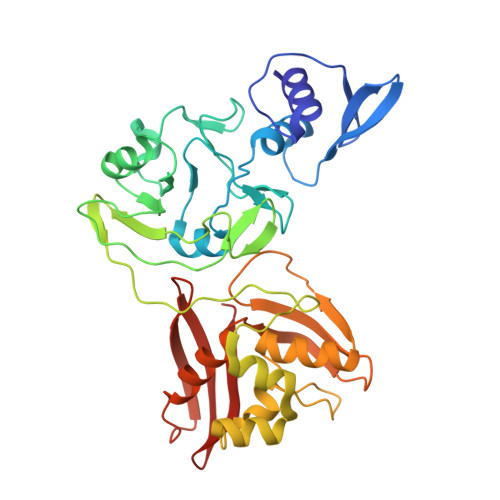
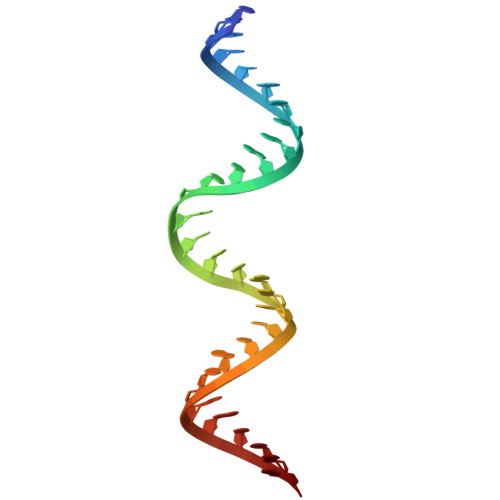
Cryo-EM structure of 6:1 nsp15/dsRNA complex


Experimental Data Snapshot

  • Method: ELECTRON MICROSCOPY
  • Resolution: 2.60 Å
  • Aggregation State: PARTICLE 
  • Reconstruction Method: SINGLE PARTICLE 

wwPDB Validation 3D Report Full Report

Validation slider image for 9M48

This is version 1.1 of the entry. See complete history

Literature

Metal ions govern coronavirus endoribonuclease activity.

Wang, X.Li, J.Liu, Z.Wang, L.Zhu, B.

(2026) Nucleic Acids Res 54

  • DOI: https://doi.org/10.1093/nar/gkaf1508
  • Primary Citation Related Structures: 
    9M48, 9M49

  • PubMed Abstract: 

    Coronavirus nonstructural protein 15 (nsp15) is an endoribonuclease that restricts viral double-stranded RNA (dsRNA) accumulation in the cytosol to evade host immunity. Given the co-localization of nsp15 and replicating viral RNA, the mechanism controlling nsp15 activity is essential, yet poorly understood. Although metal ions are widely used as cofactors for enzymes, their role in nsp15 remains elusive. Here, we show that Co2+ or Ni2+ potently activates, whereas Zn2+ inhibits nsp15 of multiple coronaviruses. In the presence of Co2+, cryo-electron microscopy structures of severe acute respiratory syndrome coronavirus 2 (SARS-CoV-2) nsp15/dsRNA complexes indicate higher dsRNA-binding affinity. Active-site mutation H249A weakens the effects of Co2+, Ni2+, and Zn2+ on SARS-CoV-2 nsp15. Furthermore, the Co2+- or Ni2+-dependent activation of nsp15 is inhibited upon Zn2+ addition, suggesting competitive regulation. Overall, our work identifies the activator and inhibitor ions of nsp15 and suggests a metal-dependent regulatory mechanism of nsp15 activity.


  • Organizational Affiliation
    • Key Laboratory of Molecular Biophysics, the Ministry of Education, College of Life Science and Technology, Huazhong University of Science and Technology, Wuhan430074, China.

Macromolecule Content 

  • Total Structure Weight: 252.47 kDa 
  • Atom Count: 16,978 
  • Modeled Residue Count: 2,051 
  • Deposited Residue Count: 2,138 
  • Unique protein chains: 1
  • Unique nucleic acid chains: 2

Macromolecules


Find similar proteins by:|  3D Structure
Entity ID: 1
MoleculeChains  Sequence LengthOrganismDetailsImage
Uridylate-specific endoribonuclease nsp15
A, B, C, D, E
A, B, C, D, E, F
346Severe acute respiratory syndrome coronavirus 2Mutation(s): 1 
Gene Names: rep1a-1b
EC: 4.6.1
UniProt
Find proteins for P0DTD1 (Severe acute respiratory syndrome coronavirus 2)
Explore P0DTD1 
Go to UniProtKB:  P0DTD1
Entity Groups
Sequence Clusters30% Identity50% Identity70% Identity90% Identity95% Identity100% Identity
UniProt GroupP0DTD1
Sequence Annotations
Expand
Reference Sequence
Find similar nucleic acids by:  (by identity cutoff) 
Entity ID: 2
MoleculeChains LengthOrganismImage
RNA (31-MER)31Severe acute respiratory syndrome coronavirus 2
Sequence Annotations
Expand
Reference Sequence
Find similar nucleic acids by:  (by identity cutoff) 
Entity ID: 3
MoleculeChains LengthOrganismImage
RNA (31-MER)31Severe acute respiratory syndrome coronavirus 2
Sequence Annotations
Expand
Reference Sequence

Small Molecules

Ligands 1 Unique
IDChains Name / Formula / InChI Key2D Diagram3D Interactions
CO
(Subject of Investigation/LOI)

Query on CO


Download:Ideal Coordinates CCD File
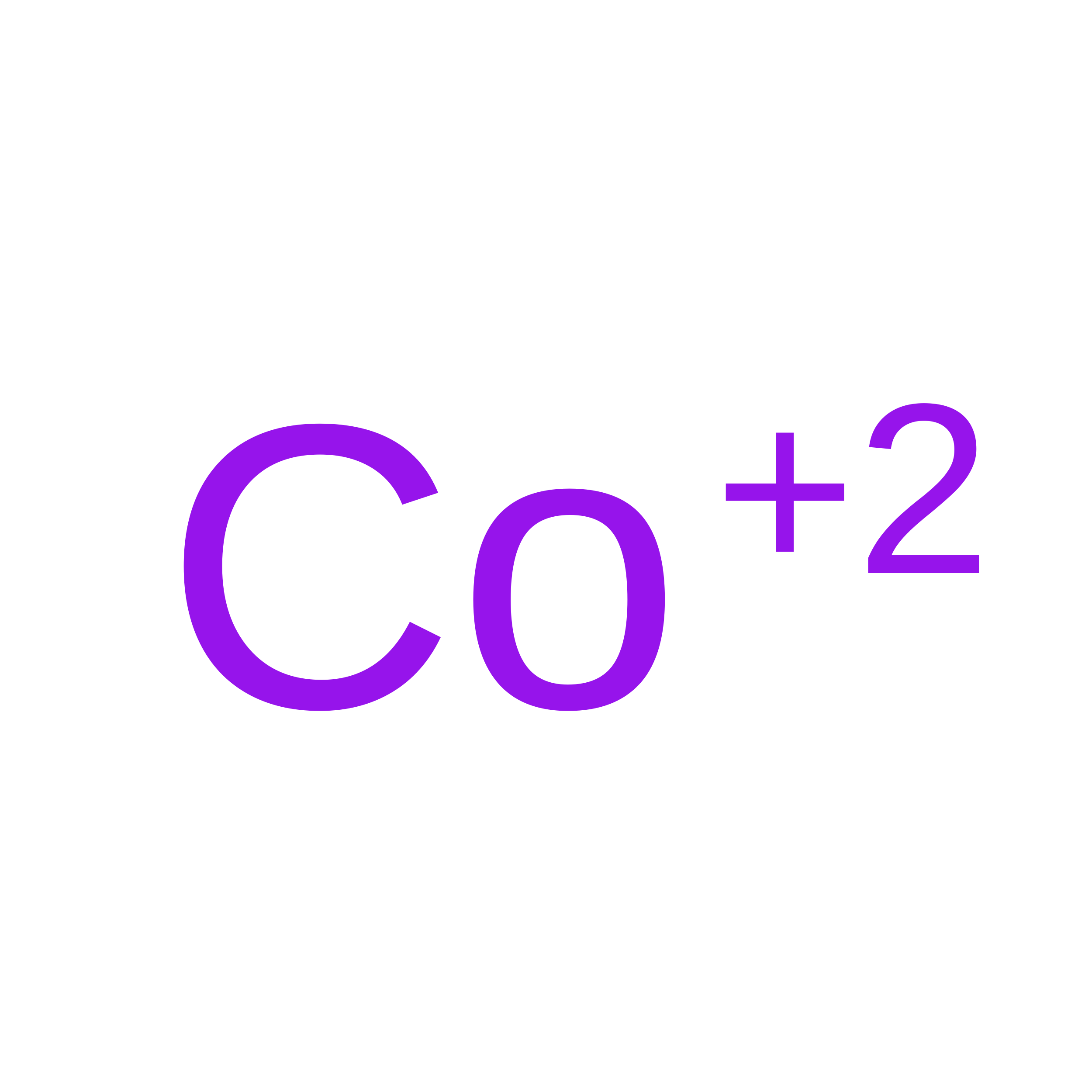
I [auth A]COBALT (II) ION
Co
XLJKHNWPARRRJB-UHFFFAOYSA-N

Experimental Data & Validation

Experimental Data

  • Method: ELECTRON MICROSCOPY
  • Resolution: 2.60 Å
  • Aggregation State: PARTICLE 
  • Reconstruction Method: SINGLE PARTICLE 
EM Software:
TaskSoftware PackageVersion
MODEL REFINEMENTPHENIX

Structure Validation

View Full Validation Report


Entry History 

& Funding Information

Deposition Data


Funding OrganizationLocationGrant Number
Not funded--

Revision History  (Full details and data files)

  • Version 1.0: 2026-02-11
    Type: Initial release
  • Version 1.1: 2026-08-26
    Changes: Data collection, Database references