Download Mendeley
pH Sensitivity of the SERF1a Conformational Ensemble.
Huang, S.Y., Shih, O., Jeng, U.S., Chang, C.F., Lin, J.H., Malliavin, T.E.(2026) ACS Omega 11: 2614-2627
- PubMed: 41585721
- DOI: https://doi.org/10.1021/acsomega.5c07620
- Primary Citation Related Structures:
9M27, 9M2D - PubMed Abstract:
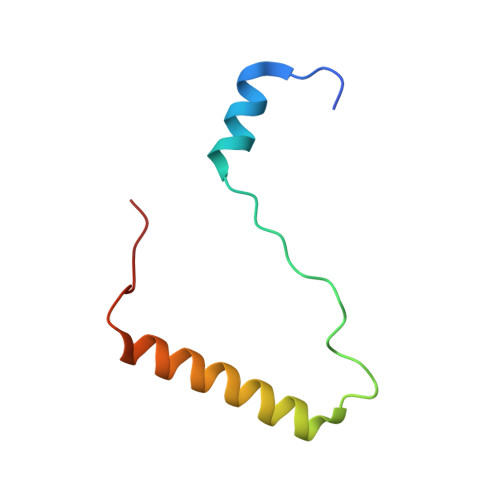
The MOAG-4/SERF class of proteins is a positive regulator of the aggregate formation of amyloid proteins that play an important role in the origin of numerous age-related diseases. In this class of proteins, previous structural studies showed that SERF1a is a very flexible protein, containing at least one α-helical region. The present work proposes the first description of the conformational space of SERF1a at two pH values (6 and 6.8) using nuclear magnetic resonance (NMR) and small-angle X-ray scattering (SAXS). SERF1a NMR conformations have been generated using the CYANA-FLYA procedure as well as the TAiBP (Threading-Augmented interval Branch-and-Prune) procedure, based on the systematic enumeration of protein conformations within an original distance geometry scheme. The generated conformations were filtered using Pepsi-SAXS by fitting small-angle X-ray experiments based on size exclusion chromatography (SEC-SAXS). At pH 6.8, a good fit of the SEC-SAXS curves was obtained for the CYANA and TAiBP NMR conformations, while at pH 6, analysis of the NMR conformations and the SEC-SAXS curves indicated that there could be a conformational exchange between a compact conformation displaying long-range nuclear Overhauser effects (NOEs) between residues LYS-13 and THR-32, and slightly more extended conformations. The shortening of the C-terminal α-helix, as well as the destabilization of the N-terminal α-helix at acidic pH, may be related to the physiological function of SERF1a in the nucleoli. Interestingly, the N-terminal region of SERF1a displays numerous possible binding pockets, particularly in the region interacting with α-synuclein, detected by chemical shift perturbations. In general, the TAiBP procedure allows for a more expanded exploration of the SERF1a conformational space as well as for a description of the internal dynamics of SERF1a in agreement with NMR relaxation and with predictions from the protein primary sequence.
- Research Center for Applied Sciences, Academia Sinica, Taipei 11529, Taiwan.
Organizational Affiliation: