Download Mendeley
Cryo-EM reveals the structural heterogeneity and conformational flexibility of multidrug efflux pumps MdtB and MdtF.
Padmanaban, S., Rencilin, C.F., Biswas, R., Dutta, S.(2026) mBio 17: e0268425-e0268425
- PubMed: 41370088 Search on PubMedSearch on PubMed Central
- DOI: https://doi.org/10.1128/mbio.02684-25
- Primary Citation Related Structures:
9LYJ, 9LYQ - PubMed Abstract:
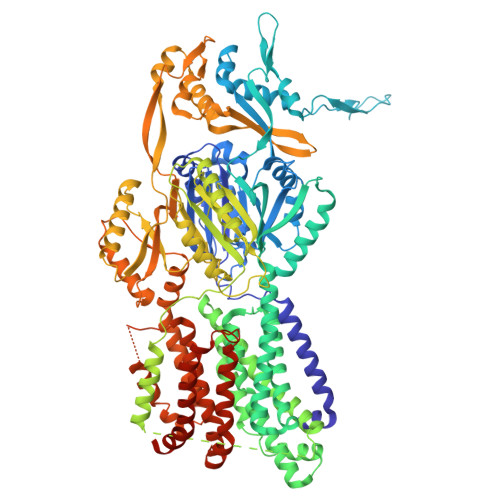
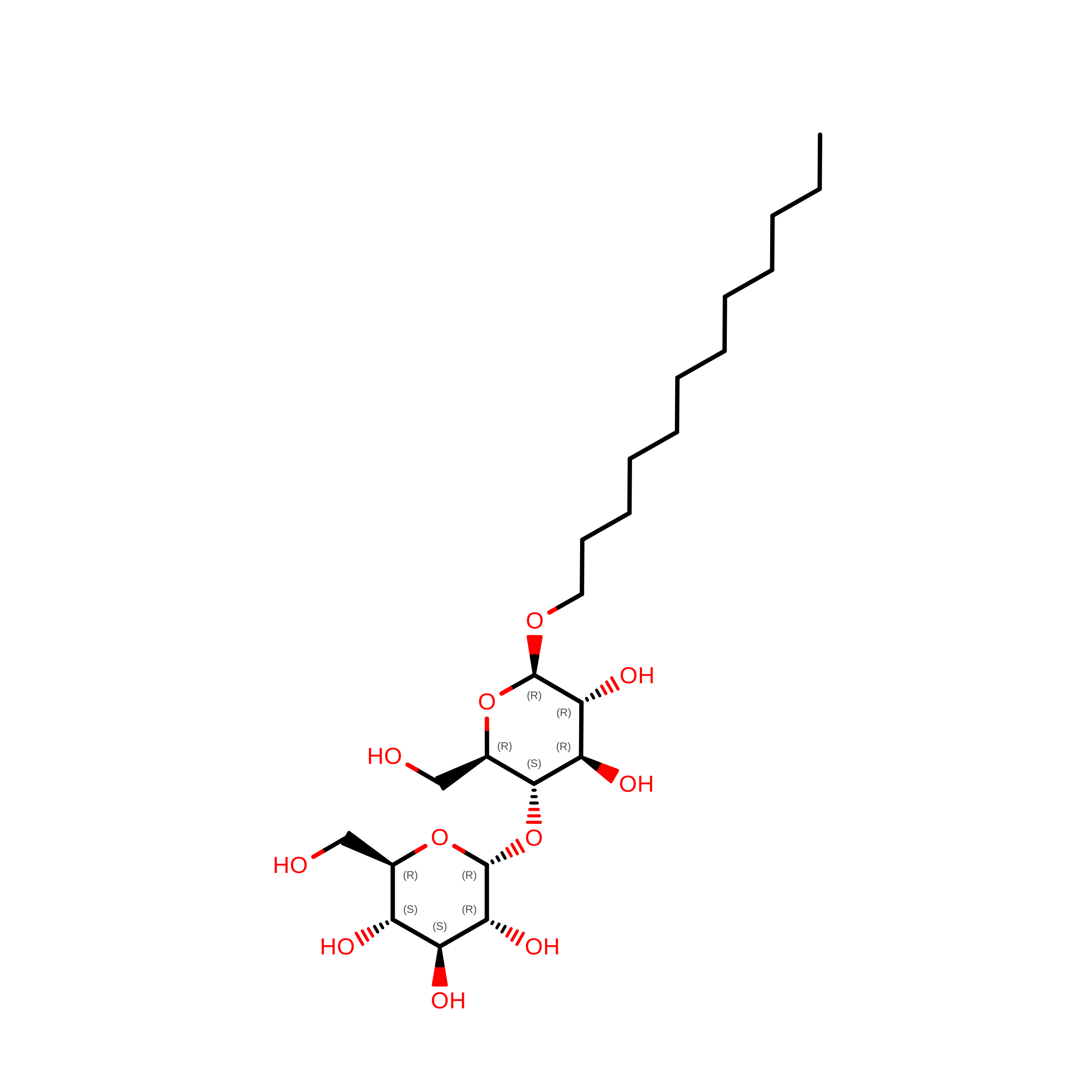
Resistance-nodulation-cell division (RND) efflux pumps are the major cause of multidrug resistance in bacteria, particularly in Gram-negative bacteria. They are complex molecular machines forming tripartite assemblies that actively transport out a wide range of antimicrobial agents, including antibiotics, biocides, and host defense molecules. However, the presence of multiple RND transporters with overlapping functions in a single bacterium raises questions about their individual functional relevance. In this study, we determined the cryo-electron microscopy (cryo-EM) structures of two distinct hydrophobic and amphiphilic efflux (HAE)-RND transporters from Escherichia coli, MdtB and MdtF. MdtB transporter is a part of the two-RND subunit system MdtABC. MdtF is a unique class of RND transporter whose expression is regulated by oxygen availability and is crucial for the survival of E. coli in anaerobic growth conditions. The cryo-EM structures of MdtB and MdtF reveal a novel conformational state of HAE-RND efflux pumps. While the MdtB structure adopts an intermediate state, MdtF displays structural dynamics in the presence of n-dodecyl-β-D-maltoside (DDM). MdtF at 2.8 Å resolution displayed a significant conformational change in the transmembrane core helices and flexibility in the transmembrane domain. Our findings highlight the significance of the novel structural state during the substrate transport mechanism. Furthermore, our structural analysis provides insights into drug-binding sites and the transport mechanism of these important transporters. Resistance-nodulation-cell division (RND) efflux pumps are mainly responsible for multidrug resistance by extruding a wide range of antibiotics from bacterial cells. These pumps are frequently overexpressed in multidrug-resistant Escherichia coli strains, which are responsible for urinary tract infections and foodborne illnesses. In this current study, we resolved the structures of two hydrophobic and amphiphilic efflux (HAE)-RND transporters, MdtB and MdtF, using single-particle cryo-electron microscopy. Our study demonstrated novel structural states of MdtF during substrate transport. This knowledge provides valuable insights into the conformational transitions underlying substrate transport. Understanding these structural mechanisms fills a critical knowledge gap in the RND-mediated efflux process and lays the groundwork for structure-guided inhibitor design. Our findings contribute to ongoing efforts to develop novel therapeutic strategies to combat multidrug-resistant E. coli infections.
- Molecular Biophysics Unit, Indian Institute of Science, Bengaluru, India.
Organizational Affiliation: