Find PDB structures and Computed Structure Models (CSM) by combining queries from tools in this suite: Attribute Search, Sequence Similarity, Sequence Motif, 3D Similarity, and 3D Motif with 'AND' logic.
Severe acute respiratory syndrome coronavirus 2 (SARS-CoV-2) continues to cause significant morbidity and mortality despite the end of its pandemic phase. The emergence of highly mutated SARS-CoV-2 variants of concern highlights the requirement of broad-spectrum antiviral countermeasures which possess both prophylactic and therapeutic efficacies. Here, we obtain a macrocyclic peptide, 6L3-3P11K, that effectively inhibits a wide range of SARS-CoV-2 variants and subvariants. Structural studies show that 6L3-3P11K forms homotrimers that lock the spike protein (S) trimer into a "closed" conformation by engaging a conserved non-receptor binding motif (non-RBM) of S. This interaction disrupts the binding between S and ACE2 receptor. Structure-guided modifications result in a thermostable and trypsin-resistant macrocyclic peptide, 6L3-1F3P11hR, that exhibits prophylactic and therapeutic effects against SARS-CoV-2 infection in a male hACE2 transgenic mouse model after intranasal administration. Our results provide a drug candidate for the control and prevention of COVID-19 and may stimulate further research on macrocyclic broad-spectrum anti-coronavirus drug development.
Organizational Affiliation:
Beijing Life Science Academy, Beijing, China.
Strategic Pandemic Action and Research Center (SPARC), Guangzhou National Laboratory, Guangzhou, China.
Laboratory of Pathogen Microbiology and Immunology, Institute of Microbiology, Chinese Academy of Sciences, Beijing, China.
College of Veterinary Medicine, China Agricultural University, Beijing, China.
State Key Laboratory of Microbial Technology, Institute of Microbial Technology, Shandong University, Qingdao, China.
State Key Laboratory of Emerging Infectious Diseases, Department of Microbiology, Carol Yu Centre for Infection, School of Clinical Medicine, Li Ka Shing Faculty of Medicine, The University of Hong Kong, Hong Kong Special Administrative Region, China.
Centre for Virology, Vaccinology and Therapeutics, Hong Kong Science and Technology Park, Hong Kong Special Administrative Region, China.
HIV Dynamics and Replication Program, Center for Cancer Research, National Cancer Institute, Frederick, MD, USA.
State Key Laboratory of Respiratory Disease, National Clinical Research Centre for Respiratory Disease, National Centre for Respiratory Medicine, Guangzhou Institute of Respiratory Health, The First Affiliated Hospital of Guangzhou Medical University, Guangzhou, China.
Shenzhen Key Laboratory of Pathogen and Immunity, Shenzhen Third People's Hospital, Shenzhen, China.
Medical School, University of Chinese Academy of Sciences, Beijing, China.
Beijing Life Science Academy, Beijing, China. houhw@blsa.com.cn.
State Key Laboratory of Emerging Infectious Diseases, Department of Microbiology, Carol Yu Centre for Infection, School of Clinical Medicine, Li Ka Shing Faculty of Medicine, The University of Hong Kong, Hong Kong Special Administrative Region, China. jfwchan@hku.hk.
Centre for Virology, Vaccinology and Therapeutics, Hong Kong Science and Technology Park, Hong Kong Special Administrative Region, China. jfwchan@hku.hk.
Department of Infectious Disease and Microbiology, The University of Hong Kong-Shenzhen Hospital, Shenzhen, China. jfwchan@hku.hk.
Pandemic Research Alliance Unit at The University of Hong Kong, Hong Kong Special Administrative Region, China. jfwchan@hku.hk.
State Key Laboratory of Microbial Technology, Institute of Microbial Technology, Shandong University, Qingdao, China. yizhenyin.1987@sdu.edu.cn.
Beijing Life Science Academy, Beijing, China. shi_yi01@gzlab.ac.cn.
Strategic Pandemic Action and Research Center (SPARC), Guangzhou National Laboratory, Guangzhou, China. shi_yi01@gzlab.ac.cn.
Laboratory of Pathogen Microbiology and Immunology, Institute of Microbiology, Chinese Academy of Sciences, Beijing, China. shi_yi01@gzlab.ac.cn.
Medical School, University of Chinese Academy of Sciences, Beijing, China. shi_yi01@gzlab.ac.cn.
Health Science Center, Ningbo University, Ningbo, China. shi_yi01@gzlab.ac.cn.
G [auth D], H [auth E], I [auth F], J [auth G], K [auth H],
G [auth D], H [auth E], I [auth F], J [auth G], K [auth H], L [auth I], M [auth J], N [auth K], O [auth L], P [auth M], Q [auth N], R [auth O], S [auth P], T [auth Q], U [auth R]
AA [auth A] BA [auth A] CA [auth A] DA [auth B] EA [auth B]
AA [auth A], BA [auth A], CA [auth A], DA [auth B], EA [auth B], FA [auth B], GA [auth B], HA [auth B], IA [auth B], JA [auth B], KA [auth C], LA [auth C], MA [auth C], NA [auth C], OA [auth C], PA [auth C], QA [auth C], V [auth A], W [auth A], X [auth A], Y [auth A], Z [auth A]
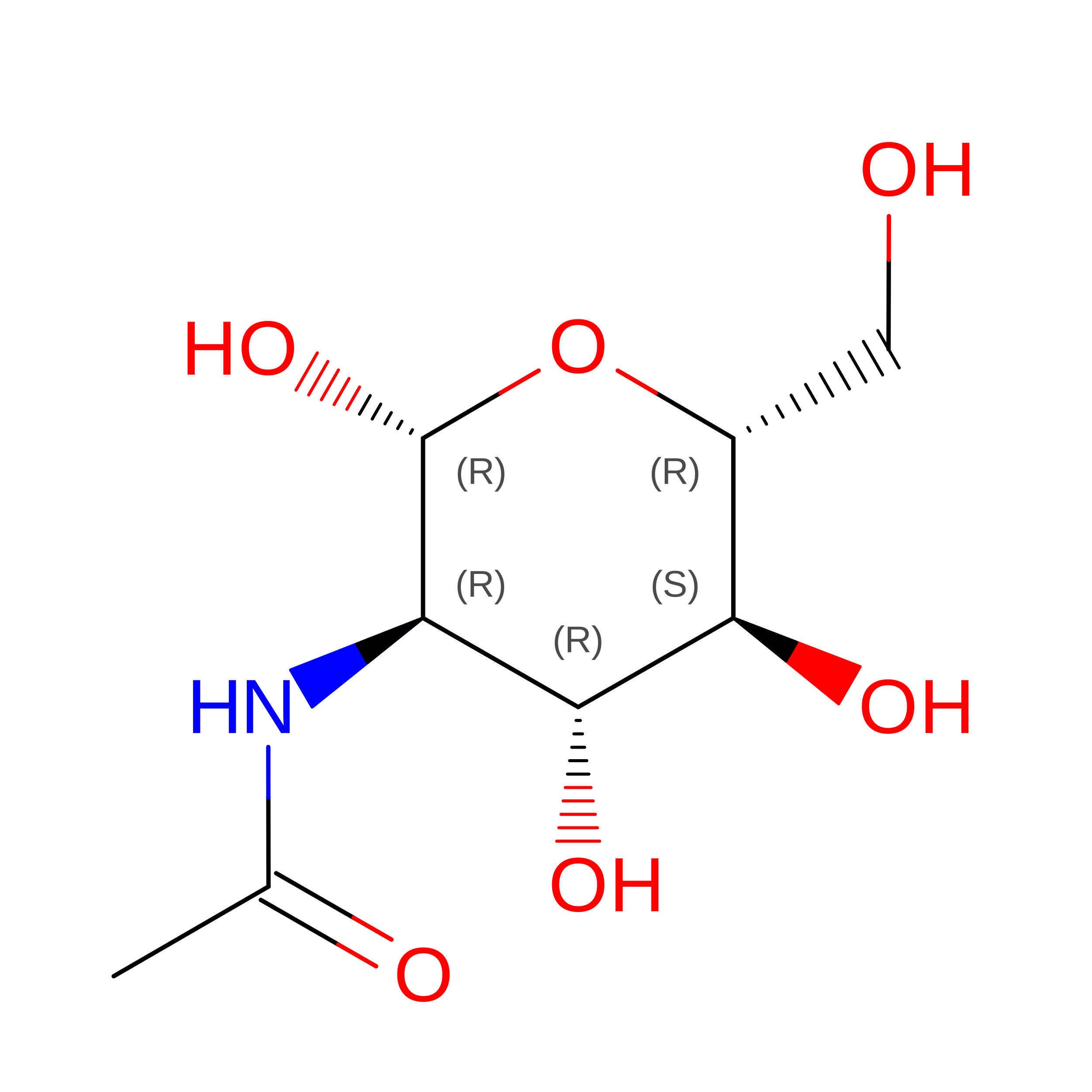
2-acetamido-2-deoxy-beta-D-glucopyranose C8 H15 N O6 OVRNDRQMDRJTHS-FMDGEEDCSA-N

 Download Mendeley