Download Mendeley
Structural basis for the catalytic mechanism of human lipid phosphate phosphatases.
Yang, M., Sun, C., He, Y., Qian, H.(2026) Nat Chem Biol 22: 793-801
- PubMed: 41513850 Search on PubMedSearch on PubMed Central
- DOI: https://doi.org/10.1038/s41589-025-02121-w
- Primary Citation Related Structures:
9L0I, 9L0O, 9L0S, 9L0U, 9VL3 - PubMed Abstract:
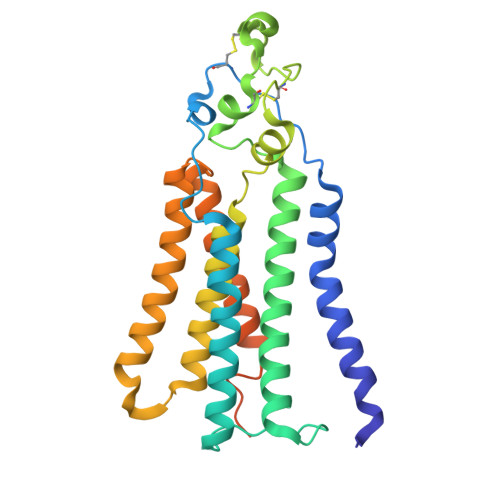
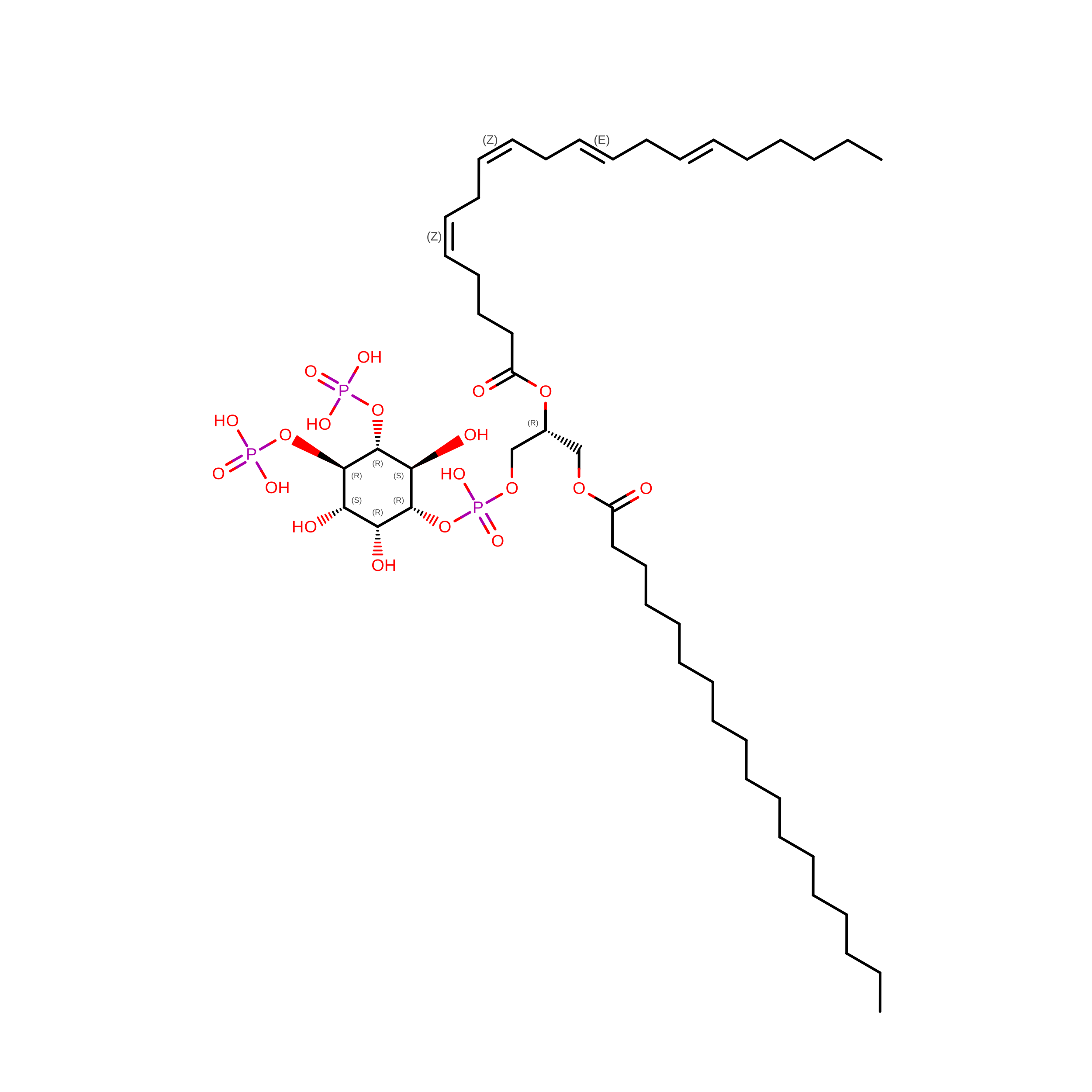
Lipid phosphate phosphatases (LPPs) catalyze the dephosphorylation of a broad range of bioactive lipid phosphates, including lysophosphatidic acid and sphingosine-1-phosphate, playing essential roles in embryonic vasculogenesis, cell differentiation and inflammation. Here we present the cryo-electron microscopic structure of human LPP1 as a tetramer with C4 symmetry. We capture the phosphohistidine intermediate state by using vanadate as a phosphate analog, where vanadate is coordinated by positively charged residues from three conserved motifs (C1, C2 and C3). Structural investigations of LPP1 variants with mutations in two catalytic histidine residues confirm that the histidine in the C2 motif facilitates phosphate bond cleavage. Enzymatic assays validate our structural observations. Additionally, a phosphatidylinositol 4,5-bisphosphate (PIP 2 ) molecule was discovered in the LPP1 structure, underscoring a potential regulatory role for PIP 2 in the catalytic activity of LPP1.
- Department of Cardiology, The First Affiliated Hospital of USTC, MOE Key Laboratory for Membraneless Organelles and Cellular Dynamics, Hefei National Research Center for Interdisciplinary Sciences at the Microscale, Division of Life Sciences and Medicine, University of Science and Technology of China, Hefei, China.
Organizational Affiliation: