Download Mendeley
Molecular mechanisms of SLC30A10-mediated manganese transport.
Shen, X., Zhang, J.K., Sun, P., Zhong, H., He, R., Wang, S., Guo, X., Yang, H.(2025) Nat Commun 16: 8581-8581
- PubMed: 41022720 Search on PubMedSearch on PubMed Central
- DOI: https://doi.org/10.1038/s41467-025-63616-7
- Primary Citation Related Structures:
9KVX, 9KVY, 9KVZ - PubMed Abstract:
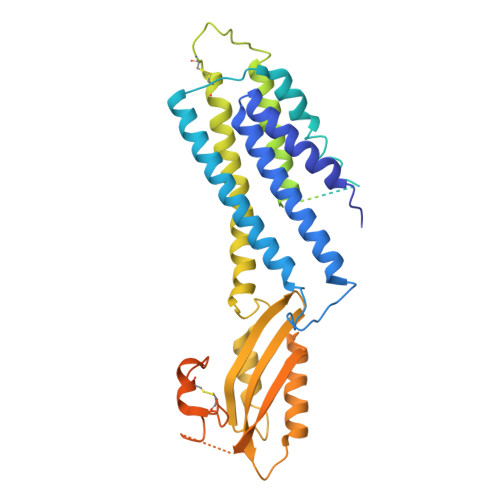
Manganese ion (Mn²⁺) is crucial for various physiological processes, yet excessive levels disrupt cellular homeostasis and impair the function of multiple organelles. The transporter SLC30A10 plays a pivotal role in Mn²⁺ homeostasis by exporting Mn²⁺ from cells, preventing toxic effects. Mutations in the SLC30A10 gene result in Mn²⁺ accumulation and lead to disorders such as hypermanganesemia with dystonia 1 (HMNDYT1). Despite its physiological significance, the structural basis underlying Mn²⁺ binding and the detailed transport mechanisms of SLC30A10 remain unknown. Here, we present diverse conformations of high-resolution cryo-electron microscopy (cryo-EM) structures that reveal a Mn²⁺-binding site in SLC30A10, setting it apart from other SLC30 family transporters. Furthermore, we show that the HMNDYT1-associated D40A mutation interrupts Mn²⁺ binding and transport, identifying D40 as a potential therapeutic target. These findings provide structural insights into Mn²⁺ transport mechanisms mediated by SLC30A10, advancing our understanding of Mn²⁺ binding and potential targets for future therapeutic exploration.
- Zhongshan Hospital, Institute for Translational Brain Research, State Key Laboratory of Brain Function and Disorders, MOE Frontiers Center for Brain Science, Fudan University, Shanghai, 200032, China.
Organizational Affiliation: