Download Mendeley
Structure-Guided Subunit Interface Engineering to Improve the Catalytic Efficiency of Dimeric Enzymes of FAH Family.
Liang, B., Meng, C., Wang, Q., Du, Y., Luo, Y., Zhao, J., Wu, D., Liang, Y., Lu, X., Yang, J.(2025) J Agric Food Chem 73: 32094-32106
- PubMed: 41339057 Search on PubMed
- DOI: https://doi.org/10.1021/acs.jafc.5c09893
- Primary Citation Related Structures:
9KKT, 9KKV - PubMed Abstract:
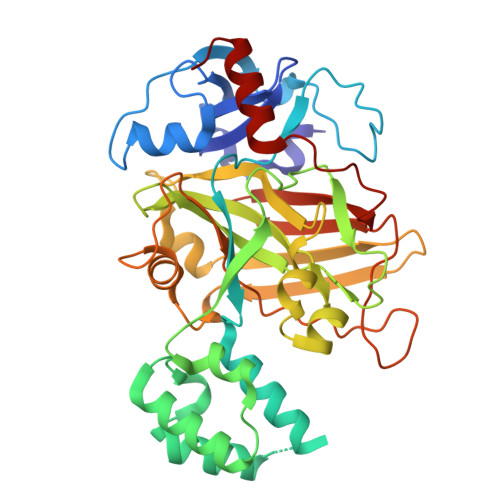
The subunit interface plays a substantial role in the structures and functions of oligomeric enzymes, yet targeted mutations remain difficult to predict. Here, we targeted 2-keto-3-deoxy-d-xylonate dehydratase ( Cc XylX), the rate-limiting catalyst in the Weimberg pathway for d-xylose catabolism and a member of the fumarylacetoacetate hydrolase (FAH) family, which forms a compact homodimer. Guided by its crystal structure, we engineered the dimer interface and obtained triple mutant L210A/P181Q/Q308A, which showed a 6.04-fold increase in catalytic efficiency. Molecular dynamics simulations revealed that moderate enhancement of intersubunit flexibility accelerates substrate binding. When the mutant was coupled with other Weimberg enzymes in a one-pot process, 77% of d-xylose was converted to 56.05 ± 0.39 g/L α-ketoglutaric acid within 6 h. Moreover, this strategy is also applicable to other dimeric enzymes within the FAH family. This study highlights a promising strategy for engineering dimeric enzymes with a higher catalytic efficiency for producing valuable chemicals.
- Energy-rich Compounds Production by Photosynthetic Carbon Fixation Research Center, Shandong Provincial Key Laboratory of Microbial Resource Exploration and Innovative Utilization, College of Life Sciences, Qingdao Agricultural University, Qingdao 266109, China.
Organizational Affiliation: