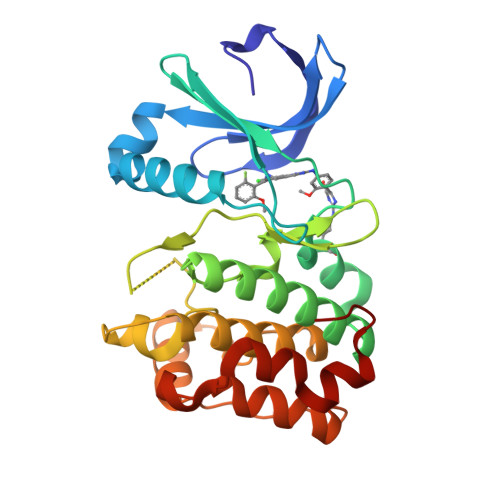
9KDS | pdb_00009kds

The crystal structure of human AURKA kinase domain in complex with RA1


Experimental Data Snapshot

  • Method: X-RAY DIFFRACTION
  • Resolution: 2.50 Å
  • R-Value Free: 
    0.253 (Depositor), 0.270 (DCC) 
  • R-Value Work: 
    0.213 (Depositor), 0.232 (DCC) 
  • R-Value Observed: 
    0.217 (Depositor) 

Starting Model: experimental
View more details

wwPDB Validation   3D Report Full Report


This is version 1.0 of the entry. See complete history


Literature

Cell-Active, Arginine-Targeting Irreversible Covalent Inhibitors for Non-Kinases and Kinases.

Chen, P.Wang, L.Wang, X.Sun, J.Miao, F.Wang, Z.Yang, F.Xiang, M.Gu, M.Li, S.Zhang, J.Yuan, P.Lu, X.Zhang, Z.M.Gao, L.Yao, S.Q.

(2025) Angew Chem Int Ed Engl 64: e202422372-e202422372

  • DOI: https://doi.org/10.1002/anie.202422372
  • Primary Citation of Related Structures:  
    9KDS

  • PubMed Abstract: 

    Targeted covalent inhibitors (TCIs) play an essential role in the fields of kinase research and drug discovery. TCI strategies to target more common amino acid side-chains have yet to be demonstrated. Targeting other amino acids would also expand the pharmaceutical industry's toolbox for targeting other tough-to-drug proteins. We report herein a glyoxal-based, arginine-reactive strategy to generate potent and selective small-molecule TCIs of Mcl-1 (an important anti-apoptotic protein) by selectively targeting the conserved arginine (R263) in the protein. We further validated the generality of this strategy by developing glyoxal-based, irreversible covalent inhibitors of AURKA (a cancer-related kinase) that showed exclusive reactivity with a solvent-exposed arginine (R220) of this enzyme. We showed the resulting compounds were potent, selective and cell-active, capable of covalently engaging endogenous AURKA in MV-4-11 cells with long residence time. Finally, we showed the potential application of glyoxal-based TCIs in targeting an acquired drug-resistance mutant of ALK kinase (G1202R).


  • Organizational Affiliation
    • Department of Chemistry, National University of Singapore, Singapore, 117543, Singapore.

Macromolecules
Find similar proteins by:  (by identity cutoff)  |  3D Structure
Entity ID: 1
MoleculeChains Sequence LengthOrganismDetailsImage
Aurora kinase A266Homo sapiensMutation(s): 1 
Gene Names: AURKAAIKAIRK1ARK1AURAAYK1BTAKIAK1STK15STK6
EC: 2.7.11.1
UniProt & NIH Common Fund Data Resources
Find proteins for O14965 (Homo sapiens)
Explore O14965 
Go to UniProtKB:  O14965
PHAROS:  O14965
GTEx:  ENSG00000087586 
Entity Groups  
Sequence Clusters30% Identity50% Identity70% Identity90% Identity95% Identity100% Identity
UniProt GroupO14965
Sequence Annotations
Expand
  • Reference Sequence
Small Molecules
Modified Residues  1 Unique
IDChains TypeFormula2D DiagramParent
A1EFT
Query on A1EFT
A
L-PEPTIDE LINKINGC34 H32 Cl F N8 O5ARG
Experimental Data & Validation

Experimental Data

  • Method: X-RAY DIFFRACTION
  • Resolution: 2.50 Å
  • R-Value Free:  0.253 (Depositor), 0.270 (DCC) 
  • R-Value Work:  0.213 (Depositor), 0.232 (DCC) 
  • R-Value Observed: 0.217 (Depositor) 
Space Group: P 61 2 2
Unit Cell:
Length ( Å )Angle ( ˚ )
a = 81.943α = 90
b = 81.943β = 90
c = 172.904γ = 120
Software Package:
Software NamePurpose
PHENIXrefinement
Cootmodel building
HKL-3000data reduction
HKL-3000data scaling
PHASERphasing

Structure Validation

View Full Validation Report


Entry History & Funding Information

Deposition Data


Funding OrganizationLocationGrant Number
Not funded--

Revision History  (Full details and data files)

  • Version 1.0: 2025-10-22
    Type: Initial release