Download Mendeley
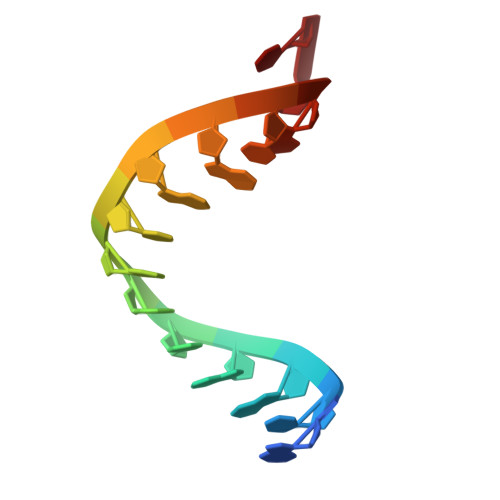
Small CAG Repeat RNA Forms a Duplex Structure with Sticky Ends That Promote RNA Condensation.
Wan, L., Zhang, C., Liu, Y., Zhang, J., He, L., Zhang, Y., Chen, G., Guo, P., Han, D.(2025) J Am Chem Soc 147: 3813-3822
- PubMed: 39807887 Search on PubMed
- DOI: https://doi.org/10.1021/jacs.4c16886
- Primary Citation Related Structures:
9KAD - PubMed Abstract:
Biomolecular condensation lays the foundation of forming biologically important membraneless organelles, but abnormal condensation processes are often associated with human diseases. Ribonucleic acid (RNA) plays a critical role in the formation of biomolecular condensates by mediating the phase transition through its interactions with proteins and other RNAs. However, the physicochemical principles governing RNA phase transitions, especially for short RNAs, remain inadequately understood. Here, we report that small CAG repeat (sCAG) RNAs composed of six to seven CAG repeats, which are pathogenic factors in Huntington's disease, undergo phase transition in vitro and in cells. Leveraging solution nuclear magnetic resonance spectroscopy and advanced coarse-grained molecular dynamic simulations, we reveal that sCAG RNAs form duplex structures with 3'-sticky ends, where the GC stickers initiate intermolecular crosslinking and promote the formation of RNA condensates. Furthermore, we demonstrate that sCAG RNAs can form cellular condensates within nuclear speckles. Our work suggests that the RNA phase transition can be promoted by specific structural motifs, reducing the reliance on sequence length and multivalence. This opens avenues for exploring new functions of RNA in biomolecular condensates and designing novel biomaterials based on RNA condensation.
- Hangzhou Institute of Medicine, Chinese Academy of Sciences, Hangzhou, Zhejiang 310022, China.
Organizational Affiliation: