Download Mendeley
Characterization of the phage Phi K64 depolymerase S2-4 and its therapeutic effect against K1 serotype Klebsiella pneumoniae.
Zhao, R., Du, T., Ji, Y., Ren, Z., Jiang, S., Ru, H., Gu, J.(2026) Microbiol Res 307: 128475-128475
- PubMed: 41702136 Search on PubMed
- DOI: https://doi.org/10.1016/j.micres.2026.128475
- Primary Citation Related Structures:
9K4A, 9K4B - PubMed Abstract:
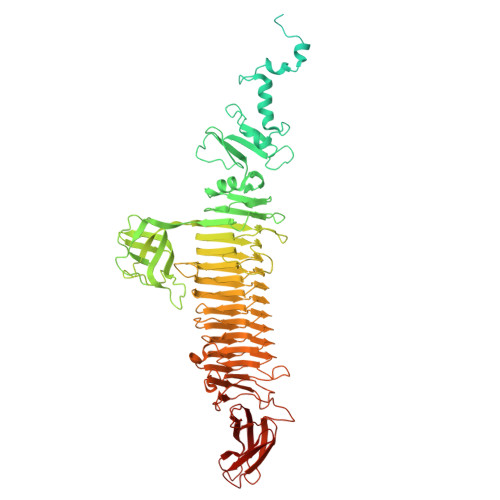
The infection rate and drug resistance of Klebsiella pneumoniae containing capsular polysaccharides (CPSs) have been increasing annually, resulting in severe human and animal infections. Depolymerases derived from bacteriophages can degrade CPSs and thus hold potential for treating bacterial infections. However, little is known about the mechanism by which K. pneumoniae phage depolymerases hydrolyze CPSs. In this study, the S2-4 encoded by the phage ΦK64 was identified as a potent depolymerase against K1 serotype Klebsiella CPSs. Cryo-electron microscopy structural analysis revealed that S2-4 forms a homotrimer with a spindle-like structure comprising a particle-binding domain, a core receptor-binding domain, an insertion domain, and a C-terminal domain. The results of structural assays suggest that S2-4 possesses multiple catalytic centers, which may contribute to its potent depolymerase activity. S2-4 inhibited K. pneumoniae biofilm formation, disrupted preformed biofilms, and enhanced macrophage adhesion and phagocytosis in depolymerase-treated bacteria. In a murine model, a single dose of 5 µg of S2-4 provided full protection against bacterial infection, underscoring the potent depolymerase activity of S2-4. These results indicate that S2-4 is a potent depolymerase against K1 serotype Klebsiella CPSs and has the potential to be a promising candidate for the clinical control of K. pneumoniae infections.
- State Key Laboratory for Diagnosis and Treatment of Severe Zoonotic Infectious Diseases, Key Laboratory of Zoonosis Research of the Ministry of Education, Institute of Zoonosis, and College of Veterinary Medicine, Jilin University, Changchun 130062, PR China.
Organizational Affiliation: