9JRY | pdb_00009jry

Crystal structure of FiDCB, a dual-cysteine cyanobacterial phytochrome of Fischerella sp. PCC 9605


Experimental Data Snapshot

  • Method: X-RAY DIFFRACTION
  • Resolution: 3.35 Å
  • R-Value Free: 
    0.297 (Depositor), 0.296 (DCC) 
  • R-Value Work: 
    0.280 (Depositor), 0.280 (DCC) 
  • R-Value Observed: 
    0.282 (Depositor) 

Starting Model: experimental
View more details

wwPDB Validation 3D Report Full Report

Validation slider image for 9JRY

Ligand Structure Quality Assessment 


This is version 1.1 of the entry. See complete history

Literature

Dual-Cys bacteriophytochromes: intermediates in cyanobacterial phytochrome evolution?

Yang, H.W.Song, J.Y.Song, J.J.Kim, Y.W.Rockwell, N.C.Kim, W.Kim, H.Lagarias, J.C.Park, Y.I.

(2025) FEBS J 292: 1197-1216

  • DOI: https://doi.org/10.1111/febs.17395
  • Primary Citation Related Structures: 
    9JRY

  • PubMed Abstract: 

    Previous studies have identified three families of knotted phytochrome photoreceptors in cyanobacteria. We describe a fourth type: 'hybrid' phytochromes with putative bilin-binding cysteine residues in both their N-terminal 'knot' extensions and cGMP-phosphodiesterase/adenylate cyclase/FhlA (GAF) domains, which we designate as dual-cysteine bacteriophytochromes (DCBs). Recombinant expression of DCBs in Escherichia coli yields photoactive phycocyanobilin (PCB) adducts with red/far-red photocycles similar to those of the GAF-Cys-containing cyanobacterial phytochromes (Cph1s). Incorporation of the PCB precursor, biliverdin IXα (BV), gave multiple populations, one of which appears similar to those of cyanobacterial bacteriophytochromes (cBphPs). A crystal structure of FiDCB bound to BV exhibits two thioether linkages between the GAF- and 'PAS-knot'-Cys residues and the C3 1 and C3 2 atoms of BV. When expressed in Synechocystis sp. PCC 6803, DCBs incorporate PCB rather than BV. DCBs can be converted to photoactive cBphP-, Cph1-, and tandem-cysteine cyanobacterial phytochrome (TCCP) analogs by removal and/or addition of a cysteine residue by site-directed mutagenesis. This structural plasticity contrasts with our inability to generate functional photosensor analogs by analogous site-directed mutagenesis of TCCP and Cph1 representatives. Phylogenetic analysis demonstrates that DCBs do not form a monophyletic clade and also suggest that Cph1 and TCCP families independently emerged from different lineages of cBphPs, possibly via DCB intermediates.


  • Organizational Affiliation
    • Department of Biological Sciences, Chungnam National University, Daejeon, Korea.

Macromolecule Content 

  • Total Structure Weight: 120.31 kDa 
  • Atom Count: 7,430 
  • Modeled Residue Count: 914 
  • Deposited Residue Count: 1,042 
  • Unique protein chains: 1

Macromolecules

Find similar proteins by:|  3D Structure
Entity ID: 1
MoleculeChains  Sequence LengthOrganismDetailsImage
FiDCB
A, B
521Fischerella sp. PCC 9605Mutation(s): 0 
EC: 2.7.13.3
UniProt
Find proteins for Q9R6X3 (Nostoc sp. (strain PCC 7120 / SAG 25.82 / UTEX 2576))
Explore Q9R6X3 
Go to UniProtKB:  Q9R6X3
Entity Groups
Sequence Clusters30% Identity50% Identity70% Identity90% Identity95% Identity100% Identity
UniProt GroupQ9R6X3
Sequence Annotations
Expand
Reference Sequence

Small Molecules

Ligands 1 Unique
IDChains Name / Formula / InChI Key2D Diagram3D Interactions
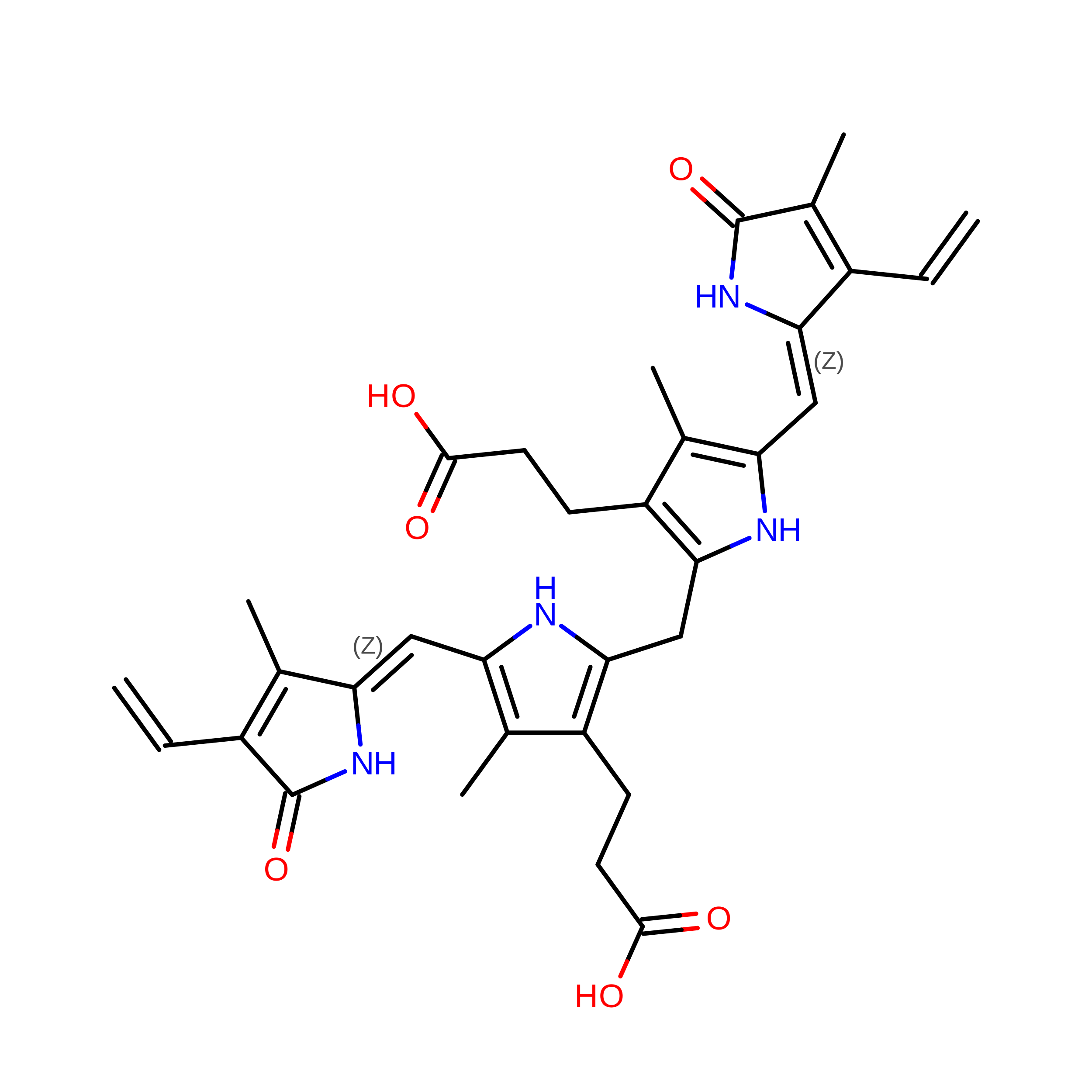
BLR
(Subject of Investigation/LOI)

Query on BLR


Download:Ideal Coordinates CCD File
C [auth A],
D [auth B]
3-[5-[(Z)-(4-ethenyl-3-methyl-5-oxidanylidene-pyrrol-2-ylidene)methyl]-2-[[5-[(Z)-(3-ethenyl-4-methyl-5-oxidanylidene-pyrrol-2-ylidene)methyl]-3-(3-hydroxy-3-oxopropyl)-4-methyl-1H-pyrrol-2-yl]methyl]-4-methyl-1H-pyrrol-3-yl]propanoic acid
C33 H36 N4 O6
BPYKTIZUTYGOLE-IFADSCNNSA-N

Experimental Data & Validation

Experimental Data

  • Method: X-RAY DIFFRACTION
  • Resolution: 3.35 Å
  • R-Value Free:  0.297 (Depositor), 0.296 (DCC) 
  • R-Value Work:  0.280 (Depositor), 0.280 (DCC) 
  • R-Value Observed: 0.282 (Depositor) 
Space Group: C 1 2 1
Unit Cell:
Length ( Å )Angle ( ˚ )
a = 104.551α = 90
b = 147.131β = 99.145
c = 88.076γ = 90
Software Package:
Software NamePurpose
PHENIXrefinement
HKL-3000data reduction
HKL-3000data scaling
PHENIXphasing

Structure Validation

View Full Validation Report


Ligand Structure Quality Assessment 


Entry History 

& Funding Information

Deposition Data


Funding OrganizationLocationGrant Number
Other governmentKGM1002311
National Research Foundation (NRF, Korea)Korea, Republic Of2020M3A9G710393422

Revision History  (Full details and data files)

  • Version 1.0: 2025-01-22
    Type: Initial release
  • Version 1.1: 2025-03-19
    Changes: Database references