9JRN | pdb_00009jrn

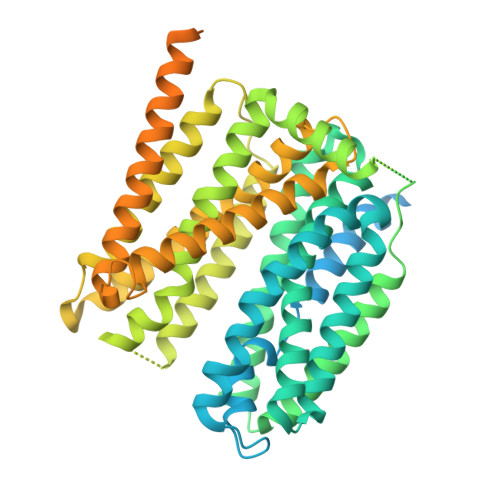
outward-open hSLC19A1 + TPP


Experimental Data Snapshot

  • Method: ELECTRON MICROSCOPY
  • Resolution: 3.74 Å
  • Aggregation State: PARTICLE 
  • Reconstruction Method: SINGLE PARTICLE 

wwPDB Validation 3D Report Full Report

Validation slider image for 9JRN

This is version 1.2 of the entry. See complete history. 

Literature

Molecular basis of SLC19A1-mediated folate and cyclic dinucleotide transport.

Zhang, Q., Zhang, X., Liu, K., Zhu, Y., Nie, X., Ma, J., Sun, P., Li, Z., Gao, Y., Liu, S., Gao, A., Zhang, L., Gao, P.

(2025) Nat Commun 16: 3146-3146

  • DOI: https://doi.org/10.1038/s41467-025-58378-1
  • Primary Citation Related Structures: 
    9JOZ, 9JRI, 9JRK, 9JRL, 9JRM, 9JRN

  • PubMed Abstract: 

    The solute carrier protein SLC19A1 is crucial for transporting folate nutrients, antifolate chemotherapeutics, and more recently cyclic dinucleotides (CDNs) immune transmitters, influencing various physiological and pathological processes. While the inward-open state of human SLC19A1 (hSLC19A1) has been previously described, key aspects regarding its conformational dynamics, substrate selectivity, and precise mechanisms underlying CDNs transport remain elusive. Using an antibody-facilitated conformation screening strategy, we present cryo-electron microscopy structures of hSLC19A1 in its outward-open state with and without bound substrates, revealing detailed mechanisms of substrate recognition and conformational changes during transport. We identify both general and specific features for folate/antifolate recognition, including an SLC19A1-specific pocket for accommodating γ-carboxylate-modified antifolates. Intriguingly, CDNs bind as monomers within the canonical pocket of outward-open hSLC19A1, contrasting with dimeric binding in inward-open structures. Together with functional assays, these findings provide a framework for developing antifolate drugs and CDN-targeted therapies, advancing our understanding of SLC19A1's physiological and therapeutic functions.


  • Organizational Affiliation: 
    • Key Laboratory of Molecular Medicine and Biotherapy, Aerospace Center Hospital, School of Life Science, Beijing Institute of Technology, Beijing, China.

Macromolecule Content 

  • Total Structure Weight: 77.91 kDa 
  • Atom Count: 3,129 
  • Modeled Residue Count: 386 
  • Deposited Residue Count: 690 
  • Unique protein chains: 1

Macromolecules

Find similar proteins by:|  3D Structure
Entity ID: 1
MoleculeChains  Sequence LengthOrganismDetailsImage
Soluble cytochrome b562,Reduced folate transporter,fusion protein690Escherichia coli, Homo sapiensMutation(s): 0 
Gene Names: cybC, SLC19A1, FLOT1, RFC1
Membrane Entity: Yes 
UniProt & NIH Common Fund Data Resources
Find proteins for P41440 (Homo sapiens)
Explore P41440 
Go to UniProtKB:  P41440
PHAROS:  P41440
GTEx:  ENSG00000173638 
Entity Groups
Sequence Clusters30% Identity50% Identity70% Identity90% Identity95% Identity100% Identity
UniProt GroupP41440
Sequence Annotations
Expand
Reference Sequence

Small Molecules

Ligands 1 Unique
IDChains Name / Formula / InChI Key2D Diagram3D Interactions
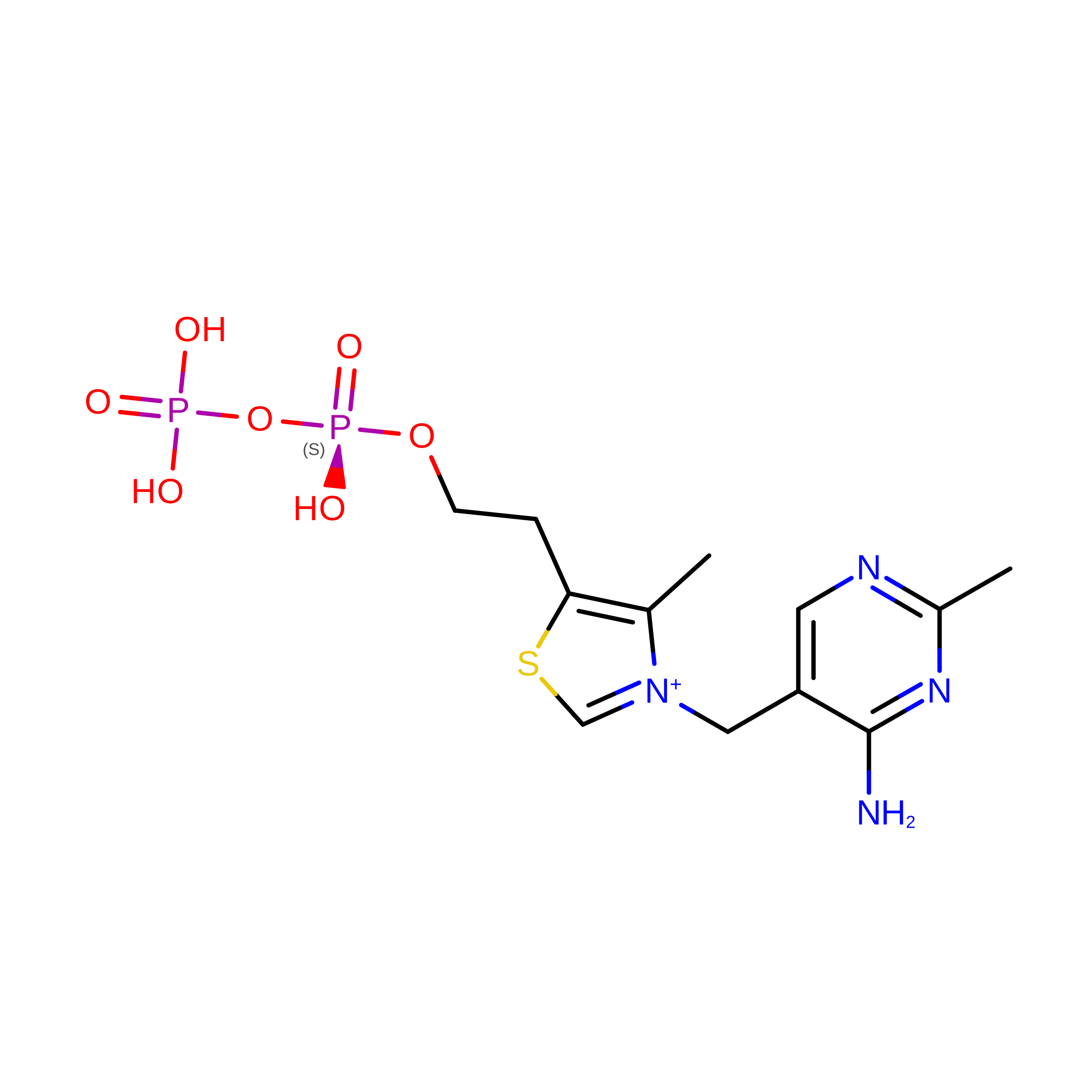
TPP
(Subject of Investigation/LOI)

Query on TPP


Download:Ideal Coordinates CCD File
B [auth A]THIAMINE DIPHOSPHATE
C12 H19 N4 O7 P2 S
AYEKOFBPNLCAJY-UHFFFAOYSA-O

Experimental Data & Validation

Experimental Data

  • Method: ELECTRON MICROSCOPY
  • Resolution: 3.74 Å
  • Aggregation State: PARTICLE 
  • Reconstruction Method: SINGLE PARTICLE 
EM Software:
TaskSoftware PackageVersion
MODEL REFINEMENTPHENIX

Structure Validation

View Full Validation Report


Entry History 

& Funding Information

Deposition Data


Funding OrganizationLocationGrant Number
National Natural Science Foundation of China (NSFC)China--

Revision History  (Full details and data files)

  • Version 1.0: 2025-02-26
    Type: Initial release
  • Version 1.1: 2025-04-23
    Changes: Data collection, Database references
  • Version 1.2: 2025-07-23
    Changes: Data collection