9JQZ | pdb_00009jqz

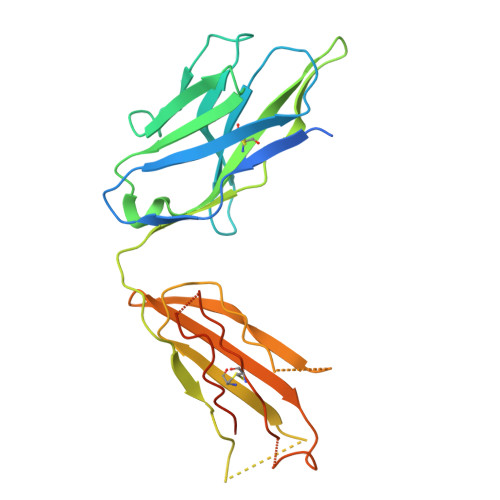
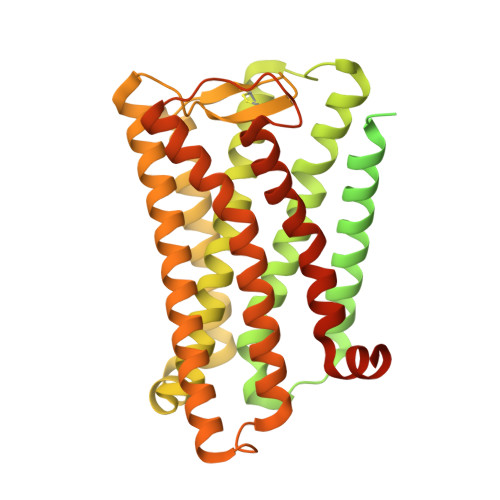
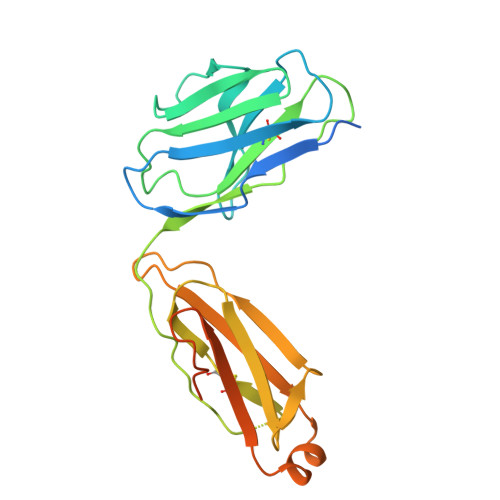
Structural Insights into Selective Antagonism Grapiprant and EP4 Prostaglandin Receptor


Experimental Data Snapshot

  • Method: ELECTRON MICROSCOPY
  • Resolution: 2.65 Å
  • Aggregation State: PARTICLE 
  • Reconstruction Method: SINGLE PARTICLE 

wwPDB Validation   3D Report Full Report


This is version 1.3 of the entry. See complete history


Literature

Structural insights into selective and dual antagonism of EP2 and EP4 prostaglandin receptors.

Wu, Y.Zhang, H.Xu, J.Wu, K.Hu, W.He, X.Wang, G.Wu, C.Xu, H.E.

(2025) EMBO J 44: 7242-7262

  • DOI: https://doi.org/10.1038/s44318-025-00611-0
  • Primary Citation of Related Structures:  
    9JQY, 9JQZ, 9JRO, 9JRT

  • PubMed Abstract: 

    Prostaglandin E2 (PGE2) signaling through EP2 and EP4 receptors is crucial in regulating inflammation, pain, and cancer progression. While selective and dual antagonists for these receptors hold therapeutic potential, their binding mechanisms and selectivity have remained unclear. In this study, we present cryo-electron microscopy (cryo-EM) structures of human EP2 and EP4 receptors in complex with selective antagonists PF-04418948 and grapiprant, as well as with the dual antagonist TG6-129. These structures reveal distinct binding pockets and interaction networks that dictate antagonist selectivity and efficacy. Notably, TG6-129 displays a novel binding mode, engaging deeply with EP2 while interacting more superficially with EP4 in a two-warhead manner. Furthermore, comparisons of active and inactive receptor structures elucidate the mechanisms underlying EP2 activation and antagonism. Overall, these findings provide a structural framework for understanding prostanoid receptor pharmacology and offer valuable insights for the rational design of improved selective and dual antagonists targeting EP2 and EP4 receptors.


  • Organizational Affiliation
    • State Key Laboratory of Drug Research, Shanghai Institute of Materia Medica, Chinese Academy of Sciences, 201203, Shanghai, China. wuyanli@simm.ac.cn.

Macromolecules
Find similar proteins by:  (by identity cutoff)  |  3D Structure
Entity ID: 1
MoleculeChains Sequence LengthOrganismDetailsImage
Heavy chain of Fab fragmentA [auth H]253Mus musculusMutation(s): 0 
Entity Groups  
Sequence Clusters30% Identity50% Identity70% Identity90% Identity95% Identity100% Identity
Sequence Annotations
Expand
  • Reference Sequence
Find similar proteins by:  (by identity cutoff)  |  3D Structure
Entity ID: 2
MoleculeChains Sequence LengthOrganismDetailsImage
GFP-like fluorescent chromoprotein,Prostaglandin E2 receptor EP4 subtypeB [auth A]549synthetic constructHomo sapiens
This entity is chimeric
Mutation(s): 5 
UniProt & NIH Common Fund Data Resources
Find proteins for P35408 (Homo sapiens)
Explore P35408 
Go to UniProtKB:  P35408
PHAROS:  P35408
GTEx:  ENSG00000171522 
Entity Groups  
Sequence Clusters30% Identity50% Identity70% Identity90% Identity95% Identity100% Identity
UniProt GroupP35408
Sequence Annotations
Expand
  • Reference Sequence
Find similar proteins by:  (by identity cutoff)  |  3D Structure
Entity ID: 3
MoleculeChains Sequence LengthOrganismDetailsImage
Light chain of Fab fragmentC [auth L]255Mus musculusMutation(s): 0 
Entity Groups  
Sequence Clusters30% Identity50% Identity70% Identity90% Identity95% Identity100% Identity
Sequence Annotations
Expand
  • Reference Sequence
Small Molecules
Experimental Data & Validation

Experimental Data

  • Method: ELECTRON MICROSCOPY
  • Resolution: 2.65 Å
  • Aggregation State: PARTICLE 
  • Reconstruction Method: SINGLE PARTICLE 
EM Software:
TaskSoftware PackageVersion
MODEL REFINEMENTPHENIX

Structure Validation

View Full Validation Report


Entry History & Funding Information

Deposition Data


Funding OrganizationLocationGrant Number
National Natural Science Foundation of China (NSFC)China--

Revision History  (Full details and data files)

  • Version 1.0: 2025-10-22
    Type: Initial release
  • Version 1.1: 2025-11-12
    Changes: Data collection, Database references
  • Version 1.2: 2025-11-26
    Changes: Data collection, Derived calculations, Structure summary
  • Version 1.3: 2025-12-17
    Changes: Data collection, Database references