Download Mendeley
Structural insights into auxin influx mediated by the Arabidopsis AUX1.
Yang, Z., Wei, H., Gan, Y., Liu, H., Cao, Y., An, H., Que, X., Gao, Y., Zhu, L., Tan, S., Liu, X., Sun, L.(2025) Cell 188: 3960-3973.e15
- PubMed: 40378849 Search on PubMed
- DOI: https://doi.org/10.1016/j.cell.2025.04.028
- Primary Citation Related Structures:
9JDR, 9JDS, 9M2H - PubMed Abstract:
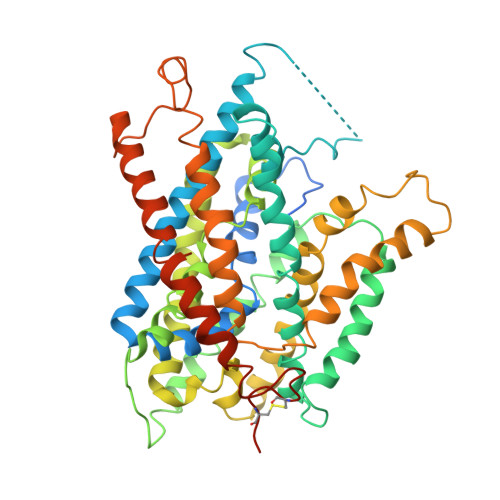
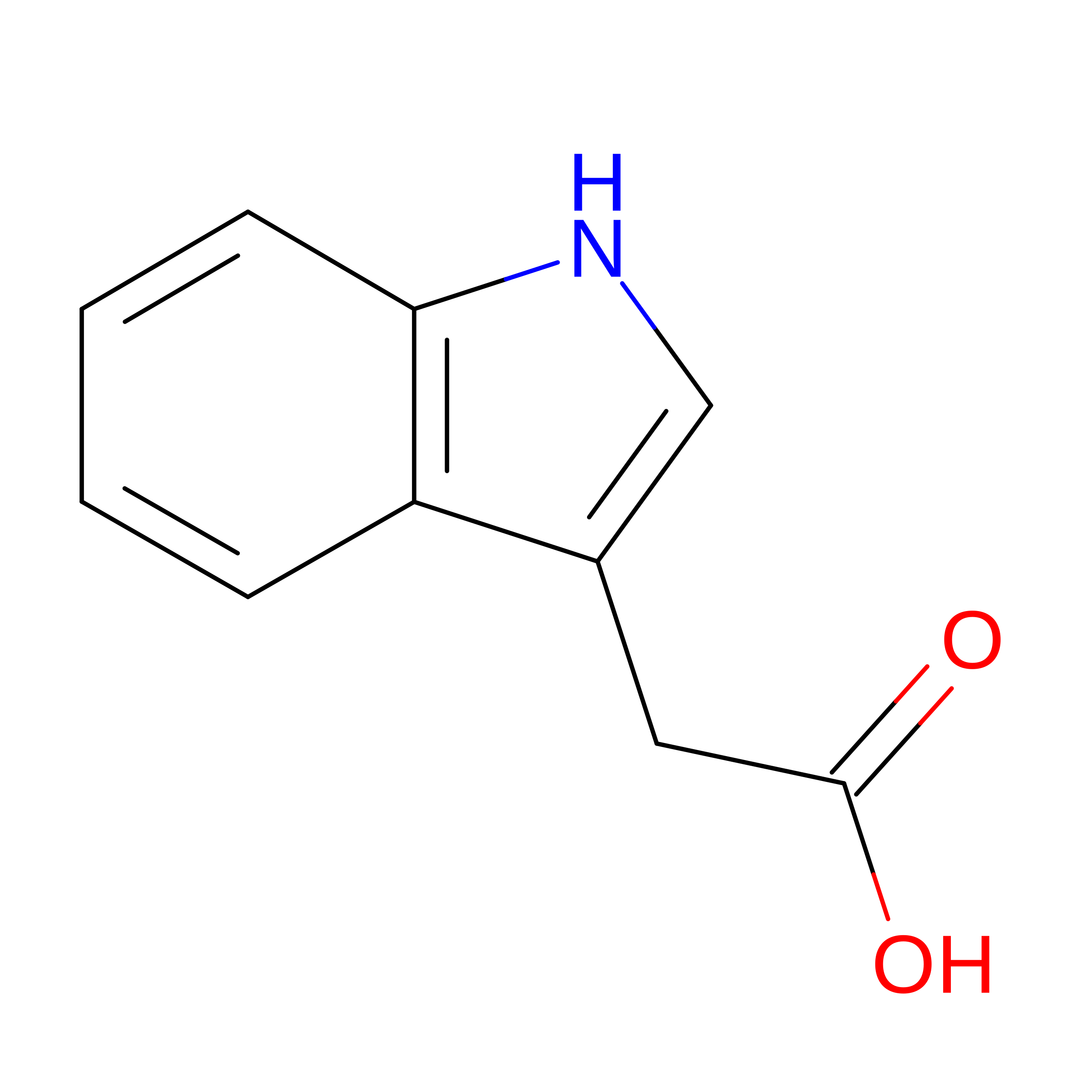
Auxin is crucial in orchestrating diverse aspects of plant growth and development and modulating responses to environmental signals. The asymmetric spatiotemporal distribution of auxin generates local gradient patterns, which are regulated by both cellular auxin influx and efflux. The AUXIN1/LIKE-AUX1 (AUX1/LAX) family transporters have been identified as major auxin influx carriers. Here, we characterize the auxin uptake mediated by AUX1 from Arabidopsis thaliana. Using cryoelectron microscopy (cryo-EM), we determine its structure in three states: the auxin-unbound, the auxin-bound, and the competitive inhibitor, 3-chloro-4-hydroxyphenylacetic acid (CHPAA)-bound state. All structures adopt an inward-facing conformation. In the auxin-bound structure, indole-3-acetic acid (IAA) is coordinated to AUX1 primarily through hydrogen bonds with its carboxyl group. The functional roles of key residues in IAA binding are validated by in vitro and in planta analyses. CHPAA binds to the same site as IAA. These findings advance our understanding of auxin transport in plants.
- Department of Neurology of The First Affiliated Hospital of USTC, MOE Key Laboratory for Membraneless Organelles and Cellular Dynamics, Hefei National Research Center for Physical Sciences at the Microscale, Center for Advanced Interdisciplinary Science and Biomedicine of IHM, Division of Life Sciences and Medicine, University of Science and Technology of China, Hefei 230027, China.
Organizational Affiliation: