Download Mendeley
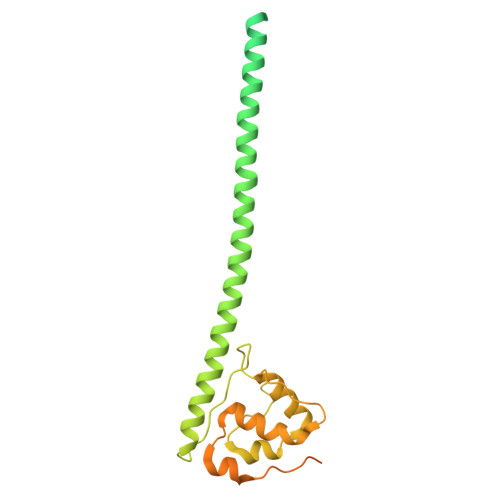
Structural duality enables a single protein to act as a toxin-antidote pair for meiotic drive.
Hua, Y., Zhang, J., Yang, M.Y., Ren, J.Y., Suo, F., Liang, L., Dong, M.Q., Ye, K., Du, L.L.(2024) Proc Natl Acad Sci U S A 121: e2408618121-e2408618121
- PubMed: 39485800 Search on PubMedSearch on PubMed Central
- DOI: https://doi.org/10.1073/pnas.2408618121
- Primary Citation Related Structures:
9JA6 - PubMed Abstract:
In sexual reproduction, selfish genetic elements known as killer meiotic drivers (KMDs) bias inheritance by eliminating gametes that do not carry them. The selective killing behavior of most KMDs can be explained by a toxin-antidote model, where a toxin harms all gametes while an antidote provides resistance to the toxin in carriers. This study investigates whether and how the KMD element tdk1 in the fission yeast Schizosaccharomyces pombe deploys this strategy. Intriguingly, tdk1 relies on a single protein product, Tdk1, for both killing and resistance. We show that Tdk1 exists in a nontoxic tetrameric form during vegetative growth and meiosis but transforms into a distinct toxic form in spores. This toxic form acquires the ability to interact with the histone reader Bdf1 and assembles into supramolecular foci that disrupt mitosis in noncarriers after spore germination. In contrast, Tdk1 synthesized during germination of carrier spores is nontoxic and acts as an antidote, dismantling the preformed toxic Tdk1 assemblies. Replacement of the N-terminal region of Tdk1 with a tetramer-forming peptide reveals its dual roles in imposing an autoinhibited tetrameric conformation and facilitating the assembly of supramolecular foci when autoinhibition is released. Moreover, we successfully reconstituted a functional KMD element by combining a construct that exclusively expresses Tdk1 during meiosis ("toxin-only") with another construct that expresses Tdk1 specifically during germination ("antidote-only"). This work uncovers a remarkable example of a single protein employing structural duality to form a toxin-antidote pair, expanding our understanding of the mechanisms underlying toxin-antidote systems.
- National Institute of Biological Sciences, Beijing 102206, China.
Organizational Affiliation: