9J95 | pdb_00009j95

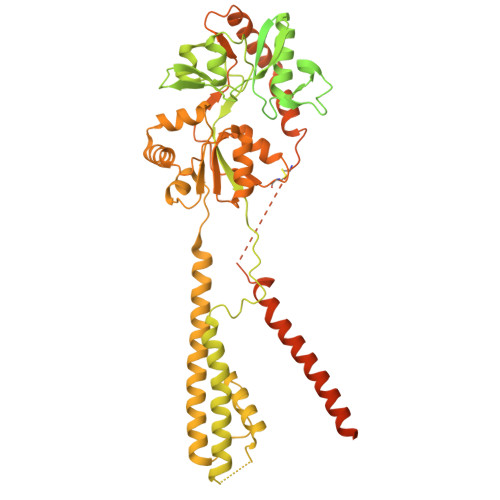
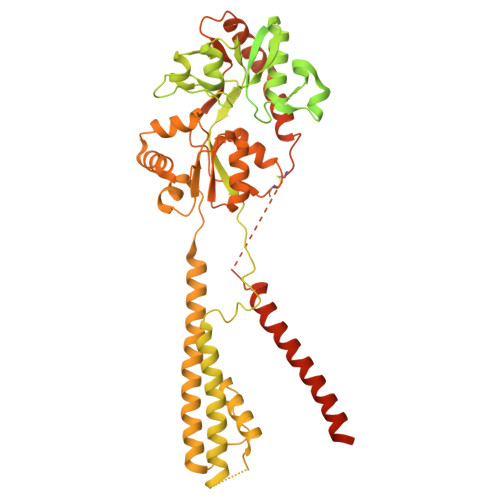
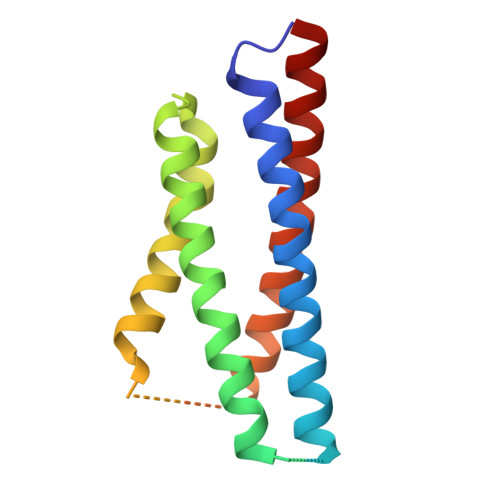
Native GluA1/GluA4-CNIH3 complex in desensitized state


Experimental Data Snapshot

  • Method: ELECTRON MICROSCOPY
  • Resolution: 4.26 Å
  • Aggregation State: PARTICLE 
  • Reconstruction Method: SINGLE PARTICLE 

wwPDB Validation 3D Report Full Report

Validation slider image for 9J95

This is version 1.2 of the entry. See complete history

Literature

Assembly and gating mechanism of native AMPA receptors from the cerebellum.

Li, X.Li, R.Wei, Y.Chen, J.Zhao, J.Zhao, J.Wang, W.Li, N.Wang, L.Hu, T.Dong, Y.Zhu, Y.Wei, C.Li, L.Zhang, W.Huang, Z.Zhao, Y.

(2026) Cell Res 

  • DOI: https://doi.org/10.1038/s41422-026-01234-8
  • Primary Citation Related Structures: 
    9J92, 9J93, 9J94, 9J95, 9X57, 9X58, 9XJL, 9XJM

  • PubMed Abstract: 

    AMPA receptors (AMPARs) mediate the majority of fast excitatory synaptic transmission throughout the central nervous system. Calcium-permeable AMPARs and GluA4-containing receptors are critical for cerebellar functions, such as motor learning, associative memory, auditory processing, and synaptic plasticity. In contrast to the well-characterized, predominantly GluA2-containing AMPARs of the hippocampus and cortex, cerebellar AMPARs contain a higher proportion of GluA4 and remain poorly understood. Here, we generated a highly GluA4-specific antibody. Using this antibody in combination with antibodies specifically recognizing GluA1 and GluA2, we purified native AMPARs and determined the subunit compositions of both calcium-impermeable and calcium-permeable native AMPARs in the cerebellum. The isolated cerebellar AMPARs that contained both GluA1 and GluA4 were calcium-permeable, with GluA4 occupying mainly the B/D positions, GluA1 occupying the A/C positions, and the complex associated primarily with cornichon 3 (CNIH3). We determined the structures of the complex in distinct functional states, including the resting, active, and desensitized states, and characterized the conformational transitions that underlie its activity. During desensitization, the receptor adopts a pseudo-4-fold configuration of the ligand-binding domain layer, which may be important for its functional properties. This study provides a blueprint for the subunit compositions of AMPARs in the cerebellum and clarifies the gating mechanism of the calcium-permeable native AMPAR A1A4 -CNIH3 complex, providing significant insight into AMPAR-mediated synaptic transmission in the cerebellum.


  • Organizational Affiliation
    • Key Laboratory of Biomacromolecules (CAS), National Laboratory of Biomacromolecules, CAS Center for Excellence in Biomacromolecules, Institute of Biophysics, Chinese Academy of Sciences, Beijing, China.

Macromolecule Content 

  • Total Structure Weight: 477.36 kDa 
  • Atom Count: 16,528 
  • Modeled Residue Count: 2,064 
  • Deposited Residue Count: 4,216 
  • Unique protein chains: 3

Macromolecules

Find similar proteins by:|  3D Structure
Entity ID: 1
MoleculeChains  Sequence LengthOrganismDetailsImage
Glutamate receptor
A, C
906Sus scrofaMutation(s): 0 
UniProt
Find proteins for A0A286ZS63 (Sus scrofa)
Explore A0A286ZS63 
Go to UniProtKB:  A0A286ZS63
Entity Groups
Sequence Clusters30% Identity50% Identity70% Identity90% Identity95% Identity100% Identity
UniProt GroupA0A286ZS63
Sequence Annotations
Expand
Reference Sequence
Find similar proteins by:|  3D Structure
Entity ID: 2
MoleculeChains  Sequence LengthOrganismDetailsImage
Glutamate receptor
B, D
884Sus scrofaMutation(s): 0 
UniProt
Find proteins for I3L8N9 (Sus scrofa)
Explore I3L8N9 
Go to UniProtKB:  I3L8N9
Entity Groups
Sequence Clusters30% Identity50% Identity70% Identity90% Identity95% Identity100% Identity
UniProt GroupI3L8N9
Sequence Annotations
Expand
Reference Sequence
Find similar proteins by:|  3D Structure
Entity ID: 3
MoleculeChains  Sequence LengthOrganismDetailsImage
Cornichon family AMPA receptor auxiliary protein 3
E, F, G, H
159Sus scrofaMutation(s): 0 
UniProt
Find proteins for A0A287BJP0 (Sus scrofa)
Explore A0A287BJP0 
Go to UniProtKB:  A0A287BJP0
Entity Groups
Sequence Clusters30% Identity50% Identity70% Identity90% Identity95% Identity100% Identity
UniProt GroupA0A287BJP0
Sequence Annotations
Expand
Reference Sequence

Experimental Data & Validation

Experimental Data

  • Method: ELECTRON MICROSCOPY
  • Resolution: 4.26 Å
  • Aggregation State: PARTICLE 
  • Reconstruction Method: SINGLE PARTICLE 
EM Software:
TaskSoftware PackageVersion
MODEL REFINEMENTPHENIX

Structure Validation

View Full Validation Report


Entry History 

& Funding Information

Deposition Data


Funding OrganizationLocationGrant Number
National Natural Science Foundation of China (NSFC)China92157102

Revision History  (Full details and data files)

  • Version 1.0: 2026-03-04
    Type: Initial release
  • Version 1.1: 2026-03-25
    Changes: Data collection, Database references
  • Version 1.2: 2026-04-01
    Changes: Data collection, Database references