9INK | pdb_00009ink

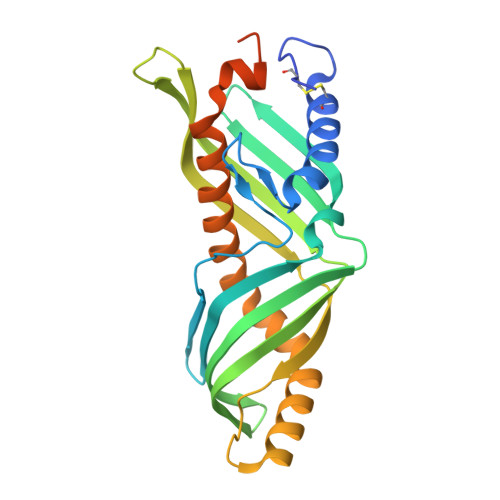
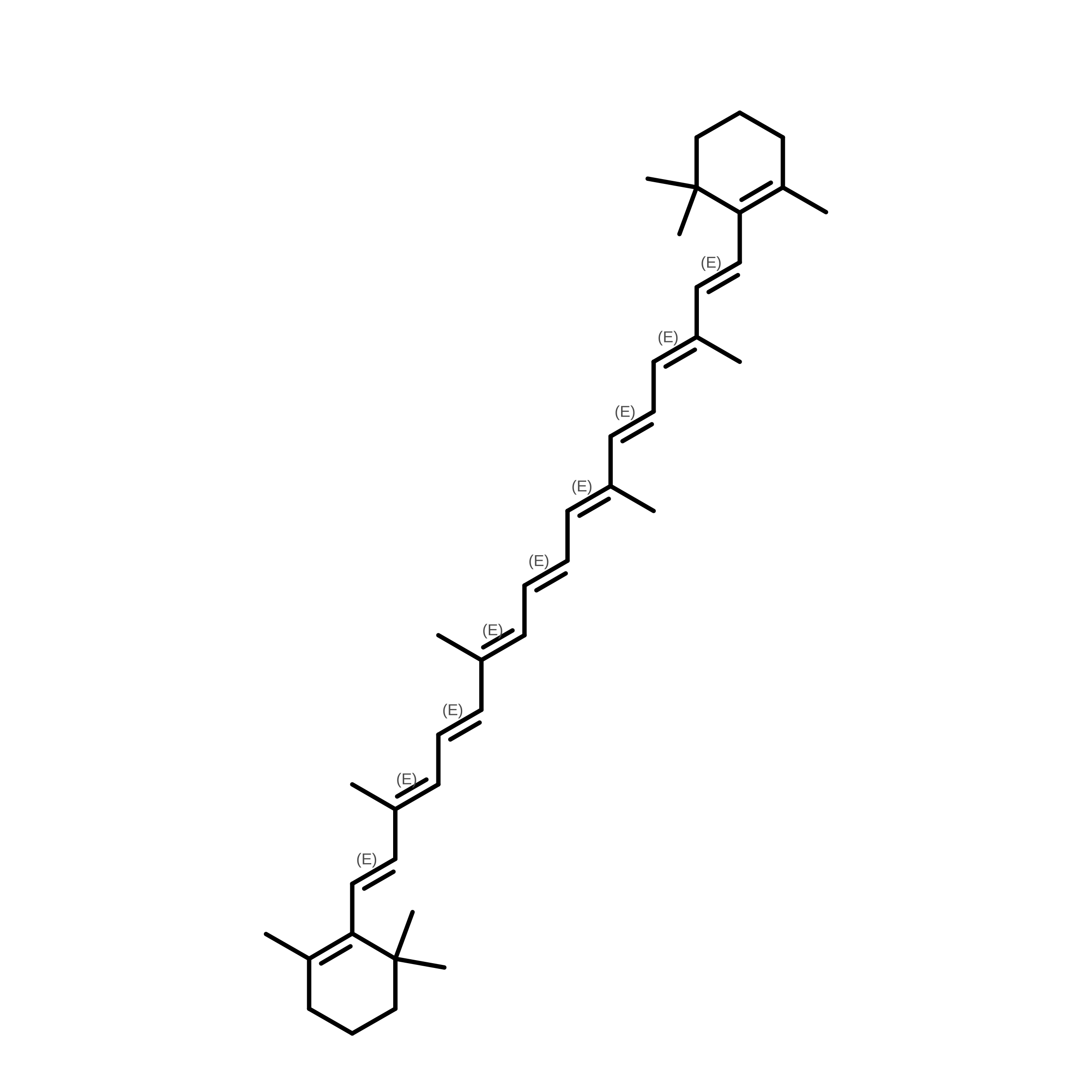
Crystal structure of beta-carotene-binding protein (BBP) from Schistocerca gregaria complexed with beta-carotene


Experimental Data Snapshot

  • Method: X-RAY DIFFRACTION
  • Resolution: 2.70 Å
  • R-Value Free: 
    0.278 (Depositor), 0.281 (DCC) 
  • R-Value Work: 
    0.221 (Depositor), 0.224 (DCC) 
  • R-Value Observed: 
    0.224 (Depositor) 

Starting Model: in silico
View more details

wwPDB Validation 3D Report Full Report

Validation slider image for 9INK

Ligand Structure Quality Assessment 


This is version 1.2 of the entry. See complete history

Literature

Structural basis of selective beta-carotene binding by a soluble protein.

Egorkin, N.A.Dominnik, E.E.Raevskii, R.I.Kuklina, D.D.Varfolomeeva, L.A.Popov, V.O.Boyko, K.M.Sluchanko, N.N.

(2024) Structure 32: 2123-2133.e3

  • DOI: https://doi.org/10.1016/j.str.2024.09.014
  • Primary Citation Related Structures: 
    9INK

  • PubMed Abstract: 

    β-carotene (BCR) is the most abundant carotenoid, a colorant, antioxidant, and provitamin A. The extreme hydrophobicity of this hydrocarbon requires special mechanisms for distribution in aqueous media, including water-soluble carotenoproteins. However, all known carotenoproteins prefer oxygenated carotenoids and bind BCR inefficiently. Here, we present the crystal structure of the BCR-binding protein (BBP) from gregarious male locusts, which is responsible for their vivid yellow body coloration, in complex with its natural ligand, BCR. BBP forms an antiparallel tubular homodimer with α/β-wrap folded monomers, each forming a hydrophobic 47 Å long, coaxial tunnel that opens outward and is occupied by one s-cis C6-C7 , all-trans BCR molecule. In the BCR absence, BBP accepts a range of xanthophylls, with reduced efficiency depending on the position and number of oxygen atoms, but rejects lycopene. The structure captures a pigment complex with a Takeout 1 protein and inspires potential applications of BBP as a BCR solubilizer.


  • Organizational Affiliation
    • A.N. Bach Institute of Biochemistry, Federal Research Centre of Biotechnology of the Russian Academy of Sciences, 33 Leninsky prospect, building 1, Moscow 119071, Russia; M.V. Lomonosov Moscow State University, School of Biology, 1 Lenin Hills, building 12, Moscow 119991, Russia.

Macromolecule Content 

  • Total Structure Weight: 53.55 kDa 
  • Atom Count: 3,274 
  • Modeled Residue Count: 441 
  • Deposited Residue Count: 510 
  • Unique protein chains: 1

Macromolecules

Find similar proteins by:|  3D Structure
Entity ID: 1
MoleculeChains  Sequence LengthOrganismDetailsImage
Yellow protein of the takeout family
A, B
255Schistocerca gregariaMutation(s): 0 
Gene Names: YPT
UniProt
Find proteins for A0A6N3ISN1 (Schistocerca gregaria)
Explore A0A6N3ISN1 
Go to UniProtKB:  A0A6N3ISN1
Entity Groups
Sequence Clusters30% Identity50% Identity70% Identity90% Identity95% Identity100% Identity
UniProt GroupA0A6N3ISN1
Sequence Annotations
Expand
Reference Sequence

Experimental Data & Validation

Experimental Data

  • Method: X-RAY DIFFRACTION
  • Resolution: 2.70 Å
  • R-Value Free:  0.278 (Depositor), 0.281 (DCC) 
  • R-Value Work:  0.221 (Depositor), 0.224 (DCC) 
  • R-Value Observed: 0.224 (Depositor) 
Space Group: C 2 2 21
Unit Cell:
Length ( Å )Angle ( ˚ )
a = 55.39α = 90
b = 75.51β = 90
c = 224.22γ = 90
Software Package:
Software NamePurpose
REFMACrefinement
XSCALEdata scaling
XDSdata reduction
MOLREPphasing

Structure Validation

View Full Validation Report


Ligand Structure Quality Assessment 


Entry History 

& Funding Information

Deposition Data


Funding OrganizationLocationGrant Number
Not funded--

Revision History  (Full details and data files)

  • Version 1.0: 2024-09-18
    Type: Initial release
  • Version 1.1: 2024-11-13
    Changes: Structure summary
  • Version 1.2: 2024-12-18
    Changes: Database references