Download Mendeley
Lid loop-mediated proton transfer revealed in the Fe/ alpha KG-dependent decarboxylase TraH.
Zheng, X., Ge, R., Guo, Z., Girbig, M., Freitag, J., Li, A., Hochberg, G.K.A., Li, S.M., Bange, G., Zheng, L.(2026) Commun Chem 9
- PubMed: 41981143 Search on PubMedSearch on PubMed Central
- DOI: https://doi.org/10.1038/s42004-026-01986-9
- Primary Citation Related Structures:
9IG3, 9IG4, 9IG5 - PubMed Abstract:
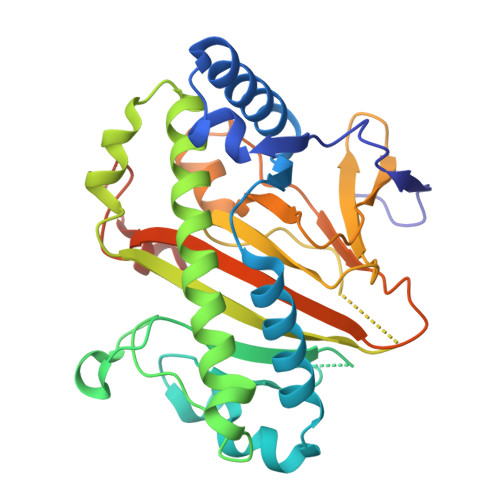
TraH, a fungal decarboxylase from Penicillium crustosum, belongs to the isopenicillin N synthase (IPNS) subfamily of non-heme iron/α-ketoglutarate (αKG)-dependent enzymes. IPNS enzymes are characterized by N- and C-terminal insertions that can reshape the active site. However, the functional and mechanistic roles of these elements, particularly in fungal decarboxylases, remain largely unexplored. Here, we report crystal structures of TraH in complex with various substrates, revealing a N-terminal loop, serving as lid and undergoes substrate-dependent dynamic conformational rearrangements. Upon binding of crustosic acid, this lid loop forms a hydrogen-bonding network to stabilize a water molecule, which mediates interaction between the conserved K191 residue in the DSBH (double-stranded β-helix) core and the substrate. Mutagenesis and QM/MM metadynamics simulations suggest that proton transfer from K191 is mediated by water molecules stabilized by the lid loop, supporting a decarboxylation mechanism distinct from the canonical strategy of direct carboxylate stabilization by DBSH core-located basic residues in other αKG-dependent decarboxylases. Interestingly, this loop is dispensable for the desaturation of crustosic acid methyl ester, thereby pinpointing its essential role to the precise positioning of the carboxylate substrate for proton transfer during decarboxylation. Evolutionary and structural analyses reveal significant variation in lid loop composition across IPNS enzymes, indicating its contribution to substrate recognition and functional diversification. Overall, our findings uncover a regulatory element in iron/αKG-dependent enzymes and offer insights into how non-core structural elements contribute to catalytic mechanism and evolution.
- Philipps-Universität Marburg, Center for Synthetic Microbiology (SYNMIKRO) & Department of Chemistry, Marburg, Germany.
Organizational Affiliation: