Download Mendeley
Consequences of Peptide Macrocyclization Revealed by Virus-Inspired beta-Hairpin Mimetics.
Bula, A.L., Bobrovs, R., Arsenyan, P., Pantelejevs, T.(2026) ACS Chem Biol 21: 160-169
- PubMed: 41427528 Search on PubMedSearch on PubMed Central
- DOI: https://doi.org/10.1021/acschembio.5c00834
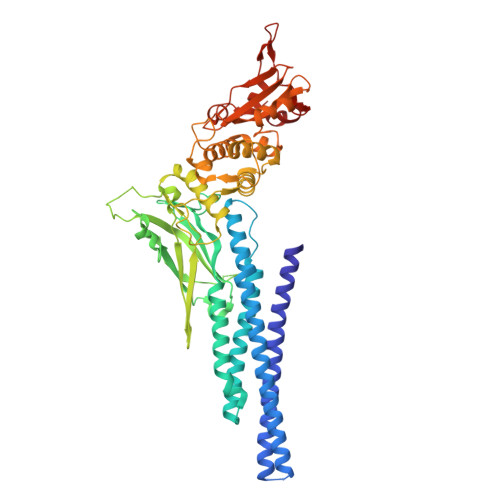
- Primary Citation Related Structures:
9IFX, 9IGA - PubMed Abstract:
Mimicry of protein secondary structure elements, such as α-helices and β-sheets, using conformationally constrained peptide macrocycles, can be utilized to disrupt native protein-protein and protein-nucleic acid interactions. Although α-helical stapled peptides have been extensively studied as pharmacological probes, the application of β-sheet and β-hairpin mimetics remains comparatively limited. Less is known about the structural and biophysical consequences of β-hairpin macrocyclization in the context of target binding. In this work, we use a poxvirus immune antagonist protein 018 as a template for the structure-based design of β-hairpin mimetic macrocyclic peptides targeting the STAT1 transcription factor. We demonstrate that successive orthogonal cyclizations have additive effects on the thermodynamic and kinetic properties of peptide binding, most notably slowing the dissociation from the target. We elucidate the structural and dynamic consequences of interstrand and head-to-tail cross-linking and propose a kinetic model explaining the gains in target residence. Finally, we highlight the pharmacological potential of these peptides by competitive inhibition of STAT1 binding to its cognate interferon receptor docking site. These data suggest that β-hairpin macrocyclization may represent a general strategy to extend target engagement, with implications for peptidic probe design.
- Latvian Institute of Organic Synthesis, Aizkraukles 21, Riga LV-1006, Latvia.
Organizational Affiliation: