9IFV | pdb_00009ifv

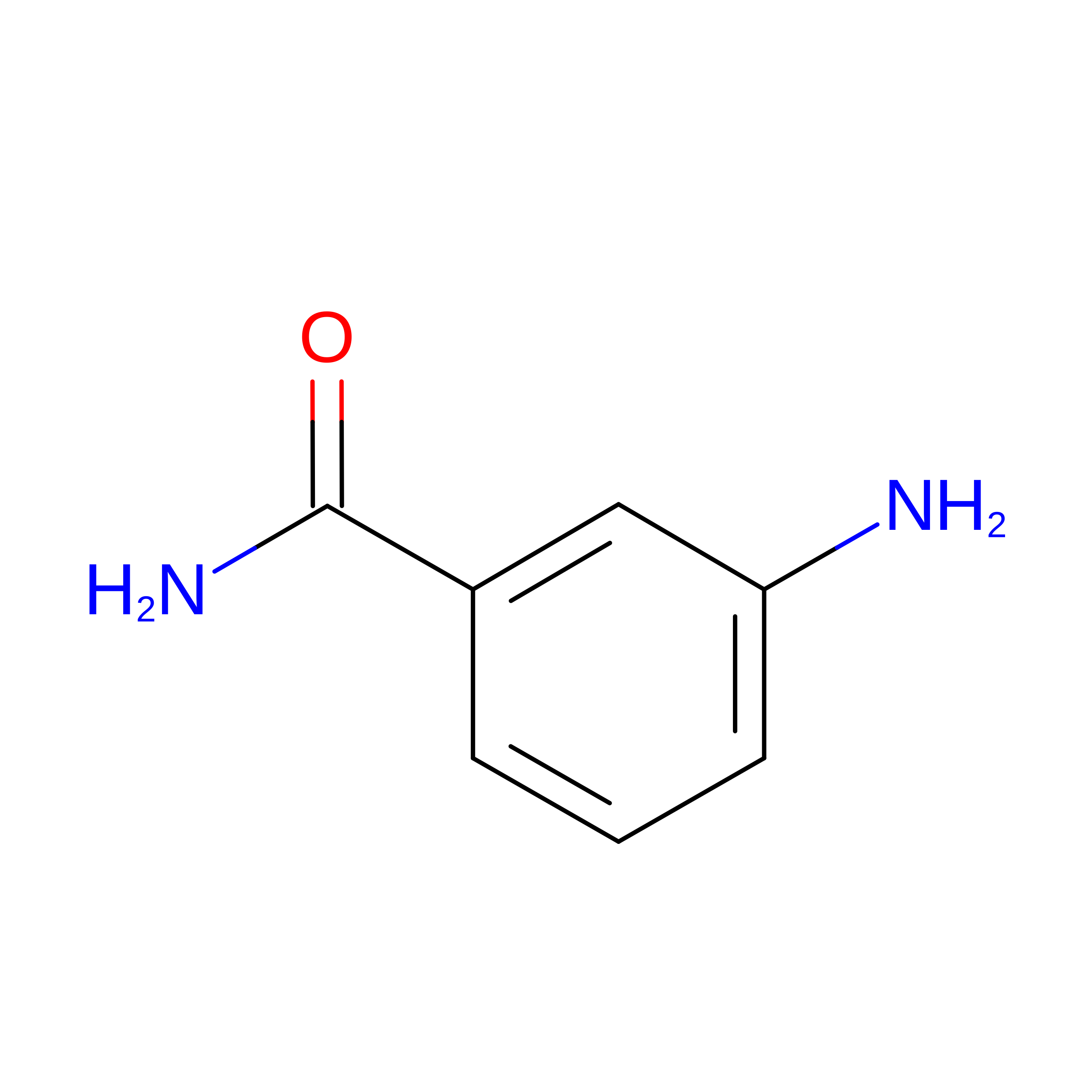
PARP15 catalytic domain mutant (R576E) in complex with 3-aminobenzamide


Experimental Data Snapshot

  • Method: X-RAY DIFFRACTION
  • Resolution: 1.43 Å
  • R-Value Free: 
    0.225 (Depositor), 0.280 (DCC) 
  • R-Value Work: 
    0.197 (Depositor) 
  • R-Value Observed: 
    0.198 (Depositor) 

Starting Model: experimental
View more details

wwPDB Validation 3D Report Full Report

Validation slider image for 9IFV

Ligand Structure Quality Assessment 


This is version 1.1 of the entry. See complete history

Literature

Regulation of ADP-ribosyltransferase activity by ART domain dimerization in PARP15.

Ebenwaldner, C.Garcia Saura, A.G.Ekstrom, S.Bernfur, K.Moche, M.Logan, D.T.Cohen, M.S.Schuler, H.

(2025) Nat Commun 16: 9567-9567

  • DOI: https://doi.org/10.1038/s41467-025-65315-9
  • Primary Citation Related Structures: 
    9IFV

  • PubMed Abstract: 

    PARP15 is a mono-ADP-ribosyltransferase that targets an unknown set of proteins as well as RNA. Its evolutionary relationship with PARP14 suggests roles in antiviral defence; its localization to stress granules points to functions in the regulation of translation. Here we show that the transferase domain of PARP15 dimerizes in solution; the formation of dimers is a prerequisite for catalytic activity and monomeric mutant variants of the domain are inactive. In cells, dimer-disrupting mutations abrogate catalytic activity and alter the subcellular localization of the full-length protein. Using biophysical methods, including X-ray crystallography and HDX-MS, we provide evidence for a regulatory mechanism by which dimerization enables correct target engagement rather than NAD + co-substrate binding, and by which the two protomers of the dimer operate independently of one another. Together, our results uncover a regulatory mechanism in a PARP family enzyme.


  • Organizational Affiliation
    • Division of Biochemistry and Structural Biology, Department of Chemistry, Lund University, Lund, Sweden.

Macromolecule Content 

  • Total Structure Weight: 51.1 kDa 
  • Atom Count: 3,487 
  • Modeled Residue Count: 396 
  • Deposited Residue Count: 442 
  • Unique protein chains: 1

Macromolecules

Find similar proteins by:|  3D Structure
Entity ID: 1
MoleculeChains  Sequence LengthOrganismDetailsImage
Protein mono-ADP-ribosyltransferase PARP15
A, B
221Homo sapiensMutation(s): 1 
Gene Names: PARP15BAL3
EC: 2.4.2
UniProt & NIH Common Fund Data Resources
Find proteins for Q460N3 (Homo sapiens)
Explore Q460N3 
Go to UniProtKB:  Q460N3
PHAROS:  Q460N3
GTEx:  ENSG00000173200 
Entity Groups
Sequence Clusters30% Identity50% Identity70% Identity90% Identity95% Identity100% Identity
UniProt GroupQ460N3
Sequence Annotations
Expand
Reference Sequence

Experimental Data & Validation

Experimental Data

  • Method: X-RAY DIFFRACTION
  • Resolution: 1.43 Å
  • R-Value Free:  0.225 (Depositor), 0.280 (DCC) 
  • R-Value Work:  0.197 (Depositor) 
  • R-Value Observed: 0.198 (Depositor) 
Space Group: C 2 2 21
Unit Cell:
Length ( Å )Angle ( ˚ )
a = 75.713α = 90
b = 76.697β = 90
c = 155.562γ = 90
Software Package:
Software NamePurpose
PHENIXrefinement
PHASERphasing
Aimlessdata scaling
autoPROCdata processing
autoPROCdata reduction

Structure Validation

View Full Validation Report


Ligand Structure Quality Assessment 


Entry History 

& Funding Information

Deposition Data


Funding OrganizationLocationGrant Number
CancerfondenSweden23-3027Pj

Revision History  (Full details and data files)

  • Version 1.0: 2025-10-08
    Type: Initial release
  • Version 1.1: 2025-11-12
    Changes: Database references