Download Mendeley
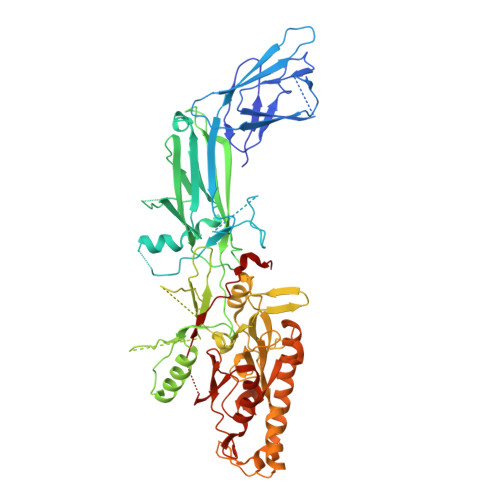
Glycosaminoglycans activate peptidylarginine deiminase 4 by enhancing calcium affinity.
Bereta, G.P., Bielecka, E., Marzec, K., Pijanowski, L., Biela, A.P., Wilk, P., Kaminska, M., Nowak, J., Wator-Wilk, E., Grudnik, P., Kowalczyk, D., Koziel, J., Mydel, P., Poreba, M., Kantyka, T.(2025) Proc Natl Acad Sci U S A 122: e2508369122-e2508369122
- PubMed: 41166417 Search on PubMedSearch on PubMed Central
- DOI: https://doi.org/10.1073/pnas.2508369122
- Primary Citation Related Structures:
9HUH, 9HUI, 9HUJ - PubMed Abstract:
Rheumatoid arthritis is a chronic inflammatory disease driven by abnormal protein modifications. These include citrullination of arginine residues by the calcium-activated enzyme peptidylarginine deiminase 4 (PAD4). However, calcium in body fluids may not fully activate PAD4, suggesting the potential involvement of other activators. In this study, we investigated the ability of glycosaminoglycans (a class of negatively charged polysaccharides) to modulate PAD4 activity. We found that model glycosaminoglycans bind to the enzyme with a nanomolar affinity, increase its calcium sensitivity, and require enzyme dimerization for activation. These effects depend on the size and negative charge of the glycosaminoglycan, and its various natural forms activate PAD4. Thus, our findings elucidate a mechanism by which common physiological compounds modulate PAD4 activity, potentially contributing to disease etiology.
- Malopolska Centre of Biotechnology, Jagiellonian University, Krakow 30-387, Poland.
Organizational Affiliation: