Download Mendeley
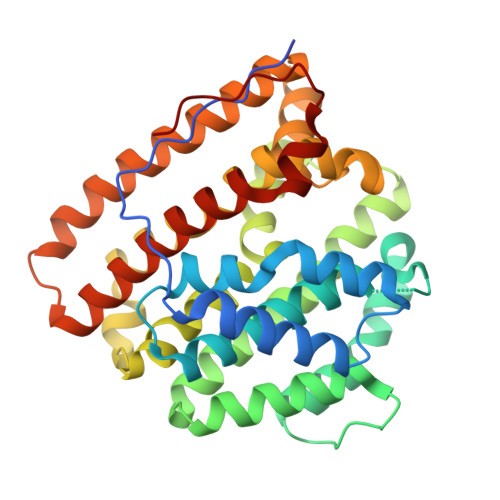
Structural Mimics of Hydrocarbon Intermediates Reveal Counterclockwise Cyclization Pathways in the Sesquiterpene Synthases TmS and NcECS.
Groll, M., Li, H., Troycke, P., Kaila, V.R.I., Dickschat, J.S.(2025) J Am Chem Soc 147: 47742-47750
- PubMed: 41372098 Search on PubMed
- DOI: https://doi.org/10.1021/jacs.5c17732
- Primary Citation Related Structures:
9HQ2, 9HQA, 9HQB, 9HQD, 9HQI, 9HQM, 9HQZ, 9HR0, 9HR3 - PubMed Abstract:
Terpene synthases orchestrate complex cyclization cascades that transform simple polyisoprenoid precursors into structurally diverse natural products, often with exquisite stereochemical control. Here we combine high-resolution X-ray crystallography, site-directed mutagenesis, and QM/MM calculations to dissect the catalytic mechanisms of two bacterial sesquiterpene synthases for T-muurolol (TmS) and 1- epi -cubenol (NcECS). The structures reveal a dynamic transition between open and closed states, controlled by a trinuclear magnesium cluster that mediates substrate binding, carbocation formation, and intramolecular pyrophosphate transfer to generate ( R )-nerolidyl pyrophosphate, the precursor to Z -configured products. Using synthetic dihydro-surrogates, we identify a counterclockwise substrate orientation, not previously observed in terpene synthases, and visualize a series of trapped hydrocarbons that resemble several of the proposed cationic intermediates along the cyclization cascade. Complementary quantum chemical calculations support their observed geometries and indicate that the active site can transiently accommodate these intermediate analogs, offering a structural basis for understanding how sesquiterpene synthases guide complex carbocationic pathways.
- Center for Protein Assemblies, Department Bioscience, School of Natural Sciences, Technical University Munich, Ernst-Otto-Fischer-Straße 8, 85748 Garching, Germany.
Organizational Affiliation: