Download Mendeley
Structural and biochemical characterization of yeast Tcd enzymes installing the post-transcriptional modification ct6A in tRNA.
Hirschmann, J., Sonntag, R., Heiss, M., Wegrzyn, E., Heinemeyer, W., Carell, T., Huber, E.M.(2026) Nucleic Acids Res 54
- PubMed: 42087783 Search on PubMedSearch on PubMed Central
- DOI: https://doi.org/10.1093/nar/gkag376
- Primary Citation Related Structures:
9HMO, 9HMP, 9TZH - PubMed Abstract:
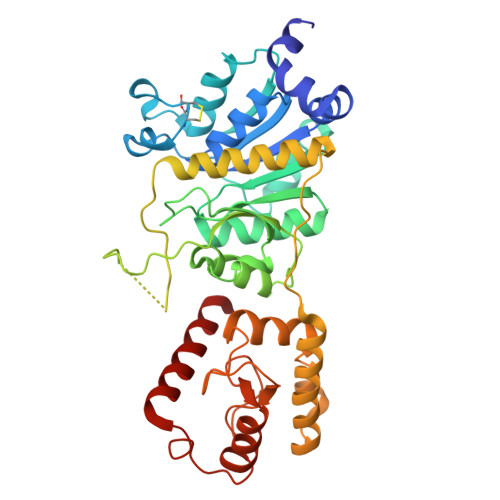
Post-transcriptional modifications near the anticodon of transfer ribonucleic acids (tRNAs) ensure translation fidelity and accuracy. For instance, at position 37, the universally conserved and essential nucleoside N6-threonylcarbamoyladenosine (t6A) supports decoding of ANN triplets. In some organisms t6A is converted to cyclic t6A (ct6A), but only little is known about this ATP-dependent reaction and the corresponding threonylcarbamoyladenosine dehydratases (Tcds). We here show that yeast Tcds localize to the outer mitochondrial membrane and co-purify with tRNAs recognizing ANN codons. Depending on the number of TCD genes in the genome, the proteins form V-shaped hetero- or homodimers, of which at least one subunit binds and modifies tRNAs. The C-terminal, monomeric domain shares similarities with Cas9-endonucleases and assists tRNA recognition, while the N-terminal domain mediates dimerization and contains the active site. Structure-based mutagenesis and activity assays imply that yeast Tcds lack a catalytic cysteine and do not covalently bind their substrate as proposed for Escherichia coli TcdA.
- Technical University of Munich, TUM School of Natural Sciences, Center for Functional Protein Assemblies, 85747 Garching, Germany.
Organizational Affiliation: