Download Mendeley
An improved nerve agent bioscavenger based on the fast self-reactivation mechanism of porcine butyrylcholinesterase.
Brazzolotto, X., Lushchekina, S., Nachon, F.(2026) Protein Sci 35: e70467-e70467
- PubMed: 41556466 Search on PubMedSearch on PubMed Central
- DOI: https://doi.org/10.1002/pro.70467
- Primary Citation Related Structures:
9HGZ, 9HH0 - PubMed Abstract:
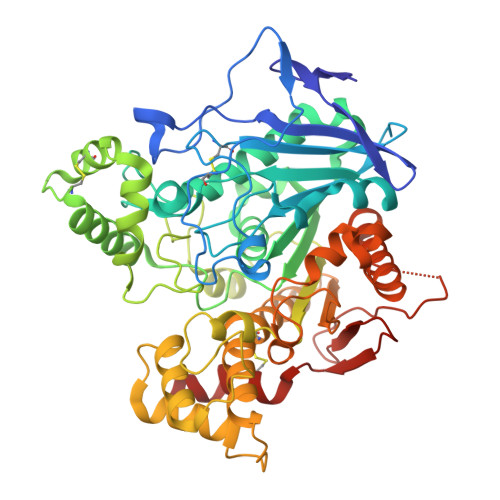
Inhibition of cholinesterases by warfare nerve agents is characterized by forming a stable covalent adduct on the active site serine. We report the fast, spontaneous hydrolysis of the adduct formed by chiral phosphonate nerve agents and porcine butyrylcholinesterase. Fast hydrolysis only occurs with the most toxic enantiomer. Crystal structures of apo and soman-inhibited porcine butyrylcholinesterase highlight the potential role of the Acyl-Binding-loop in the rate of spontaneous reactivation, further supported by molecular dynamics. Introducing mutations in human butyrylcholinesterase to mimic the loop of the porcine enzyme converted it into a fast, self-regenerating bioscavenger, particularly for V-agents. Characterization of the reactivation mechanism by molecular dynamics and quantum mechanics simulations supports that the quicker hydrolysis of the nerve agent adducts originates from its better hydration. This work represents a breakthrough in the design of butyrylcholinesterase-based bioscavengers of nerve agents.
- Département de Toxicologie et Risques Chimiques, Institut de Recherche Biomédicale des Armées, Brétigny sur Orge, France.
Organizational Affiliation: