Download Mendeley
Structural basis of regioselective double halogenation of the beta-carboline tryptoline by the single-component halogenase AetF.
Bork, S., Horstmeier, H.J., Scharkowski, B., Niemann, H.H.(2026) Acta Crystallogr D Struct Biol 82: 836-844
- PubMed: 42329691 Search on PubMedSearch on PubMed Central
- DOI: https://doi.org/10.1107/S2059798326005954
- Primary Citation Related Structures:
29OI, 9H6Z - PubMed Abstract:
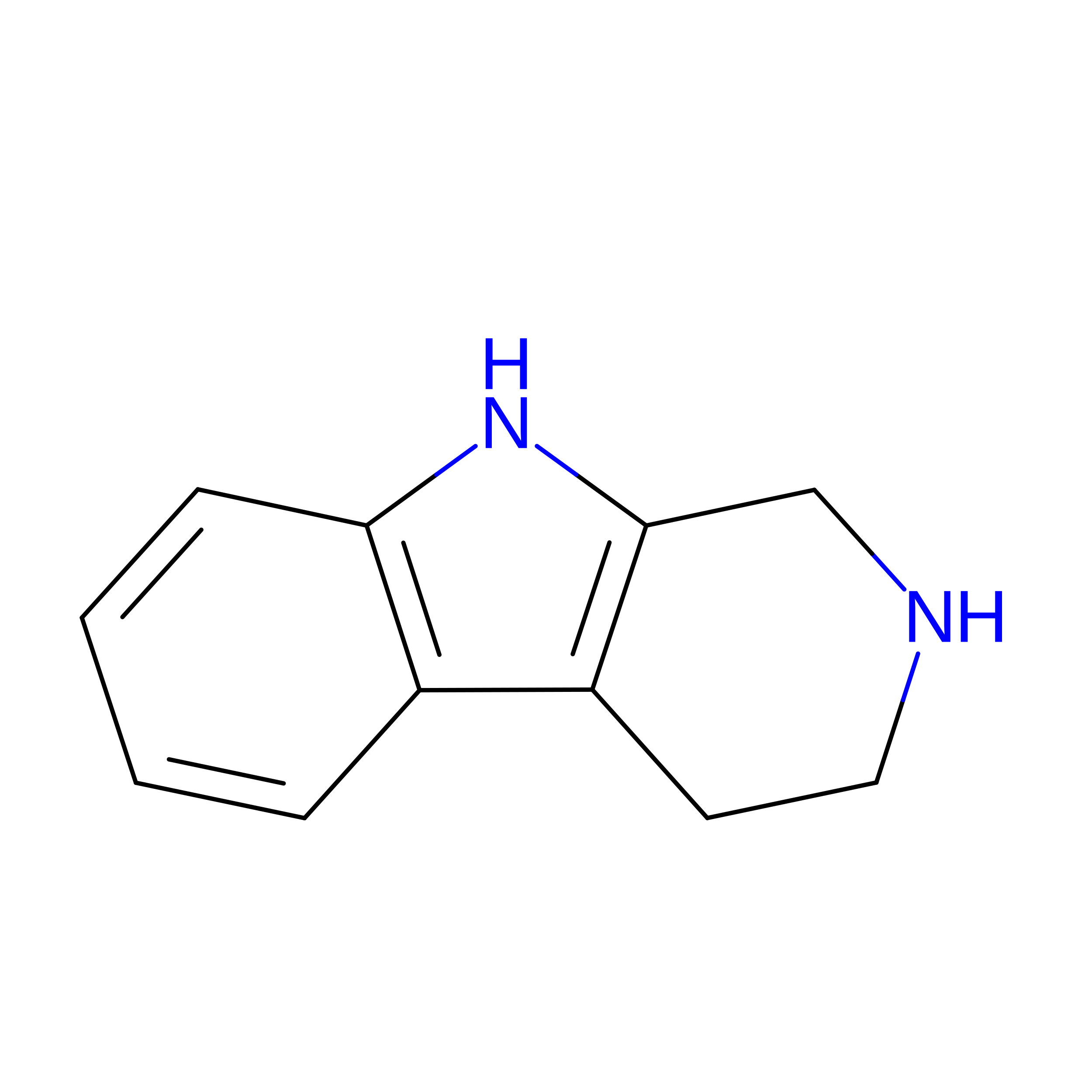
Flavin-dependent halogenases (FDHs) offer a biocatalytic route to regioselective halogenation of aromatic substrates under mild conditions. AetF, a rare self-sufficient single-component FDH, catalyzes sequential dibromination of tryptophan and has a broad substrate scope. Here, we report the crystal structure of AetF in complex with the non-native substrate tryptoline, a tricyclic β-carboline with pharmacological relevance. The structure reveals that tryptoline binds in a pose analogous to the natural AetF substrate L-tryptophan, positioning its C6 atom for initial halogenation. Enzymatic assays confirmed AetF-mediated monobromination and dibromination of tryptoline, yielding 6,8-dibromotryptoline as the final product. In accordance with the observed binding pose of the substrate tryptoline, the monobrominated initial product was almost exclusively 6-bromotryptoline. A crystal structure of AetF in complex with the minor monobrominated product 8-bromotryptoline provides insight into the effect of bromine substituents in different positions on the binding affinity and into potential pathways to the formation of 6,8-dibromotryptoline. These findings define the structural basis of site-selective halogenation of a non-native substrate by AetF and provide structural guidance for enzyme engineering.
- Structural Biochemistry, Department of Chemistry, Bielefeld University, Universitätsstrasse 25, 33615 Bielefeld, Germany.
Organizational Affiliation: