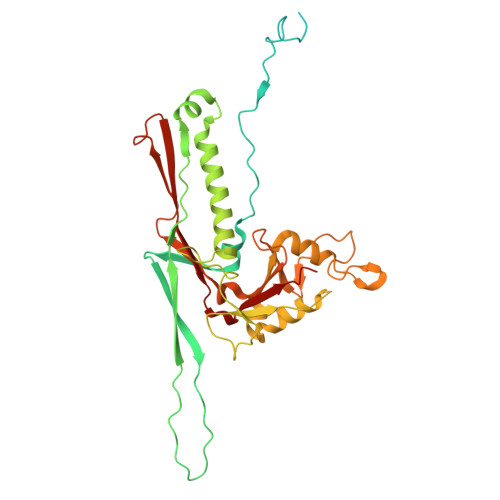
9GYI | pdb_00009gyi

Cryo-EM structure of the capsid-forming phage-inducible chromosomal island (cf-PICI) EcCI2


Experimental Data Snapshot

  • Method: ELECTRON MICROSCOPY
  • Resolution: 3.24 Å
  • Aggregation State: PARTICLE 
  • Reconstruction Method: SINGLE PARTICLE 

wwPDB Validation   3D Report Full Report


This is version 1.3 of the entry. See complete history


Literature

Chimeric infective particles expand species boundaries in phage-inducible chromosomal island mobilization.

He, L.Patkowski, J.B.Wang, J.Miguel-Romero, L.Aylett, C.H.S.Fillol-Salom, A.Costa, T.R.D.Penades, J.R.

(2025) Cell 188: 6636-6653.e17

  • DOI: https://doi.org/10.1016/j.cell.2025.08.019
  • Primary Citation of Related Structures:  
    9GYI

  • PubMed Abstract: 

    Some mobile genetic elements spread among unrelated bacterial species through unknown mechanisms. Recently, we discovered that identical capsid-forming phage-inducible chromosomal islands (cf-PICIs), a new family of phage satellites, are present across multiple species and genera, raising questions about their widespread dissemination. Here, we have identified and characterized a new biological entity enabling this transfer. Unlike other satellites, cf-PICIs produce their own capsids and package their DNA, relying solely on phage tails for transfer. cf-PICIs release non-infective, tailless capsids containing their DNA into the environment. These subcellular entities then interact with phage tails from various species, forming chimeric particles that inject DNA into different bacterial species depending on the tail present. Additionally, we elucidated the structure of the tailless cf-PICIs and the mechanism behind their unique capsid formation. Our findings illuminate the mechanisms used by satellites to spread in nature, contributing to bacterial evolution and the emergence of new pathogens.


  • Organizational Affiliation
    • Department of Infectious Disease, Imperial College London, London SW7 2AZ, UK; Centre for Bacterial Resistance Biology, Imperial College London, London SW7 2AZ, UK.

Macromolecules
Find similar proteins by:  (by identity cutoff)  |  3D Structure
Entity ID: 1
MoleculeChains Sequence LengthOrganismDetailsImage
Major head proteinA [auth B],
B [auth C],
C [auth D],
D [auth A]
385Escherichia coli O157:H7 str. EDL933Mutation(s): 0 
UniProt
Find proteins for Q8X755 (Escherichia coli O157:H7)
Explore Q8X755 
Go to UniProtKB:  Q8X755
Entity Groups  
Sequence Clusters30% Identity50% Identity70% Identity90% Identity95% Identity100% Identity
UniProt GroupQ8X755
Sequence Annotations
Expand
  • Reference Sequence
Experimental Data & Validation

Experimental Data

  • Method: ELECTRON MICROSCOPY
  • Resolution: 3.24 Å
  • Aggregation State: PARTICLE 
  • Reconstruction Method: SINGLE PARTICLE 

Structure Validation

View Full Validation Report


Entry History & Funding Information

Deposition Data


Funding OrganizationLocationGrant Number
Wellcome TrustUnited Kingdom--
Medical Research Council (MRC, United Kingdom)United Kingdom--
Biotechnology and Biological Sciences Research Council (BBSRC)United Kingdom--
Engineering and Physical Sciences Research CouncilUnited Kingdom--
European Research Council (ERC)European Union--

Revision History  (Full details and data files)

  • Version 1.0: 2025-09-10
    Type: Initial release
  • Version 1.1: 2025-09-17
    Changes: Data collection, Database references
  • Version 1.2: 2025-09-24
    Changes: Data collection, Database references
  • Version 1.3: 2025-11-26
    Changes: Data collection, Database references