Download Mendeley
Cyclized Peptide Inhibitors of the Small G Protein Cdc42 Mimic Binding of Effector Proteins.
Murphy, N.P., Tetley, G.J.N., Revell, J., Mott, H.R., Owen, D.(2026) Biochemistry 65: 297-310
- PubMed: 41566164 Search on PubMedSearch on PubMed Central
- DOI: https://doi.org/10.1021/acs.biochem.5c00616
- Primary Citation Related Structures:
9GRK, 9GRL, 9GRM - PubMed Abstract:
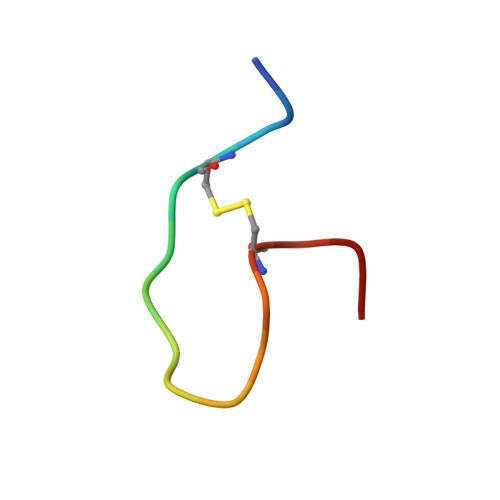
The Ras superfamily of small GTPases are challenging targets for therapeutic inhibition, partially due to a lack of pockets amenable to small molecule inhibition. Our previous work identified high-affinity cyclized peptide binders of Cdc42, a member of the Rho family of small GTPases, capable of inhibiting activity. To further optimize these Cdc42 inhibitors, we have engineered modifications to the best sequence available from the original maturation and screened the ability of these third-generation peptides to compete with Cdc42-effector interactions. Improvements in affinity were achieved by single amino acid substitutions at several residue positions. We present the structure of one of these nanomolar affinity, cyclized peptides in complex with Cdc42. The structure reveals that the peptide binds in a β-hairpin conformation to create an extension of the β-sheet of the GTPase Rossman fold, acting as a structural mimic of native Cdc42 effectors. We additionally elucidate the NMR structures of four unbound C-terminal alanine variants and employ both the bound and unbound structures to inform the rational design of substituted peptide inhibitors. Overall, this study expands our understanding of how Ras GTPases can be targeted, by demonstrating a rare example of an inhibitor binding contiguously with a surface of β-strand of the small G protein, which illustrates an innovative avenue for noncovalent therapeutic design.
- Department of Biochemistry, University of Cambridge, 80 Tennis Court Road, Cambridge CB2 1GA, U.K.
Organizational Affiliation: