9GFZ | pdb_00009gfz

Crystal structure of Medicago Truncatula LYK3 kinase domain D459N


Experimental Data Snapshot

  • Method: X-RAY DIFFRACTION
  • Resolution: 2.50 Å
  • R-Value Free: 
    0.257 (Depositor), 0.258 (DCC) 
  • R-Value Work: 
    0.206 (Depositor), 0.207 (DCC) 
  • R-Value Observed: 
    0.211 (Depositor) 

Starting Model: experimental
View more details

wwPDB Validation 3D Report Full Report

Validation slider image for 9GFZ

Ligand Structure Quality Assessment 


This is version 1.3 of the entry. See complete history

Literature

Two residues reprogram immunity receptors for nitrogen-fixing symbiosis.

Tsitsikli, M.Simonsen, B.Luu, T.B.Larsen, M.M.Andersen, C.G.Gysel, K.Lironi, D.Kronauer, C.Rubsam, H.Hansen, S.B.Baerentsen, R.Wulff, J.L.Johansen, S.H.Sezer, G.Stougaard, J.Andersen, K.R.Radutoiu, S.

(2025) Nature 648: 443-450

  • DOI: https://doi.org/10.1038/s41586-025-09696-3
  • Primary Citation Related Structures: 
    9GB9, 9GFZ

  • PubMed Abstract: 

    Receptor signalling determines cellular responses and is crucial for defining specific biological outcomes. In legume root cells, highly similar and structurally conserved chitin and Nod factor receptor kinases activate immune or symbiotic pathways, respectively, when chitinous ligands are perceived 1 . Here we show that specific amino acid residues in the intracellular part of the Nod factor receptor NFR1 control signalling specificity and enable the distinction of immune and symbiotic responses. Functional investigation of CERK6, NFR1 and receptor variants thereof revealed a conserved motif that we term Symbiosis Determinant 1 in the juxtamembrane region of the kinase domain, which is key for symbiotic signalling. We show that two residues in Symbiosis Determinant 1 are indispensable hallmarks of NFR1-type receptors and are sufficient to convert Lotus CERK6 and barley RLK4 kinase outputs to enable symbiotic signalling in Lotus japonicus.


  • Organizational Affiliation
    • Department of Molecular Biology and Genetics, Aarhus University, Aarhus, Denmark.

Macromolecule Content 

  • Total Structure Weight: 66.49 kDa 
  • Atom Count: 4,543 
  • Modeled Residue Count: 569 
  • Deposited Residue Count: 592 
  • Unique protein chains: 1

Macromolecules

Find similar proteins by:|  3D Structure
Entity ID: 1
MoleculeChains  Sequence LengthOrganismDetailsImage
LysM domain receptor-like kinase 3
A, B
296Medicago truncatulaMutation(s): 1 
Gene Names: LYK3HCLRLK3MTR_5g086130
EC: 2.7.11.1
UniProt
Find proteins for Q6UD73 (Medicago truncatula)
Explore Q6UD73 
Go to UniProtKB:  Q6UD73
Entity Groups
Sequence Clusters30% Identity50% Identity70% Identity90% Identity95% Identity100% Identity
UniProt GroupQ6UD73
Sequence Annotations
Expand
Reference Sequence

Small Molecules

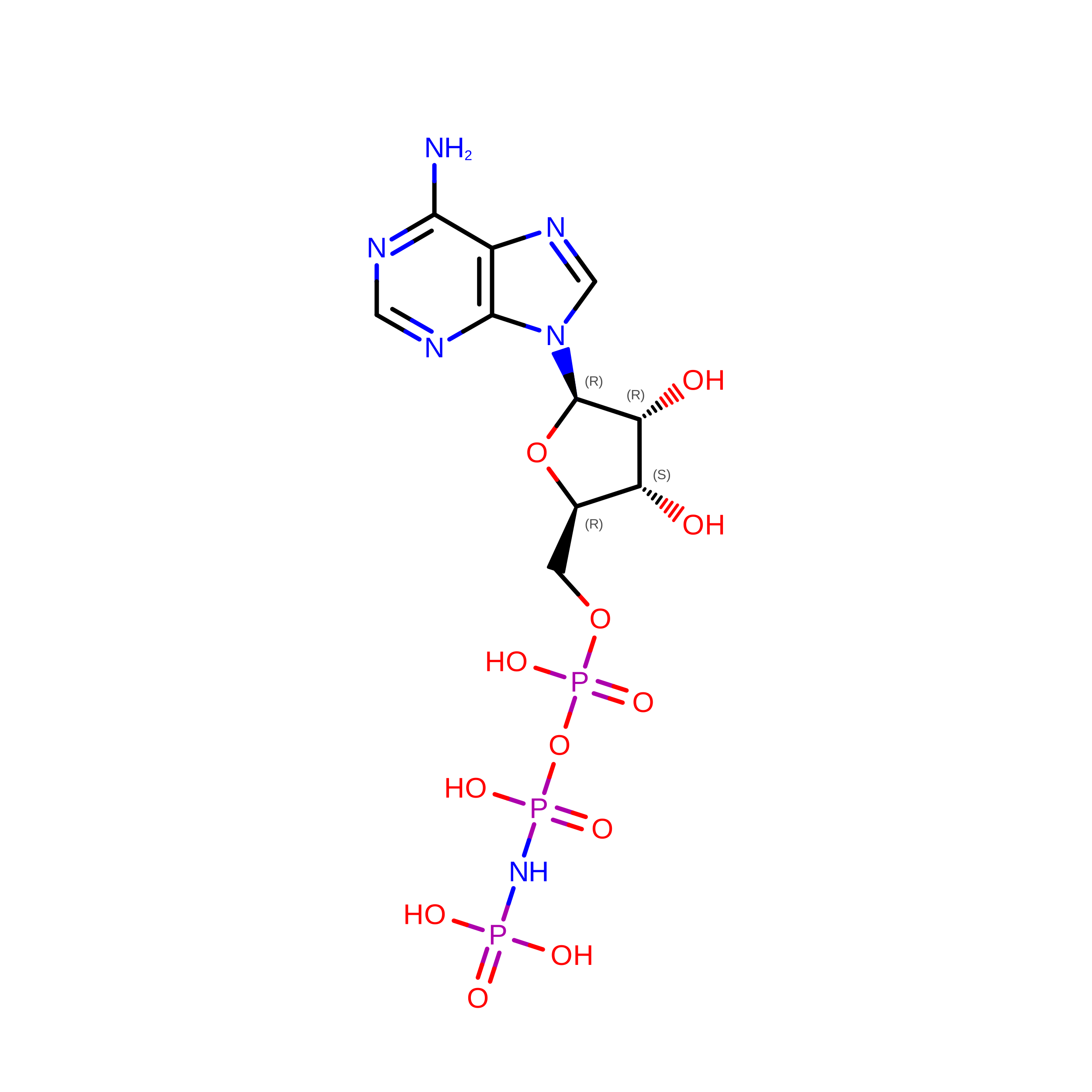
Ligands 1 Unique
IDChains Name / Formula / InChI Key2D Diagram3D Interactions
ANP
(Subject of Investigation/LOI)

Query on ANP


Download:Ideal Coordinates CCD File
C [auth A]PHOSPHOAMINOPHOSPHONIC ACID-ADENYLATE ESTER
C10 H17 N6 O12 P3
PVKSNHVPLWYQGJ-KQYNXXCUSA-N

Experimental Data & Validation

Experimental Data

  • Method: X-RAY DIFFRACTION
  • Resolution: 2.50 Å
  • R-Value Free:  0.257 (Depositor), 0.258 (DCC) 
  • R-Value Work:  0.206 (Depositor), 0.207 (DCC) 
  • R-Value Observed: 0.211 (Depositor) 
Space Group: P 1
Unit Cell:
Length ( Å )Angle ( ˚ )
a = 52.98α = 99.905
b = 59.84β = 105.75
c = 61.24γ = 119.799
Software Package:
Software NamePurpose
PHENIXrefinement
XDSdata reduction
XSCALEdata scaling
PHASERphasing

Structure Validation

View Full Validation Report


Ligand Structure Quality Assessment 


Entry History 

& Funding Information

Deposition Data


Funding OrganizationLocationGrant Number
Novo Nordisk FoundationDenmarkNNF18OC0052855

Revision History  (Full details and data files)

  • Version 1.0: 2024-11-27
    Type: Initial release
  • Version 1.1: 2025-03-26
    Changes: Structure summary
  • Version 1.2: 2025-12-10
    Changes: Database references
  • Version 1.3: 2025-12-24
    Changes: Database references