9GC7 | pdb_00009gc7

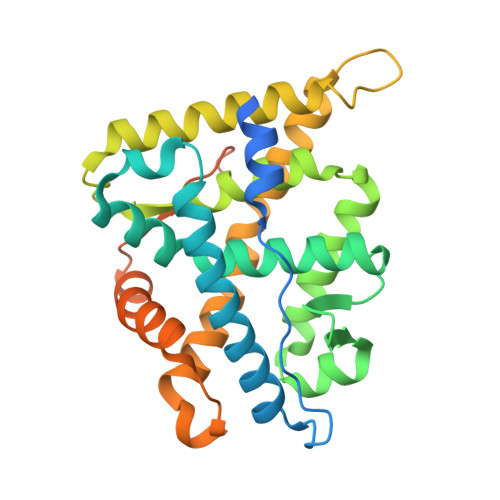
Mineralocorticoid receptor in complex with acylurea antagonists.


Experimental Data Snapshot

  • Method: X-RAY DIFFRACTION
  • Resolution: 1.46 Å
  • R-Value Free: 
    0.210 (Depositor), 0.205 (DCC) 
  • R-Value Work: 
    0.186 (Depositor), 0.179 (DCC) 
  • R-Value Observed: 
    0.187 (Depositor) 

Starting Model: experimental
View more details

wwPDB Validation 3D Report Full Report

Validation slider image for 9GC7

Ligand Structure Quality Assessment 


This is version 1.1 of the entry. See complete history

Literature

Mineralocorticoid Receptor Antagonists With an Acylurea as a Key Polar Interaction Motif.

Nordqvist, A.Lindmark, B.Granberg, K.L.Aagaard, A.Barlind, L.Fredenwall, M.Hansson, E.Hogner, A.Ivarsson, I.Johansson, M.Lindberg, J.Liu, D.Sorensen, H.Tangefjord, S.William-Olsson, L.Atilaw, Y.Yuan, Z.Q.Bamberg, K.O'Mahony, G.Edman, K.

(2026) ChemMedChem 21: e202501047-e202501047

  • DOI: https://doi.org/10.1002/cmdc.202501047
  • Primary Citation Related Structures: 
    9GC7

  • PubMed Abstract: 

    Mineralocorticoid receptor (MR) antagonists play a vital role in the management of conditions such as heart failure and hypertension. The recent approval of finerenone for diabetic kidney disease, along with expanding opportunities to treat chronic kidney disease and heart failure with preserved ejection fraction has led to a continued interest in MR antagonism. This article describes the identification and initial optimization of MR antagonists based on a phenylglycine scaffold containing an acylurea motif. Optimization efforts aimed at enhancing MR potency and DMPK properties revealed that replacing the phenylglycine scaffold with l-alanine avoided a risk of racemization at the stereocenter. The most potent compound exhibited an MR binding affinity of pK i  = 9.3 and a potency in human MR reporter gene assay of pIC 50  = 8.4. X-ray crystallography of a protein-ligand complex structure with an l-alanine based compound revealed an internal hydrogen bond imposing a cyclic conformation on the acylurea, which in turn formed a bidentate hydrogen bond interaction with the side chain of Asn770, a key polar interaction site in MR for endogenous as well as synthetic ligands. Further lead generation efforts identified two compounds with suitable in vivo PK properties allowing assessment of their effect on acute urinary electrolyte excretion.


  • Organizational Affiliation
    • Medicinal Chemistry, Research and Early Development, Cardiovascular, Renal and Metabolism (CVRM), BioPharmaceuticals R&D, AstraZeneca, Gothenburg, Sweden.

Macromolecule Content 

  • Total Structure Weight: 36.86 kDa 
  • Atom Count: 2,445 
  • Modeled Residue Count: 258 
  • Deposited Residue Count: 317 
  • Unique protein chains: 2

Macromolecules

Find similar proteins by:|  3D Structure
Entity ID: 1
MoleculeChains  Sequence LengthOrganismDetailsImage
Mineralocorticoid receptor305Homo sapiensMutation(s): 3 
Gene Names: NR3C2MCRMLR
UniProt & NIH Common Fund Data Resources
Find proteins for P08235 (Homo sapiens)
Explore P08235 
Go to UniProtKB:  P08235
PHAROS:  P08235
GTEx:  ENSG00000151623 
Entity Groups
Sequence Clusters30% Identity50% Identity70% Identity90% Identity95% Identity100% Identity
UniProt GroupP08235
Sequence Annotations
Expand
Reference Sequence
Find similar proteins by:  Sequence   |   3D Structure  
Entity ID: 2
MoleculeChains  Sequence LengthOrganismDetailsImage
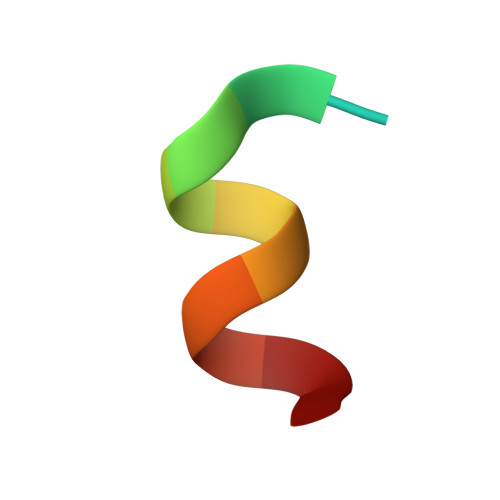
Nuclear receptor coactivator 112Homo sapiensMutation(s): 0 
Gene Names: NCOA1BHLHE74SRC1
EC: 2.3.1.48
UniProt & NIH Common Fund Data Resources
Find proteins for Q15788 (Homo sapiens)
Explore Q15788 
Go to UniProtKB:  Q15788
PHAROS:  Q15788
GTEx:  ENSG00000084676 
Entity Groups
Sequence Clusters30% Identity50% Identity70% Identity90% Identity95% Identity100% Identity
UniProt GroupQ15788
Sequence Annotations
Expand
Reference Sequence

Small Molecules

Ligands 3 Unique
IDChains Name / Formula / InChI Key2D Diagram3D Interactions
A1IJ6
(Subject of Investigation/LOI)

Query on A1IJ6


Download:Ideal Coordinates CCD File
E [auth A](2S)-N-aminocarbonyl-2-[(4-cyano-6-cyclopropyl-cyclohexa-1,2,3,5-tetraen-1-yl)amino]propanamide
C14 H14 N4 O2
BZGASCWVHGFRKP-QMMMGPOBSA-N
NHE

Query on NHE


Download:Ideal Coordinates CCD File
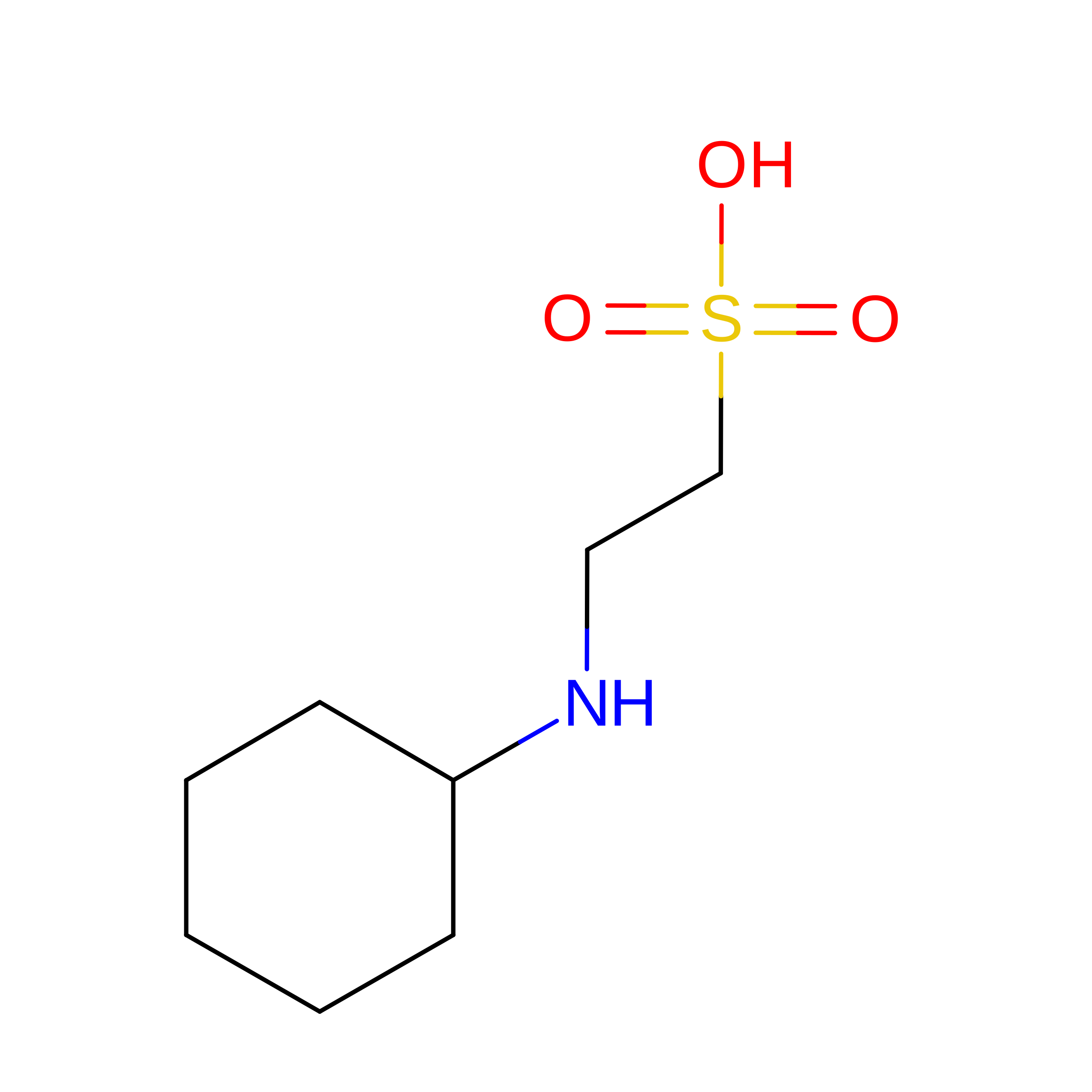
D [auth A]2-[N-CYCLOHEXYLAMINO]ETHANE SULFONIC ACID
C8 H17 N O3 S
MKWKNSIESPFAQN-UHFFFAOYSA-N
MPD

Query on MPD


Download:Ideal Coordinates CCD File
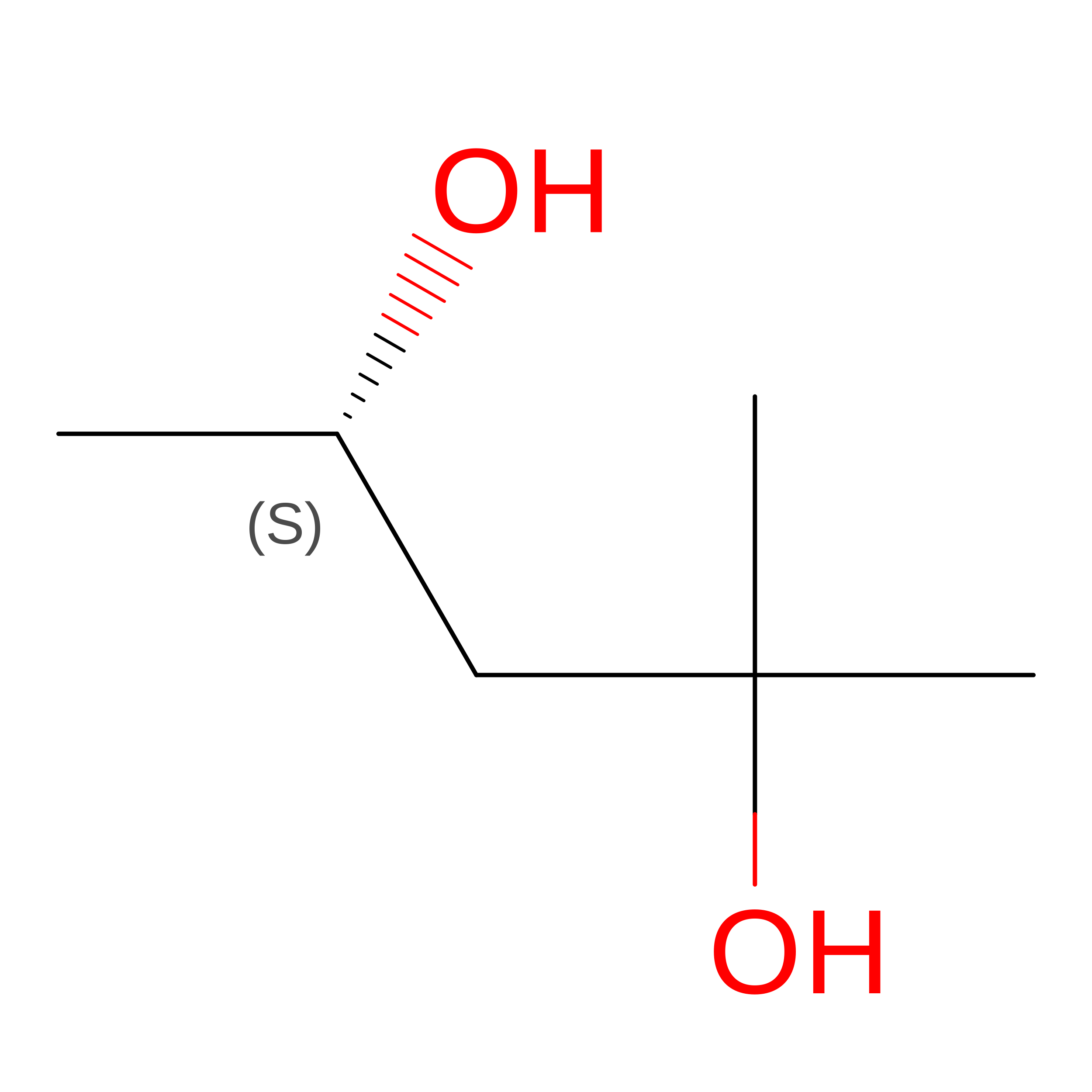
C [auth A](4S)-2-METHYL-2,4-PENTANEDIOL
C6 H14 O2
SVTBMSDMJJWYQN-YFKPBYRVSA-N

Experimental Data & Validation

Experimental Data

  • Method: X-RAY DIFFRACTION
  • Resolution: 1.46 Å
  • R-Value Free:  0.210 (Depositor), 0.205 (DCC) 
  • R-Value Work:  0.186 (Depositor), 0.179 (DCC) 
  • R-Value Observed: 0.187 (Depositor) 
Space Group: P 21 21 21
Unit Cell:
Length ( Å )Angle ( ˚ )
a = 48.472α = 90
b = 77.789β = 90
c = 78.055γ = 90
Software Package:
Software NamePurpose
BUSTERrefinement
MOSFLMdata reduction
SCALAdata scaling
MOLREPphasing

Structure Validation

View Full Validation Report


Ligand Structure Quality Assessment 


Entry History 

& Funding Information

Deposition Data


Funding OrganizationLocationGrant Number
Not funded--

Revision History  (Full details and data files)

  • Version 1.0: 2026-02-18
    Type: Initial release
  • Version 1.1: 2026-05-13
    Changes: Database references